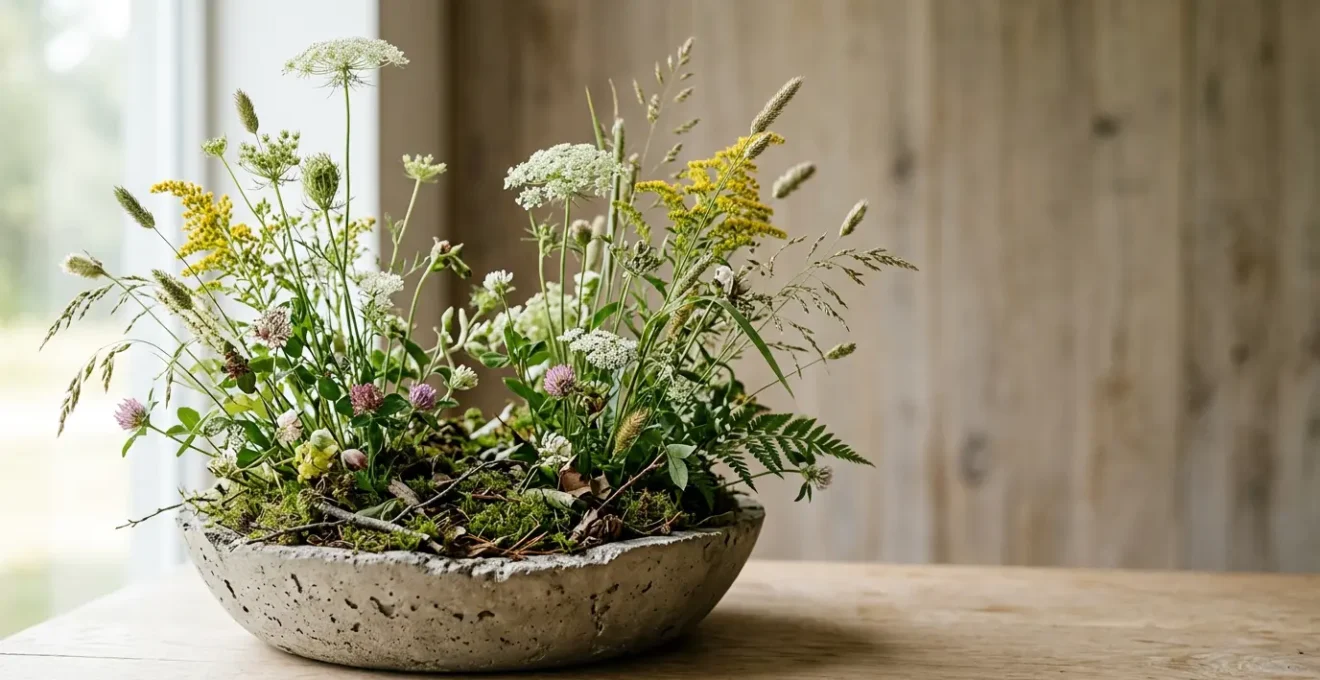
Vegetative design is more than creating a ‘wild look’; it’s the art of translating the fundamental rules of ecology and botany into a vase.
- Observing how plants group in colonies, form layers, and turn to the sun provides the blueprint for authentic placement.
- True naturalism comes from honoring a plant’s entire life cycle—from bulb to bloom to seed head, reflecting its growth logic.
Recommendation: Start by observing a single patch of wild ground; its ecological storytelling is the best teacher for your next arrangement.
For any gardener-florist, the allure of the “garden style” is undeniable. We strive to capture that sense of untamed beauty, that effortless grace found in a wild meadow or a woodland edge. Many arrangements achieve a beautiful, loose, and organic shape, yet something can still feel… off. They look like a collection of beautiful flowers, not a living community of plants. This is where the discipline of vegetative design takes us deeper. It asks us not just to imitate the look of nature, but to understand its underlying systems.
The common advice to “be asymmetrical” or “use seasonal flowers” is just the surface. True vegetative design is a more rigorous practice, a philosophy rooted in botanical authenticity. It’s about recreating a micro-habitat in a vessel, ensuring every stem is placed with intention, as if it genuinely grew there. It challenges us to think less like a decorator and more like a naturalist. What is the difference between garden style and vegetative design? While garden style evokes a feeling, vegetative design is governed by observable, natural laws—the very laws we will explore.
This approach moves beyond simple aesthetics. It’s about telling an ecological story. It considers how plants compete for light, how they grow in communities, and how they respond to their environment. By learning to see and replicate these patterns, our arrangements gain a new level of integrity and life. They stop being mere decorations and become small, living landscapes that resonate with the profound logic of the natural world.
This guide will walk you through the core principles that govern this approach. We will decode the rules of nature so you can apply them to your craft, transforming your work from simply beautiful to breathtakingly alive.
Summary: The Ecological Principles of Living Floral Arrangements
- The Colony Rule: Why Plants of the Same Species Grow Together?
- Canopy and Understory: How to Mimic Forest Layers in a Bowl?
- Bulbs on Roots: Why Leaving the Bulb On Adds Authenticity?
- Facing the Sun: Why All Heads Should Turn Towards the Light?
- The 10% Foraging Rule: How to Gather Wild Materials Without Harming Nature?
- Weed or Wildflower: How to Use Cow Parsley and Ox-Eye Daisies?
- The Seasonal Calendar: Why You Can’t Buy British Dahlias in May?
- Why Use British Native Varieties in Your Commercial Designs?
The Colony Rule: Why Plants of the Same Species Grow Together?
Walk through any wild meadow and observe. You’ll rarely find single, isolated specimens. Instead, plants grow in colonies and drifts. A patch of Queen Anne’s Lace here, a sweep of Black-Eyed Susans there. This isn’t a coincidence; it’s a survival strategy. Plants of the same species often thrive together, creating a supportive monoculture that can out-compete other species for resources. One powerful mechanism they use is allelopathy, a biological process where an organism releases biochemicals to influence the growth of others around it. This can be both a defensive and an offensive tactic, with some field studies demonstrating that certain plants can cause a growth reduction of around 40% in competing species through these chemical signals.
To achieve botanical authenticity in our designs, we must honor this fundamental rule. Instead of dotting a single type of flower evenly throughout an arrangement (a common mistake), we should group them. Create a strong, confident colony of three, five, or seven stems of the same flower. Let them rise from the same perceived point in your vessel, as if they all sprouted from a single seed bank. This grouping creates a more powerful visual impact and tells a more believable ecological story.
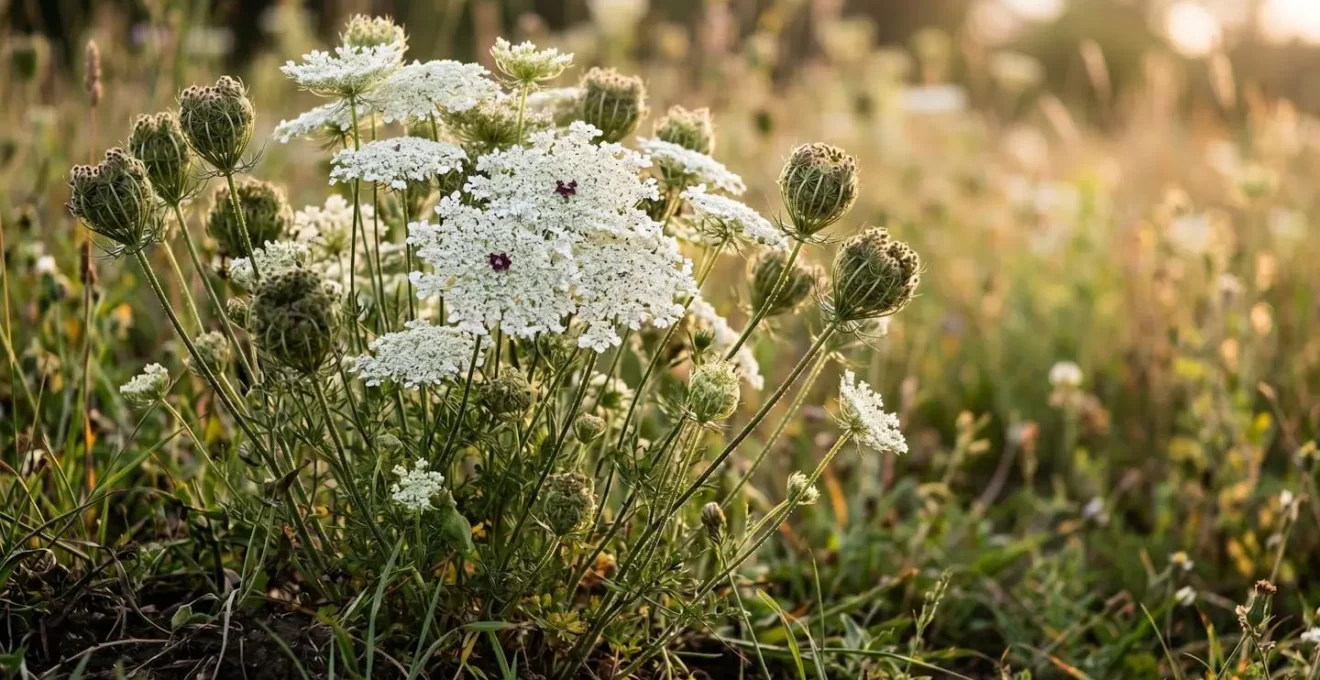
As the image of a wild carrot colony shows, this also allows you to play with the life cycle of a single species. By grouping buds, fully open blooms, and even spent seed heads of the same plant, you create a dynamic and texturally rich scene that tells the story of time. This is the essence of vegetative design: translating the growth logic of the wild into the controlled environment of a vase.
Embracing the colony rule immediately elevates an arrangement from a simple bouquet to a thoughtful composition that respects and reflects the way plants actually live.
Canopy and Understory: How to Mimic Forest Layers in a Bowl?
If the colony rule governs the horizontal layout of our designs, the principle of canopy and understory dictates the vertical structure. A forest is not a single, flat plane of green; it’s a complex, multi-layered system. You have the tall, light-seeking canopy trees, the smaller understory trees and shrubs, the herbaceous layer, and finally the forest floor. Each layer is a distinct micro-habitat, defined largely by one critical factor: light. In fact, research on rainforest structure reveals that as little as 5% of sunlight may penetrate the dense canopy to reach the forest floor.
This stratification directly determines which plants can survive where. A comprehensive study on boreal forests confirmed that canopy structure is the primary driver of understory plant composition. Shade-tolerant species like ferns, mosses, and certain herbs thrive in these low-light conditions, while sun-loving flowers would quickly perish. This is the growth logic we must replicate in our vegetative designs. Taller, branching elements (like branches of crabapple or beech) create the “canopy” of our arrangement. Beneath this, we place our “understory” flowers—those that would naturally grow in dappled light.
This means we must resist the urge to place a delicate, woodland flower like a Lily of the Valley at the very top of an arrangement, exposed and reaching for the sun. Its botanical story is one of a sheltered existence. Instead, it should be nestled lower down, peeking out from beneath larger foliage or taller stems. This layering creates depth, mystery, and a sense of discovery for the viewer. You are not just arranging flowers; you are building a complete ecosystem in a bowl, where every plant’s position is justified by its relationship to the available light and its neighbors.
By respecting the roles of canopy and understory, we create arrangements that are not only visually balanced but also ecologically coherent and deeply satisfying.
Bulbs on Roots: Why Leaving the Bulb On Adds Authenticity?
In our quest for botanical authenticity, sometimes the most powerful statement is made by revealing what is usually hidden. In early spring, there’s nothing more hopeful than the sight of the first crocuses, snowdrops, or grape hyacinths. In conventional floristry, we would cut these blooms and place them in a vase, divorcing them from their source of life. But the vegetative designer sees an opportunity to tell a more complete story. By gently excavating the entire plant—bulb, roots, and all—and incorporating it into the design, we anchor the arrangement in its season and its very earthiness.
Leaving the bulb and roots attached does several things. First, it adds a unique and unexpected textural element. The pale, tangled roots and the smooth, firm bulb create a beautiful contrast with the delicate petals and green stems. Second, it serves as a powerful symbol of the plant’s life cycle. It reminds the viewer that this bloom is not a manufactured object but a living thing, drawn up from the soil by the energy stored within that bulb. It’s the ultimate expression of seasonal integrity.
This technique is particularly effective for low, bowl-style arrangements where the mechanics can be hidden by moss or soil. A cluster of muscari bulbs, their roots still dusted with earth, nestled at the base of some pussy willow branches, creates a scene of incredible naturalism. It looks as if you’ve scooped up a perfect slice of a woodland floor. This approach requires a delicate touch and a respect for the plant itself, but the result is an arrangement that feels less “designed” and more “discovered.” It’s a quiet, confident statement that you understand the plant from its roots to its petals.
Ultimately, including the bulb is a commitment to showing the whole truth of the plant, adding a layer of depth and narrative that a simple cut stem can never achieve.
Facing the Sun: Why All Heads Should Turn Towards the Light?
One of the most dynamic forces in the plant world is the sun. Plants are not static; they are in constant, subtle motion, and much of that movement is dictated by their need for light. This phenomenon, known as phototropism, is the directional growth of a plant in response to a light source. The underlying mechanism, explained by the Cholodny-Went hypothesis, involves the plant hormone auxin, which migrates to the shaded side of the stem, promoting cell elongation there and causing the stem to bend towards the light. In nature, virtually all plants in a given area will orient themselves toward the dominant light source.
This provides a crucial, and often overlooked, rule for vegetative design: create a single, imaginary light source for your arrangement. All of your flower heads, and to some extent their foliage, should turn towards this conceptual “sun.” This means resisting the temptation to have flowers facing outwards in all directions, as seen in traditional, symmetrical bouquets. In a vegetative arrangement, some flowers will show their faces, others their profiles, and some may even turn their backs to the viewer as they reach for the light. This creates a sense of unified movement and energy.
This technique instantly breathes life and dynamism into a piece. An arrangement where all the poppies or tulips curve in the same gentle arc, as if seeking daylight from a nearby window, feels alive and in motion. It tells the viewer that this is not a static collection of objects, but a community of living things responding to their environment. It’s a subtle detail, but one that separates a merely pretty arrangement from one with profound botanical integrity.
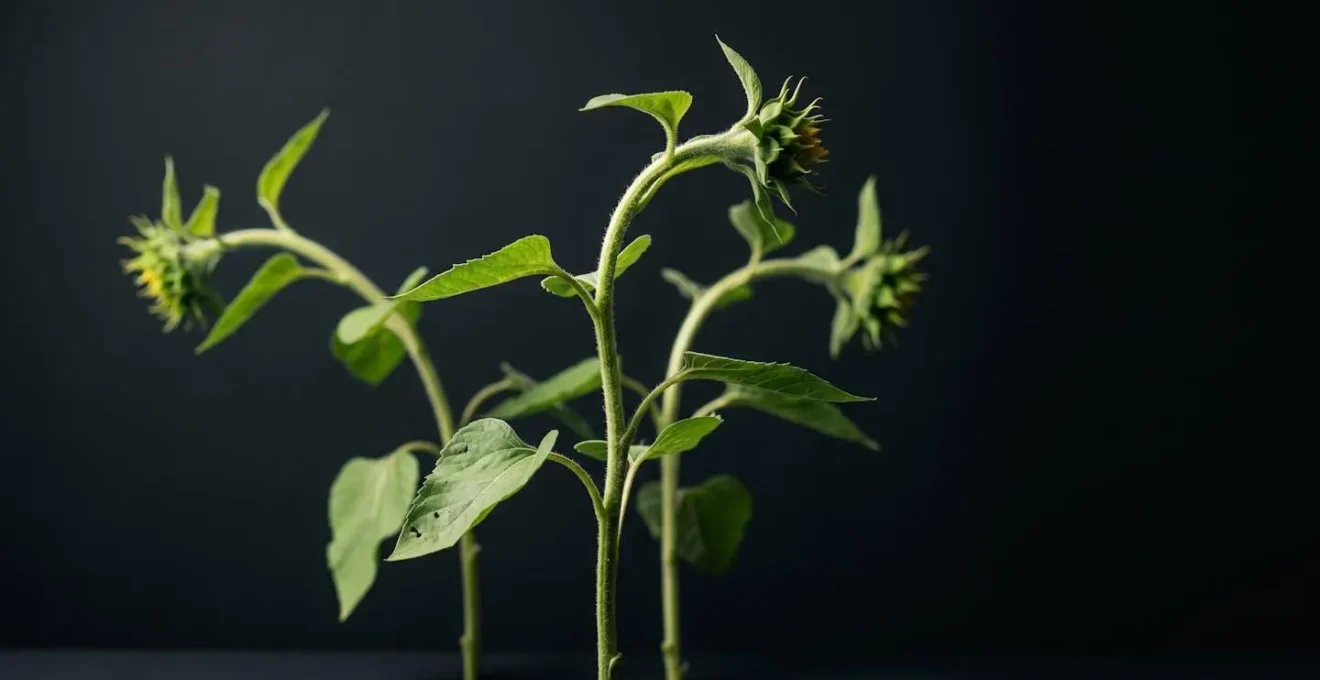
By making all heads turn towards an imaginary sun, you infuse your work with a sense of purpose and direction that is deeply rooted in the science of how plants grow.
The 10% Foraging Rule: How to Gather Wild Materials Without Harming Nature?
The soul of vegetative design is often found in the materials that cannot be bought—the twisting branch, the seed pod, the wisp of wild clematis. Foraging is an essential skill for the gardener-florist, but it comes with a profound responsibility. The goal is to gather materials in a way that is regenerative, not destructive. The cardinal rule, echoed by many sustainable foraging experts, is to take no more than 10% of any given plant community. This ensures the population can easily recover and continue to support the local ecosystem.
This “10% Rule” is more than a number; it’s a mindset. It forces you to be an observer first and a harvester second. Before you cut a single stem, you must assess the health and abundance of the patch. Is it a vast, thriving colony or a small, struggling one? Are there already signs of stress or over-harvesting? If the answer is yes, you must walk away. The most ethical forager is one who is willing to leave empty-handed. This respect for nature’s limits is what separates thoughtful gathering from careless taking.
Beyond the 10% rule, ethical foraging involves a specific code of conduct. It means using clean, sharp tools to minimize damage, never taking the single “best” specimen, and always leaving plenty behind for pollinators and seed dispersal. It also means having an intimate knowledge of your local environment, including what is protected, what is poisonous, and what is on private land. This deep connection to place and plant is the true heart of the vegetative style. The materials you gather carry the story of that responsible interaction.
Your Ethical Foraging Checklist
- Identify permitted foraging areas: Check local regulations, avoid private property and protected nature reserves.
- Assess population abundance: Only gather from thriving, dense populations, leaving rare or stressed patches untouched.
- Apply the 1-in-10 rule: Harvest no more than 10% of a single plant colony to ensure it can regenerate and support local wildlife.
- Harvest with precision: Use clean, sharp snips to make a clean cut, rather than tearing, to minimize damage and promote plant health.
- Prioritize reproductive success: Always leave behind plenty of flowers and seed heads to support pollinators and allow for natural seed dispersal.
By following these principles, you ensure that your beautiful, “wild” arrangements are not contributing to the destruction of the very wilderness that inspires them.
Weed or Wildflower: How to Use Cow Parsley and Ox-Eye Daisies?
In a manicured garden, plants like cow parsley, ox-eye daisies, or even elegant grasses are often dismissed as “weeds”—unruly invaders to be eradicated. But for the vegetative designer, these common, often overlooked plants are treasures. They are the very essence of the wild, untamed landscape we seek to emulate. Their inclusion in an arrangement is a deliberate act of re-evaluation, a challenge to conventional notions of beauty. They bring an authenticity and a sense of place that more cultivated, “perfect” blooms often lack.
Using these materials is about celebrating the beauty of the commonplace. The airy, delicate structure of cow parsley (or its cultivated cousin, Ammi majus) is the perfect material to create a misty, meadow-like haze in an arrangement, acting as a “scaffolding” for other blooms. An ox-eye daisy, with its simple, honest face, brings a cheerful, unpretentious charm. These are the plants that grow in hedgerows, along footpaths, and in forgotten corners. By bringing them into our designs, we bring in a piece of that real, lived-in landscape. It is this connection to the everyday wild that makes vegetative design so powerful.
This philosophy of finding beauty in the overlooked is a core tenet of the style, as it reflects a deeper appreciation for nature in all its forms. It’s about letting go of sterile perfection and embracing the slightly unruly character of the wild.
Living in the city, where it’s so pristine or dirty, so sterile, so industrial. Sometimes going back to my childhood, thinking about the weeds, flowers growing in the garden gives me such happiness. Letting the weeds come up in between the blooms… just adding that little bit extra that makes it fabulous.
– Leanne Kesler, Floral Design Institute
The decision to include a “weed” is a conscious choice to prioritize naturalism over formality, and in doing so, to create something that is not just beautiful, but also meaningful and true.
The Seasonal Calendar: Why You Can’t Buy British Dahlias in May?
The global flower market has created a strange, seasonless world where we can buy roses in December and tulips in August. This convenience comes at a cost, both environmental and aesthetic. A core principle of vegetative design is a radical return to seasonality. This means using only the flowers and foliage that are naturally available in your specific location at that specific time of year. It’s a creative constraint that fosters a deeper connection to the rhythms of nature.
The question, “Why can’t you buy British dahlias in May?” gets to the heart of this principle. Dahlias are tender perennials whose tubers are planted in late spring after the last frost. They grow through the summer and reach their glorious peak in late August, September, and October, before the first frosts of autumn signal their retreat into dormancy. To have a British-grown dahlia in May is a botanical impossibility. Any dahlia available then would have been grown in a heated greenhouse or, more likely, flown halfway across the world from a warmer climate, carrying a heavy carbon footprint.
Working seasonally means your designs become a true reflection of the landscape outside your window. In spring, your work is filled with the hopeful energy of bulbs, flowering branches, and hellebores. Summer brings an abundance of blowsy perennials and annuals. Autumn offers the rich tones of dahlias, chrysanthemums, and changing foliage. Winter challenges you to find beauty in seed heads, dried grasses, and evergreen textures. This ever-changing palette keeps your work fresh, exciting, and, most importantly, honest. It tells a story not just of a place, but of a specific moment in time.
By embracing the limitations of the season, we paradoxically unlock a deeper well of creativity and produce work that is grounded, meaningful, and truly alive.
Key Takeaways
- Group Like with Like: Mimic nature by planting flowers in colonies or drifts, not isolated specimens, to create visual impact and botanical realism.
- Build in Layers: Structure your arrangements like a forest, with tall ‘canopy’ elements sheltering lower ‘understory’ plants to create depth and an ecological story.
- Honor the Calendar: Restrict your palette to what is genuinely in season in your location to create work that is authentic, sustainable, and connected to the present moment.
Why Use British Native Varieties in Your Commercial Designs?
While using any seasonal, locally-grown flower is a huge step forward, the strictest application of vegetative design encourages us to go even further: prioritizing native varieties. These are the plants that have co-evolved with the local climate, soil, and wildlife for millennia. Their inclusion brings a level of authenticity that cannot be replicated. A native British wildflower like a foxglove or a red campion simply *belongs* in a representation of a British woodland in a way an imported exotic never can. It carries the genetic story of the place.
Beyond aesthetics, there’s a powerful ecological reason. Native plant communities have developed complex relationships and defense mechanisms. A fascinating 2024 study in the Journal of Plant Ecology revealed that native herbaceous communities exhibit strong allelopathic resistance against invasive species. This “biotic resistance” demonstrates that native plants are not just passive inhabitants; they are active guardians of their ecosystem’s integrity. By using them, we celebrate and support this intricate web of life.
Case Study: The Power of Native Allelopathy
The 2024 study highlighted how established native plant communities chemically defended their territory. They found that these native species exerted strong negative effects on the germination and growth of a range-expanding woody species, effectively restricting its invasion. This showcases how native plants are uniquely adapted to maintain the balance of their local ecosystem, a quality of authenticity and strength that translates directly into vegetative design.
For the commercial designer, using native varieties can also be a unique selling proposition. It demonstrates a commitment to sustainability, biodiversity, and a sophisticated understanding of horticulture that sets your work apart. It aligns your brand with a powerful and growing movement towards ecological responsibility. As the masters of the craft have long understood, the strictest path often leads to the most profound results.
In the strict application of Vegetative Design, the flowers and foliages should be those found growing together in a particular environment with emphasis placed on climatic, seasonal, geographical and topographical compatibility.
– Floral Design Institute, Vegetative Floral Design – Step-by-Step Tutorial
Your journey into true vegetative design begins not in the studio with exotic imports, but in the nearest wild patch of earth, observing what truly belongs. Go, observe, and let nature be your ultimate guide and supplier.