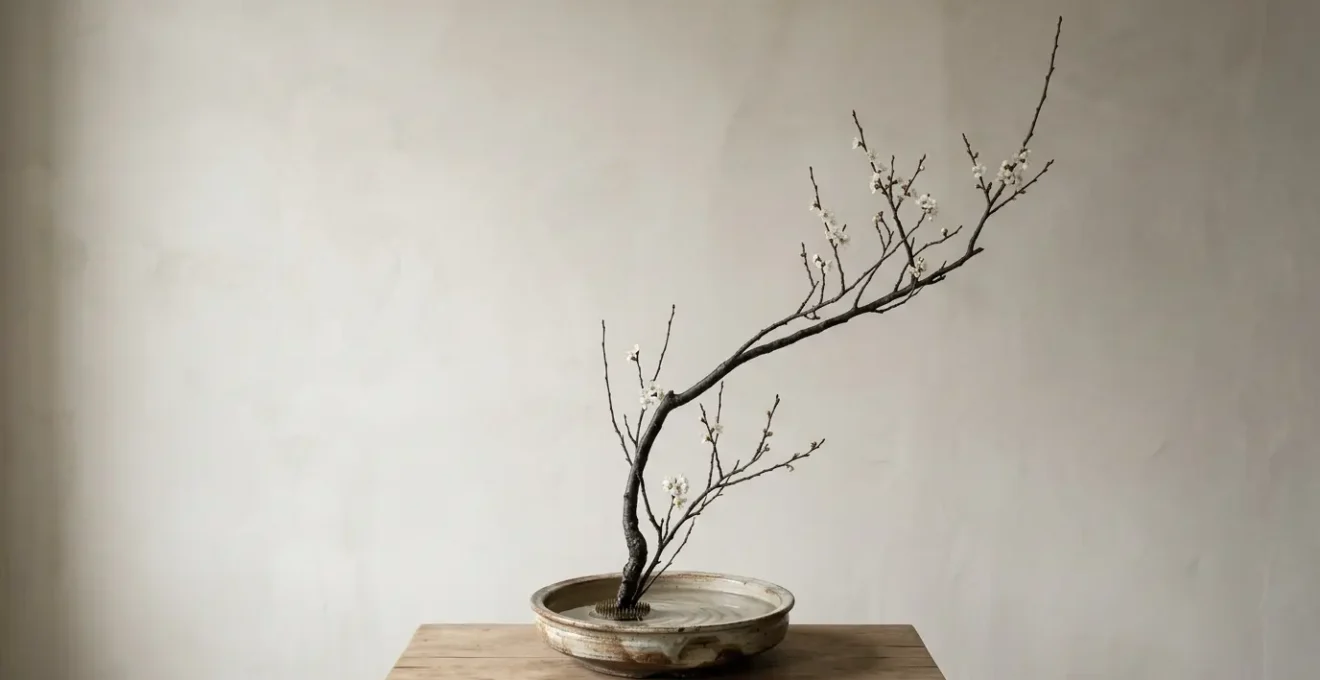
In summary:
- Ikebana is a meditative practice that prioritizes line, space, and asymmetry over mass and color.
- Core principles include the trinity of Heaven-Earth-Human (Shin-Soe-Hikae) and embracing imperfection (wabi-sabi).
- The empty space (Ma) in an arrangement is as important as the flowers themselves, creating balance and tension.
- It challenges the Western desire for perfection and teaches the beauty of transience and simplicity.
- You can begin with a few simple tools and a single branch to start shifting your perception.
In a world saturated with noise and a constant pressure to accumulate more, the desire for a quiet space—both externally and internally—has never been greater. We often seek solace by adding things to our lives: more decor, more hobbies, more distractions. We buy lush, overflowing bouquets, hoping their vibrant chaos will bring us joy, only to find the feeling is fleeting. This approach, rooted in a “more is more” philosophy, often leaves us feeling just as stressed, surrounded by clutter that mirrors our own mental state.
But what if the path to tranquility wasn’t about adding, but about subtracting? What if true mastery and peace could be found not in abundance, but in a single, perfectly placed line? This is the profound question posed by Ikebana, the traditional Japanese art of flower arranging. Far from being a mere decorative craft, Ikebana is a disciplined art form, a moving meditation that challenges our core assumptions about beauty, perfection, and life itself.
This is not a guide on how to simply place flowers in a vase. It is an introduction to arranging your mind. We will move beyond the superficial rules and delve into the philosophy that gives Ikebana its power. We will explore why asymmetry is dynamic, why a withered leaf holds more meaning than a perfect bloom, and why the empty space in a composition is its most vital element. Through this journey, you will learn to see the world not just as it is, but for all the silent, powerful potential it holds.
This article will guide you through the fundamental philosophies and techniques of Ikebana. By understanding the core principles, you will be equipped to transform not only a few simple branches but also your own perspective.
Contents: An Introduction to Ikebana’s Core Philosophies
- Shin, Soe, Hikae: The 3 Main Lines Representing Heaven, Earth, Man
- Pin Frog Mechanics: How to Secure Heavy Branches on Spikes?
- Why Perfect Symmetry is Considered Stagnant in Japanese Art?
- Seasonal Impermanence: Why Use Withered Leaves in Autumn Arrangements?
- The Void: How the Empty Space in the Vase Is Part of the Art?
- Line over Mass: Why One Branch Can Be More Powerful Than 50 Roses?
- The Frame: How Negative Space Defines the Edges of Your Design?
- How to Apply Asian Design Principles to Contemporary Western Floristry?
Shin, Soe, Hikae: The 3 Main Lines Representing Heaven, Earth, Man
The foundation of any Ikebana arrangement is not a multitude of flowers, but a structural and philosophical trinity. These are the three main stems, or lines, that create the invisible skeleton of your composition: Shin (真), Soe (副), and Hikae (控え). Together, they form an asymmetrical triangle that represents the harmonious relationship between Heaven, Humanity, and Earth. This concept is central to understanding that Ikebana is a microcosm of the universe.
Shin represents Heaven. It is the tallest, strongest, and most dominant stem, establishing the central axis and the overall height of the arrangement. It points upward, reaching for the divine or the ideal. Soe, representing Humanity, is the secondary stem. It is typically two-thirds the height of Shin and leans outward, creating movement and suggesting interaction with the world. Finally, Hikae, representing Earth, is the shortest element, positioned at the front and often angled forward, grounding the entire composition.
This structural principle is not merely a decorative formula. It is a deep-rooted philosophical concept. As a celebrated painter and friend of the Shōgun Ashikaga Yoshimasa, Sōami conceived of representing these three elements to bring cosmic order into the art form. The Ikenobo School, the oldest in Ikebana, bases its entire teaching on this principle. The school’s foundational text, the *Senno Kuden*, emphasizes that flowers should be arranged to represent the passage of time and the depth of thought. By deliberately placing these three lines, the practitioner is not just arranging plants; you are creating a silent, living sculpture that tells the story of the universe and your place within it.
Pin Frog Mechanics: How to Secure Heavy Branches on Spikes?
The magic of Ikebana, where a heavy branch seems to defy gravity, standing elegantly on its own, is not magic at all. It is mechanics. The essential tool that makes this possible is the kenzan, or pin frog. This heavy, lead-based disc filled with sharp brass needles is the hidden anchor that gives your arrangement life. Mastering the kenzan is a fundamental skill, transforming a frustrating struggle into a confident, creative act.
Securing a thick, woody stem is often the first major hurdle for a beginner. The key is not brute force alone, but technique. You must prepare the stem to meet the pins. The most effective method is to cut the base of the branch at a sharp angle. This increases the surface area for water absorption and creates a pointed end that is easier to insert between the needles. For particularly heavy or thick branches, an additional vertical cut into the base allows the stem to straddle a row of pins, providing significantly more stability.
This macro photograph shows the crucial moment of connection. Notice the texture of the wood and the sharpness of the brass pins, a meeting of nature and tool. This is the foundation of your design’s strength.
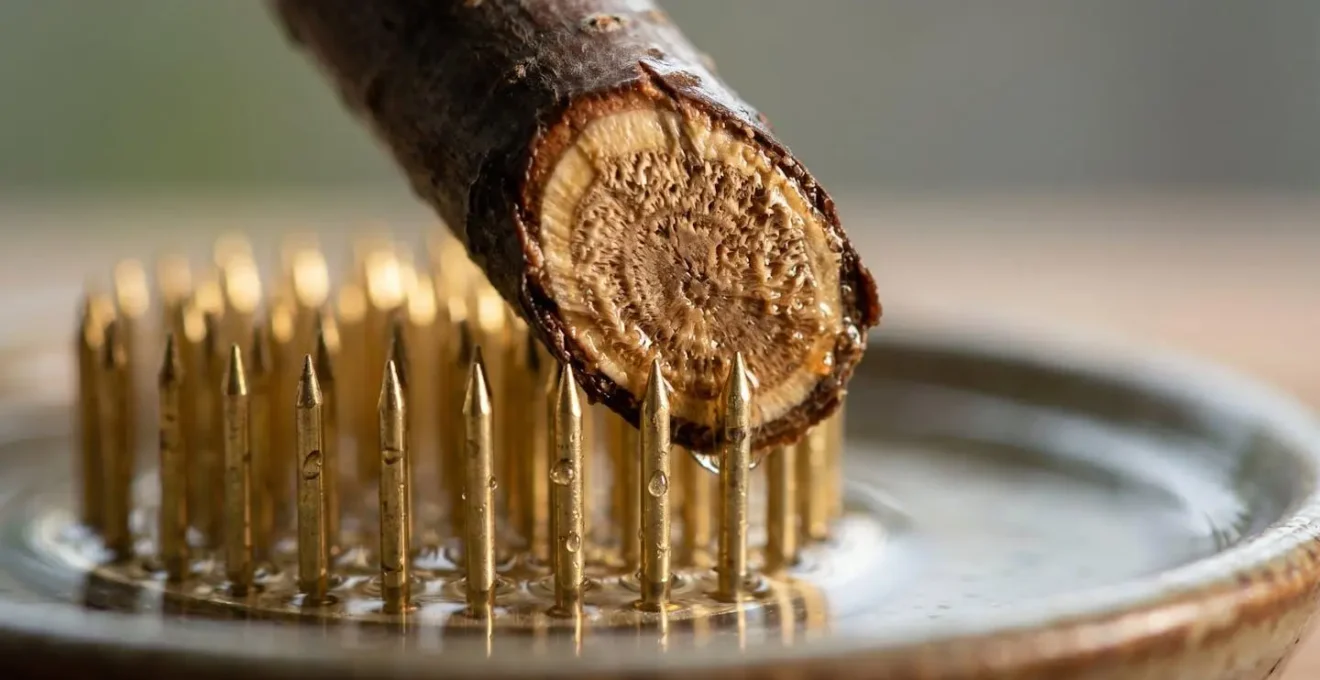
Once prepared, push the branch down onto the kenzan with firm, steady pressure. You should feel the needles pierce the woody fibers, locking it in place. The goal is to make the branch feel like a natural extension of the kenzan itself. For very delicate stems that are too thin to be held, a small bundle can be wrapped with floral tape to create a thicker base. This mechanical skill is the gateway to artistic freedom.
Your Action Plan: Mastering the Kenzan
- Cut the base of all flower stems at a sharp angle to make insertion easier and to stabilize the element on the kenzan pins.
- For thicker branches: make a vertical cut into the base, allowing the stem to straddle the needles for better penetration and grip.
- Use firm, consistent force to push the branch directly down into the kenzan needles until it feels completely secure.
- Consider support structures for complex arrangements: use thin, pliable vines to create an invisible framework within the vase to hold stems.
- For delicate blooms: gently wrap a few stems together with floral stem tape and insert the resulting bundle into the kenzan as a single unit.
Why Perfect Symmetry is Considered Stagnant in Japanese Art?
The Western eye is often trained to seek and appreciate symmetry. We see it as a sign of balance, order, and perfection. In architecture, design, and even floral arrangements, a symmetrical composition feels complete and stable. Yet, in the world of Ikebana and traditional Japanese aesthetics, perfect symmetry is deliberately avoided. It is considered stagnant, lifeless, and, ultimately, unnatural.
This preference for imbalance is captured by the aesthetic principle of Fukinsei (不均斉), which embraces irregularity and asymmetry. The core idea is simple but profound: nature itself is not symmetrical. A tree’s branches do not grow in perfect pairs, a mountain range is not a mirror image of itself, and no two leaves are identical. To create a perfectly symmetrical arrangement is to create something artificial, something that denies the dynamic, ever-changing reality of the natural world.
Fukinsei is irregularity, imbalance, inequality, and odd counts, as a response that denies perfection. Nature is not perfect or symmetrical.
– Japanese Aesthetic Principles Study, Analysis of Seven Japanese Aesthetic Principles
An asymmetrical design is full of energy and movement. The viewer’s eye is encouraged to travel through the composition, following the lines and discovering the spaces between them. This is why traditional ikebana practice guidelines favor using odd numbers of stems—typically three, five, or seven. An even number creates pairs and invites symmetry, while an odd number forces imbalance and creates a more dynamic visual tension. By choosing asymmetry, the artist is not creating chaos; they are reflecting a deeper, more organic form of order, one that is alive with potential.
Seasonal Impermanence: Why Use Withered Leaves in Autumn Arrangements?
In a typical Western flower shop, any sign of decay—a browned petal, a wilting leaf—is immediately discarded. The goal is to present a vision of perpetual peak bloom, an impossible standard of perfection. Ikebana takes a radically different approach. It not only accepts but actively celebrates the entire life cycle of a plant, including its decline. An arrangement featuring a withered leaf or a branch with buds yet to open is often considered more profound and beautiful than one with only perfect, open flowers.
This is an expression of wabi-sabi (侘寂), a worldview centered on the acceptance of transience and imperfection. Wabi-sabi finds beauty in things that are modest, humble, and unconventional. It recognizes that an object’s story—its journey through time—is part of its beauty. A withered leaf in an autumn arrangement tells a powerful story of the changing seasons, of letting go, and of the graceful arc of life and death. It is a poignant reminder that all things are impermanent.
Things in bud, or things in decay, as it were, are more evocative of wabi-sabi than things in full bloom because they suggest the transience of things. As things come and go, they show signs of their coming or going, and these signs are considered to be beautiful.
– Wikipedia – Japanese Aesthetics, Japanese aesthetics entry on wabi-sabi principles
This concept, also known as *mono no aware* (the pathos of things), is deeply ingrained in Japanese culture. Consider the celebrated cherry blossoms. The national obsession is not just with their beauty, but with the heartbreaking brevity of it. The fact that the peak cherry blossom bloom lasts less than two weeks is precisely what makes it so precious. By including a “flawed” element in your arrangement, you are not making a mistake; you are infusing your work with a deeper, more resonant truth about the nature of existence.
The Void: How the Empty Space in the Vase Is Part of the Art?
When you look at an Ikebana arrangement, what do you see? Your first instinct might be to focus on the flowers, the branches, the tangible elements. But a practitioner of Ikebana learns to see what is *not* there. The empty space, or Ma (間), is not a void to be filled; it is an active, essential component of the design. It is the silent pause in a piece of music, the breath between words in a poem. Without it, there is only noise.
In Western floral design, the goal is often to create a dense mass of color and texture, leaving no empty space. Ikebana operates on the opposite principle. The space between the flowers, known as kire (the void), is deliberately carved out and shaped by the placement of each stem. This negative space defines the lines of the arrangement, creates rhythm and tension, and allows each individual element to be seen and appreciated in its own right. It gives the composition room to breathe.
This illustration demonstrates the power of Ma. The single branch is defined not by itself, but by the vast, intentional space surrounding it. It is this “nothingness” that gives the “something” its meaning and power.
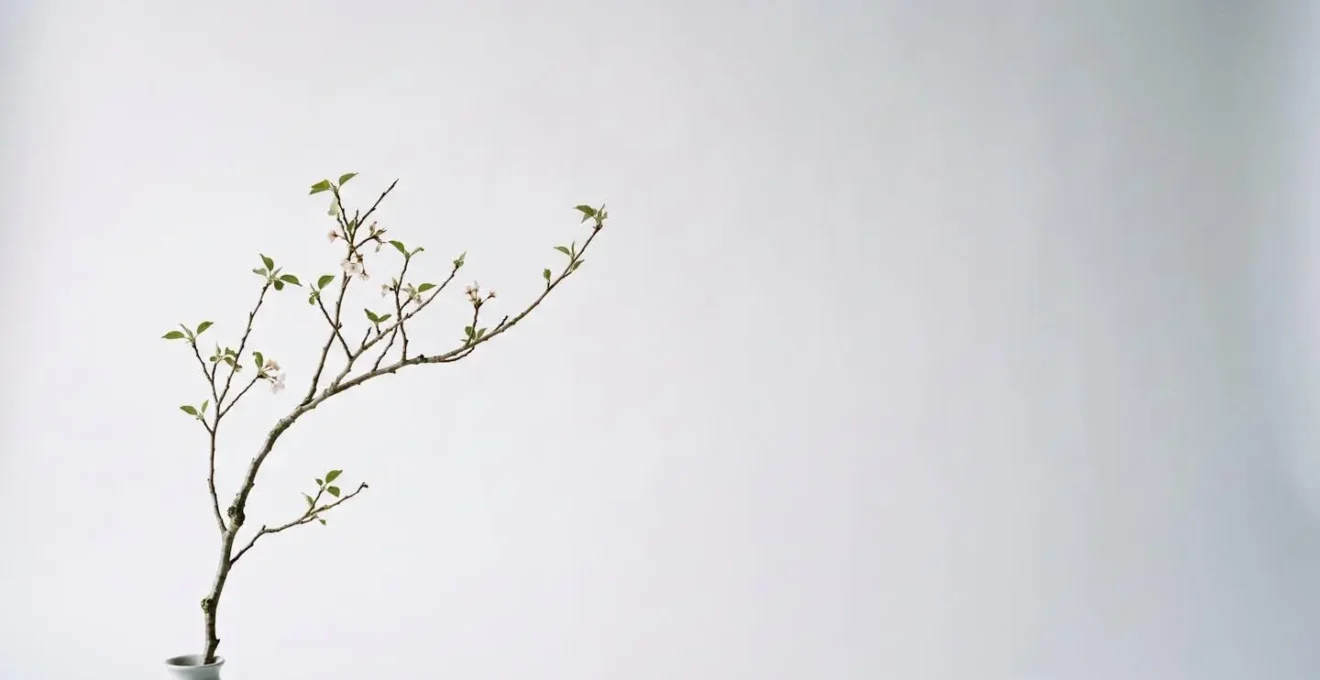
Learning to see and use Ma is a radical shift in perception for the Western mind, which is often conditioned to fear emptiness and fill every silence. In Ikebana, you are invited to embrace the void. You learn that by using fewer elements, you can create a more powerful and evocative statement. The empty space is not an absence; it is a presence. It is the silent canvas upon which the story of your arrangement unfolds, holding all the potential of what is unsaid and unseen.
Line over Mass: Why One Branch Can Be More Powerful Than 50 Roses?
A bouquet of 50 perfect red roses is a powerful symbol of love and abundance in Western culture. It is a statement of mass, color, and overwhelming presence. An Ikebana master, however, might find more power, emotion, and narrative in a single, gnarled branch of plum blossoms. This contrast highlights one of the most fundamental differences in philosophy: Ikebana prioritizes line over mass. While Western floristry often focuses on the bloom—the end result—Ikebana celebrates the entire plant and its journey.
The line of a stem, the curve of a branch, the angle of a leaf—these are the primary vocabulary of the Ikebana artist. The “Case Study: Western vs Japanese Floral Approach” highlights how instructors like Matsuki sensei emphasize this distinction. The line tells a story. A straight, strong line speaks of vitality and aspiration. A bent, twisted line speaks of struggle and resilience. The delicate tracery of a bare winter branch against a white wall can evoke a feeling of quiet melancholy that a dense bouquet never could.
Ikebana asks the practitioner to look beyond the flower head and see the character of the entire plant. You are encouraged to find beauty in the stem’s elegant curve, the tension in a budding branch, and the graceful droop of a leaf. These are the elements that create movement, direction, and emotion in the arrangement. A single, well-chosen line can guide the viewer’s eye, create a sense of scale, and define the entire emotional tone of the piece in a way that a mass of color cannot.
The Frame: How Negative Space Defines the Edges of Your Design?
In Ikebana, the physical container is only one frame for your art. The true frame, the one that gives your composition its shape and boundary, is the negative space you cultivate around it. As we have seen, this space (Ma) is not passive. By placing your stems, you are actively “carving” this void, and in doing so, you define the outer edges and the internal dynamics of your design. The triangular structure of Shin, Soe, and Hikae is not just about the three stems themselves, but about the three triangular planes of empty space they create.
This practice of using minimal elements to define a larger space is a core tenet. The impact of an arrangement is not measured by how much material it contains, but by how effectively that material activates the space around it. This is why, as noted by ikebana practitioners, most traditional Japanese flower arrangements are surprisingly sparse, often including only five to thirteen stems. A Westerner might see this and think something is “missing.” The Ikebana artist understands that nothing is missing; the space itself is the missing piece, and it’s there by design.
Think of your arrangement as an island in an ocean of air. The shape of the coastline (your stems and leaves) is what gives the ocean its form. By carefully positioning your elements, you control the flow and energy within the composition. A tall, vertical branch creates a sense of upward movement, drawing energy from the base to the tip. A low, horizontal element can create a feeling of stability and tranquility, grounding the entire piece. The edges of your design are not the tips of the leaves, but the invisible line where the energy of your composition meets the stillness of the surrounding room.
Key Takeaways
- Embrace Imperfection (Wabi-Sabi): True beauty lies in the transient, the flawed, and the incomplete. A withered leaf tells a more profound story than a perfect bloom.
- Value the Void (Ma): Empty space is not an absence, but an active presence that gives form, rhythm, and meaning to the elements within it.
- Prioritize the Line: The story and emotion of an arrangement are carried not in the mass of flowers, but in the character and movement of a single branch or stem.
How to Apply Asian Design Principles to Contemporary Western Floristry?
The principles of Ikebana are not confined to a traditional Japanese setting with a formal *tokonoma* alcove. Their power lies in their universality. You can begin to integrate this profound way of seeing into your own life and your own approach to flowers, even with a simple store-bought bouquet and a modern vase. The goal is not to perfectly replicate an ancient art form, but to allow its wisdom to shift your own creative process from one of accumulation to one of mindful curation.
The first step is the art of subtraction. Take a standard mixed bouquet, deconstruct it, and lay out all the individual stems. Instead of trying to cram them all into one vase, select only two or three elements. Look for the one with the most interesting line, the most unusual curve, or the most delicate texture. Place just these few stems in a simple container and give them what they rarely have in a dense bouquet: breathing space. Observe how, when isolated, each element’s unique character becomes visible.
This practice can extend to all aspects of design. Choose your vessels thoughtfully, not as mere water holders but as the foundational “Earth” of your composition. Use pruning not just to remove dead leaves, but as a shaping tool to simplify and clarify the line of a branch. A key exercise is to create an arrangement and then, when you think it is finished, force yourself to remove one more element. More often than not, this final act of subtraction is what brings the entire piece into perfect, imperfect harmony. With a global reach demonstrated by how the three major ikebana schools have over one million members each, these principles clearly resonate across cultures.
Your journey into the way of flowers begins not with a grand gesture, but with a single branch. The next time you are on a walk, find one that has fallen. Bring it inside. Place it in a simple cup of water. Do not try to “arrange” it. Simply observe it. Observe its lines, its texture, the way it holds itself in space. This is the first and most important step. The branch is your teacher; all you must do is be a willing student.