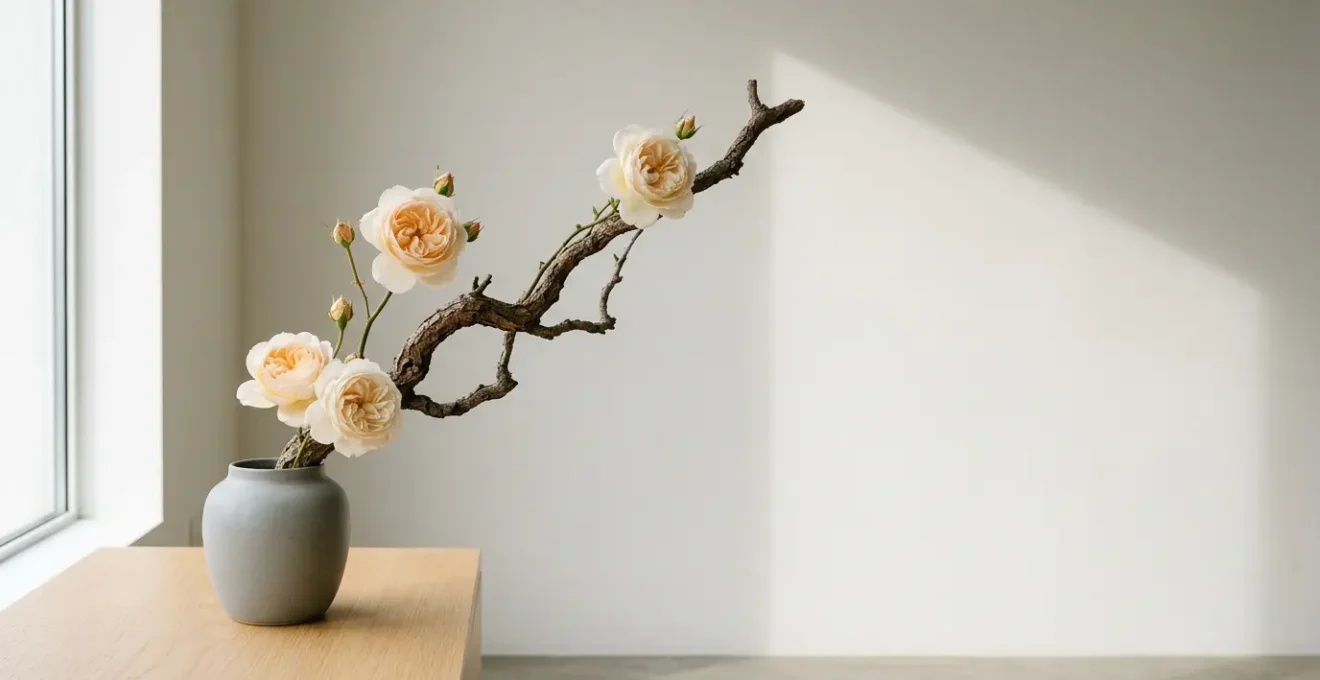
The most impactful element in your floral design isn’t a flower—it’s the empty space you intentionally create.
- It transforms crowded, ‘value’ bouquets into sophisticated, high-perceived-value luxury statements.
- It actively guides the viewer’s eye, making premium flowers the undisputed star of the composition.
Recommendation: Stop filling every gap and start sculpting the void. This shift in mindset elevates your work from craft to art, justifying higher price points and setting your designs apart.
There is a pervasive belief among florists, born from a genuine desire to provide value, that a full bouquet is a good bouquet. The instinct is to pack stems tightly, ensuring the client sees a dense, quantifiable return on their investment. We’ve been taught that more is more, that every gap is a missed opportunity to add another bloom. This approach, while well-intentioned, often leads to arrangements that are visually cluttered, heavy, and ultimately, less impactful.
But what if the common wisdom is flawed? What if the most potent tool in your design arsenal isn’t another stem of lisianthus, but the deliberate, artful use of nothing at all? The conversation must shift from simply “filling a vase” to “composing an experience.” This is the power of negative space—the purposeful voids and gaps that define shapes, create rhythm, and command attention. It’s the difference between a crowd of flowers shouting at once and a beautifully orchestrated symphony where each note can be heard.
This guide moves beyond the generic advice to “add air.” We will deconstruct the principles of negative space, examining it as an active, strategic element. We will explore the visual psychology that makes sparse designs feel luxurious, the techniques to make a single premium flower sing, and the language to sell “empty air” as the ultimate expression of artistry. It’s time to treat space not as a deficit to be corrected, but as the substance that gives your work its soul.
To master this critical concept, we will dissect the function and application of negative space across several key areas of floral composition. This structured approach will provide a clear roadmap from understanding the theory to confident practical application.
Summary: The Power of Negative Space: Why Your Arrangement Needs Room to Breathe
- The Frame: How Negative Space Defines the Edges of Your Design?
- Staccato vs Legato: How Spacing Creates Visual Music?
- High Value, Low Cost: How Negative Space Increases Perceived Value?
- The Star Performer: How Space Makes a Premium Flower Shine?
- Silhouette and Shadow: How to Photograph Designs with Holes?
- Ma (Negative Space): How to Sell “Empty Air” to Value-Conscious Clients?
- Negative Space in Linear Design: Why the Void Is as Important as the Flower?
- How to Apply Asian Design Principles to Contemporary Western Floristry?
The Frame: How Negative Space Defines the Edges of Your Design?
Before a single flower is appreciated, the viewer’s brain must first process the entire composition. This is not a poetic notion but a biological fact. The human brain processes an immense amount of visual data, and according to research on visual perception shows that a significant portion of its capacity is dedicated to making sense of what we see. An overstuffed arrangement is a form of cognitive overload; it presents a chaotic jumble of color, texture, and form with no clear entry point or hierarchy. The eye doesn’t know where to look, so it glazes over everything.
Negative space is the antidote to this chaos. It functions as an invisible frame, corralling the visual information and telling the brain, “Look here. This is what’s important.” By creating clear breathing room around elements, you define their boundaries. A flower is no longer just a flower; it is a distinct shape against a quiet background. This separation allows each element to be seen and appreciated individually. The void isn’t emptiness; it’s a delimiter. It’s what gives form to the formless.
This concept pushes back against the idea that value is only in what is present. The artist and designer Alan Fletcher eloquently captured this idea in his book, The Art of Looking Sideways, stating: “Space is substance.” This is the fundamental shift in thinking required. The empty air in your design has compositional weight and purpose. It is as deliberate and as crucial as the most perfect peony. By mastering the frame, you move from merely arranging flowers to directing the viewer’s gaze with surgical precision.
Staccato vs Legato: How Spacing Creates Visual Music?
Once you accept that space is a tangible element, you can begin to manipulate it to create rhythm and movement. In music, the silence between notes is as important as the notes themselves. The same principle applies to floral composition. The spacing between your floral elements creates a form of visual music, directing the pace at which the viewer experiences the design. You can create sharp, staccato beats or smooth, legato flows.
A staccato rhythm is achieved with tight clusters of materials separated by dramatic, clear gaps. This creates a punchy, energetic, and modern feel. The eye hops from one point of interest to the next, creating a sense of excitement and dynamism. Conversely, a legato rhythm uses more gradual and connected spacing, where elements flow into one another with minimal interruption. This evokes a feeling of calm, grace, and elegance. The choice is a deliberate artistic one, dictated by the mood you wish to create.
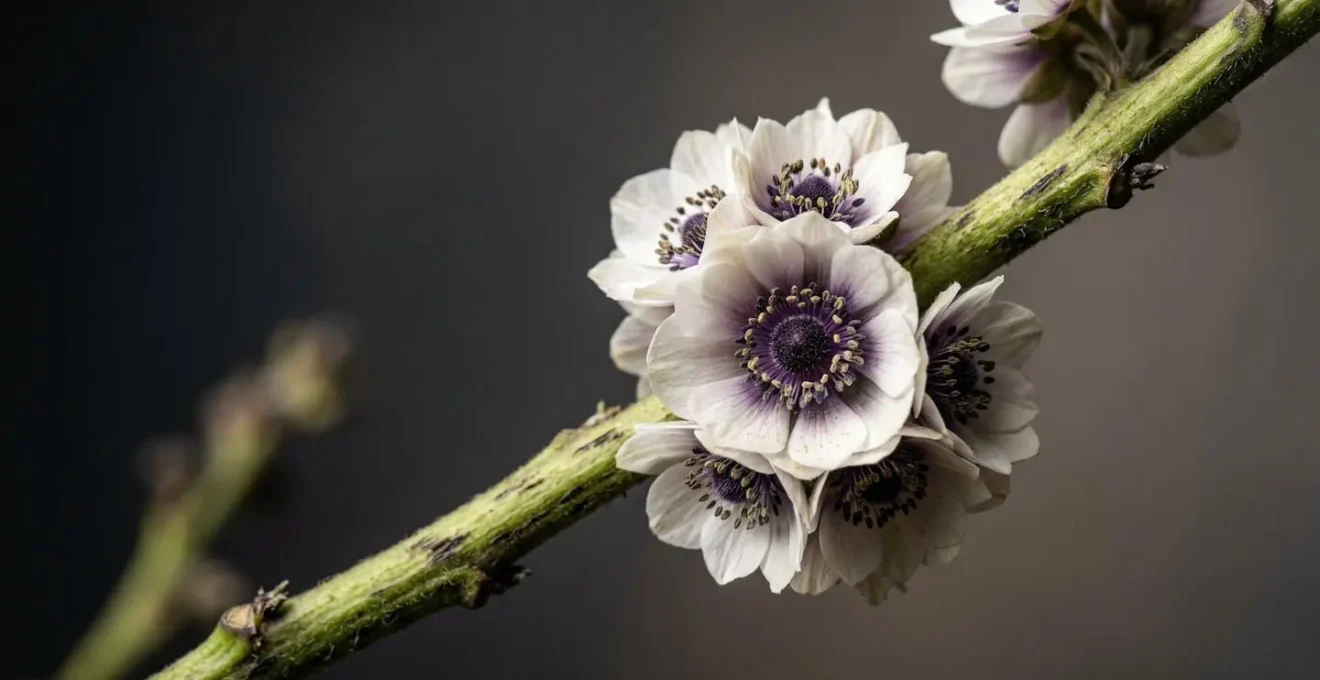
The image above perfectly illustrates a staccato rhythm. Notice how the clustered anemones are grouped into distinct visual “beats” along the stem. The significant gaps between these clusters are not dead space; they are active intervals that force the eye to pause and jump. This creates visual tension and a dynamic energy that a uniformly packed stem could never achieve. The void makes the presence of the blooms more impactful. Without these calculated rests, the design would devolve into a monotonous line of flowers.
High Value, Low Cost: How Negative Space Increases Perceived Value?
The fear that a sparse arrangement looks “cheap” is perhaps the biggest hurdle for florists to overcome. The reality, backed by psychology, is precisely the opposite. Luxury branding across all industries—from high fashion to technology—is built on the masterful use of negative space. A crowded shop window screams “discount,” while a single, perfectly lit handbag in a large, empty display whispers “exclusive.” This is not an accident; it’s a calculated strategy based on the principle of processing fluency.
The core idea is simple: our brains are lazy. We are drawn to things that are easy to process and understand. A foundational study on aesthetic perception found that designs that are easier for the brain to decode are consistently rated as more beautiful and pleasing. A dense, cluttered bouquet is hard work for the brain. A clean, well-spaced design is effortless. This ease of processing creates a positive emotional response, which we misattribute to the object itself. We don’t think, “This is easy to look at”; we think, “This is beautiful.”
This psychological quirk is your greatest commercial asset. By using negative space, you are not just making an artistic choice; you are making a strategic business decision. You are leveraging a cognitive bias to increase the perceived value of your work. The client isn’t paying for the “empty air”; they are paying for the feeling of sophistication, elegance, and clarity that the empty air creates. They are paying for a design that feels confident and intentional, not one that seems desperate to prove its worth by sheer volume.
The Star Performer: How Space Makes a Premium Flower Shine?
Imagine a theater stage. If the entire cast is on stage at once, all clamoring for attention, the lead actor becomes just another face in the crowd. To make the star truly shine, the director clears the stage, focuses the spotlight, and gives them a solo. In floral design, negative space is that spotlight, and your most beautiful, expensive, or unusual bloom is the star performer.
When you overstuff an arrangement, a prized garden rose or an exotic orchid loses its unique character. It is forced to compete for visual attention with every other element around it. Its delicate form, intricate texture, and subtle color variations are lost in the noise. By surrounding that single, exceptional flower with generous negative space, you are telling the viewer exactly where to look. You are bestowing it with importance. The surrounding void acts as a quiet, reverent audience, its silence amplifying the soloist’s voice.
This is a technique of emphasis. The space isolates the focal point, allowing its every detail to be savored. This is particularly crucial when working with high-cost materials. A client who has paid a premium for phalaenopsis orchids does not want to see them buried among filler. They want to see them presented as the treasures they are. Negative space is the velvet-lined box that presents the jewel. It doesn’t just showcase the flower; it elevates it, communicates its value, and fully justifies its cost.
Silhouette and Shadow: How to Photograph Designs with Holes?
In the age of social media, an arrangement’s life extends far beyond the vase; it lives on in photographs. And in photography, negative space takes on a new, powerful dimension. Designs with intentional voids, or “holes,” interact with light in a way that dense arrangements cannot, creating captivating silhouettes, shadows, and depth. Learning to photograph these designs is not just about documentation; it’s about capturing the very essence of your spatial composition.
The key is to think of the voids not as absences but as shapes in their own right. When backlit, these holes become luminous frames, and the flowers themselves are thrown into dramatic silhouette. The interplay between solid and void, light and shadow, becomes the subject of the photograph. This is where your skill as a composition critic truly shines, as you are now composing in three dimensions (with flowers) and two dimensions (with light).
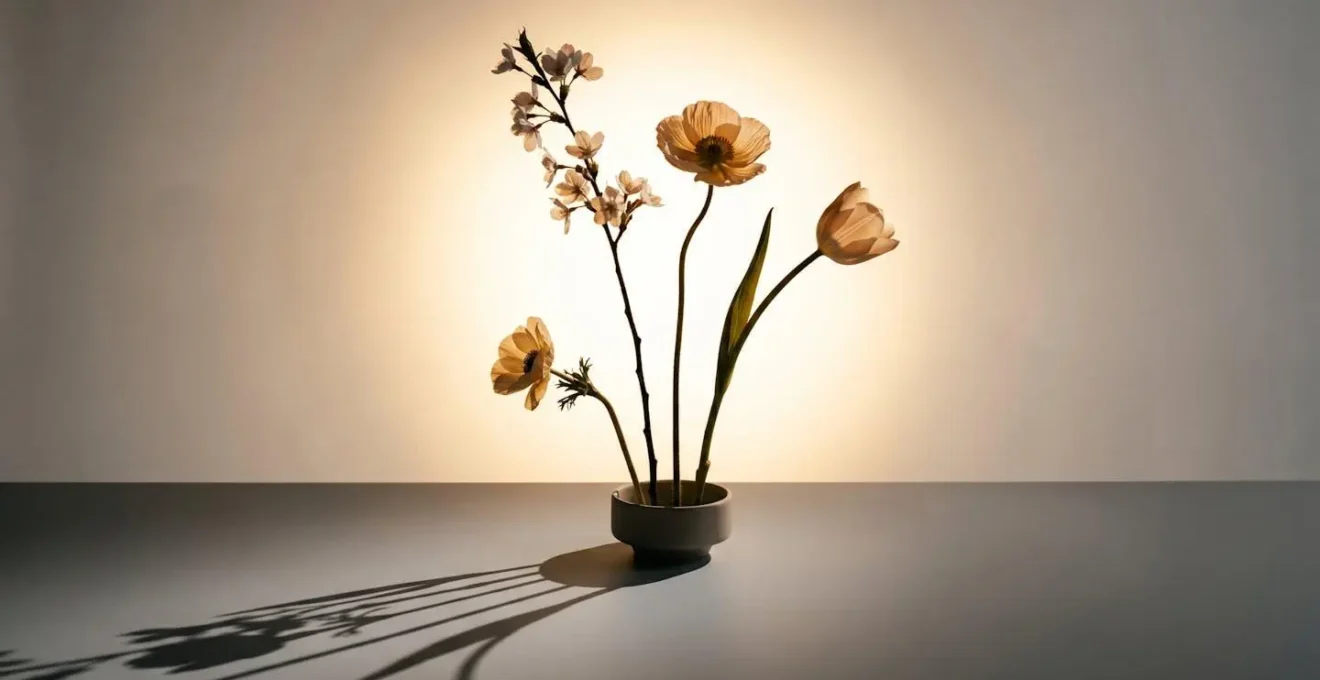
Backlighting is one of the most effective techniques for this. It can turn an ordinary flower into a translucent, glowing jewel and transform a simple stem into a bold graphic element. Mastering this requires moving beyond your camera’s automatic settings and taking creative control.
- Position your arrangement between you and a light source (like a window), so you are shooting towards the light. This will make the petals glow.
- Switch your camera to manual mode. Backlight often confuses auto-exposure and autofocus. Start with a wide aperture like f/2.8 to f/5.6 to create a soft, out-of-focus background.
- Slightly overexpose your shot by +1 to +2 stops. Since you are shooting into the light, the front of the flowers will be in shadow, and overexposing is necessary to capture their detail.
- Use a shutter speed between 1/60th and 1/400th of a second. A faster speed is necessary if there is wind or movement to ensure the image is crisp.
- Use a lens hood to block unwanted lens flare. Alternatively, you can intentionally move your camera to incorporate flare as a creative, artistic element.
Ma (Negative Space): How to Sell “Empty Air” to Value-Conscious Clients?
The Japanese have a word for this concept of active, meaningful emptiness: Ma (間). It is the interval in space and time, the pause that gives shape to action and sound. Understanding and, more importantly, articulating this concept is the key to selling designs with negative space to clients conditioned to equate value with volume. You are not selling them less; you are selling them a more sophisticated, artful product.
The conversation with a client must shift from a quantitative one (“How many flowers do I get?”) to a qualitative one (“What is the artistic impact of the design?”). This requires confidence and a clear vocabulary. Explain that your approach is inspired by principles of fine art and luxury design, where space is used to create focus, elegance, and a sense of calm. You can use analogies they understand: “It’s like the difference between a cluttered room and a minimalist, architect-designed interior. Both are furnished, but one feels chaotic and the other feels serene and valuable.”
Bringing in an expert voice can bolster your position. As floral educator Sandy Schroeck explained in a recent session, the goal is not to reduce material but to enhance the final product. She notes that “mastering the use of negative space in floral designs is about adding air into your designs and showing your customers that extra value.” This reframes the discussion perfectly. The “air” is not a subtraction of value but an addition of artistry.
Mastering the use of negative space in floral designs is about adding air into your designs and showing your customers that extra value.
– Sandy Schroeck, LBR Educates session on negative space (2024)
Ultimately, you are selling your expertise as a designer, not just flowers by the pound. When a client sees the breathtaking result—a design that commands a room with its quiet confidence—the conversation about stem count becomes irrelevant. The proof is in the palpable sense of luxury that only a well-composed, spacious design can deliver, as industry experts note that these techniques directly enhance perceived value.
Negative Space in Linear Design: Why the Void Is as Important as the Flower?
In no other style is the role of negative space more critical than in linear floral design. Unlike massed arrangements that rely on a collective of blooms, linear designs are built from individual, expressive lines. Here, the void is not merely a background; it is a co-star, an active participant in the composition. The empty spaces between branches, stems, and foliage are the very elements that define the design’s character, direction, and emotion.
Think of a single, dramatic line created by a branch of contorted willow. Its power lies not just in its own twisted form, but in the vast, empty space it carves out and traverses. The void gives the line a journey—a beginning and an end. It provides the canvas against which the line’s story unfolds. Without this surrounding emptiness, the line would be absorbed into a background of noise, its expressive power completely neutralized.
This is the essence of the Japanese aesthetic principle of Ma. It is the concept that the interval is as meaningful as the object. The space between two stems is not a gap to be filled with filler; it is a relationship, a line of tension, a silent dialogue. As the traditional philosophy describes it, the void is “the silence between the notes which make the music.”
The existence of ma in an artwork has been interpreted as ‘an emptiness full of possibilities, like a promise yet to be fulfilled’, and has been described as ‘the silence between the notes which make the music’.
– Traditional Japanese aesthetic philosophy, Ma (negative space) concept definition
In practical terms, this means that when creating a linear design, you must give as much critical thought to the shapes of the empty spaces as you do to the placement of the flowers. The contour of the void between a stem and a leaf is a compositional element. The area framed by a curving branch is a shape. By learning to see and sculpt these voids, you elevate your work from a simple arrangement to a piece of living sculpture.
Key Takeaways
- Negative space is an active tool, not a passive void; it acts as a frame to reduce cognitive load and direct the eye.
- Ease of processing is linked to beauty and perceived value; spacious designs feel more luxurious and sophisticated.
- Use negative space as a spotlight to isolate and elevate your premium blooms, giving them the attention they deserve.
How to Apply Asian Design Principles to Contemporary Western Floristry?
The principles of Asian design, particularly the Japanese concept of Ma, are not exotic, unattainable ideals. They are practical, powerful tools that can be adapted to elevate contemporary Western floristry, moving it from a craft of filling to an art of composing. The core lesson is to value absence as much as presence and to see the arrangement as a complete entity, where both flowers and the space around them work in harmony.
One of the most direct applications comes from Ikebana, the traditional Japanese art of flower arranging. Here, space is never an afterthought; it is a foundational building block of the entire composition. Each stem, leaf, and branch is placed with consideration for how it interacts with the surrounding voids.
Case Study: Ma in Ikebana: Space as Active Element
In traditional Ikebana, as explained in a recent analysis of the concept of Ma, negative space is treated as an active compositional element. Rather than being mere emptiness, the void between stems, branches, and blooms creates balance and harmony. Ancient art forms like Ikebana emphasize that the contours of vacant space between components are as important as each stem and blossom itself, demonstrating how Asian principles can elevate Western floral design through intentional spatial awareness. The result is a design that feels balanced, intentional, and alive with a quiet, dynamic energy.
Integrating this philosophy doesn’t mean you must create strict, traditional Ikebana. Instead, it means adopting the mindset. Before adding another flower, pause and ask: “What does the space look like? Does this void have a beautiful shape? Does adding this stem enhance the composition, or does it merely eliminate a powerful, silent element?” This simple checklist can transform your design process.
Your Action Plan: Applying the ‘Ma’ Principle Today
- Recognize ‘Ma’: See emptiness not as minimalism but as substance. Actively create intentional voids as architectural elements in your next design.
- Scale the Concept: Treat large installations (arches, backdrops) as three-dimensional compositions. Position floral clusters with significant breathing room to create visual pathways.
- Frame with Architecture: Use the surrounding environment (walls, columns, doorways) as active framing elements that define and give purpose to your negative space.
- Balance the Elements: Aim for a composition where the empty space holds as much visual weight and interest as the floral material itself. Presence and absence should be equal partners.
- Audit Your Work: Before declaring a design finished, step back. Is there a stem you can remove to create a more powerful void? Often, the final, most impactful touch is a subtraction, not an addition.
Embracing negative space is a declaration of confidence. It says that your work is so strong, it doesn’t need to shout. By shifting your focus from filling space to sculpting it, you will not only create more impactful, elegant, and valuable arrangements, but you will also unlock a deeper level of artistry and intention in your own practice. Start today by taking one flower away and seeing how much more you’ve added.