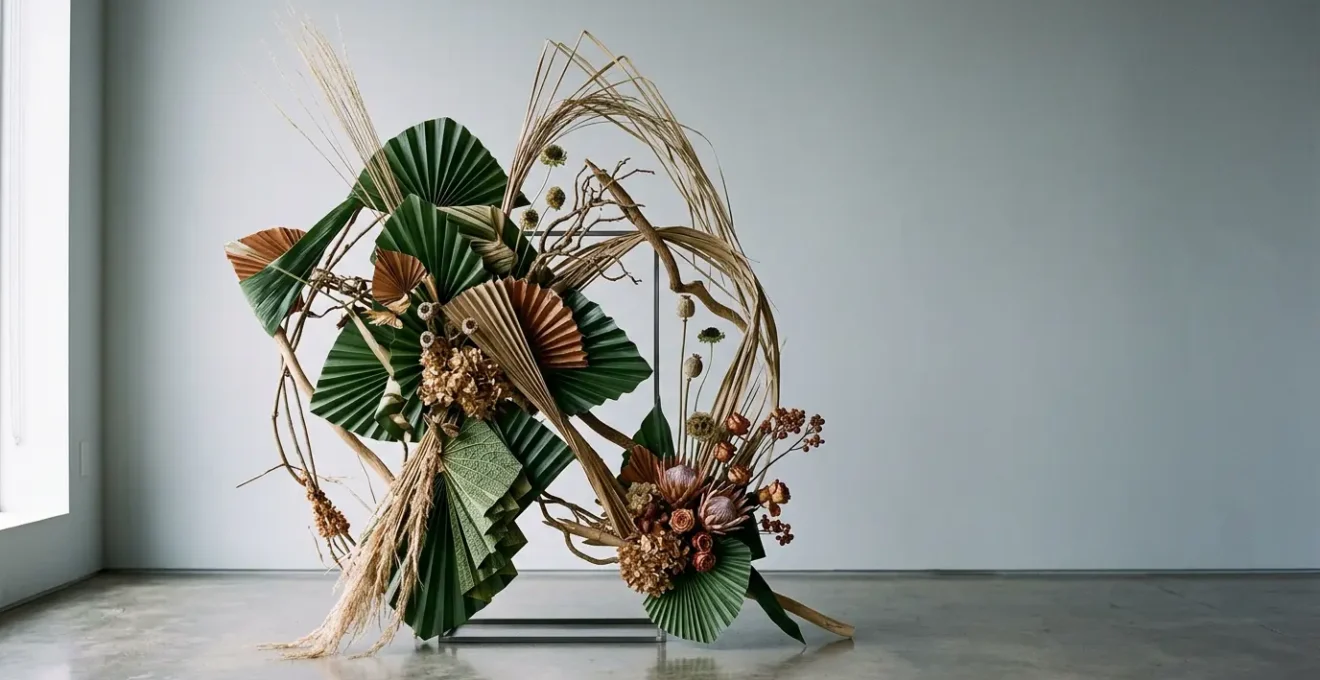
The true potential of botanical art is unlocked when the material is deconstructed from its natural identity and treated as a plastic medium for sculpture.
- Effective manipulation techniques—from folding leaves to inverting stems—prioritize line, texture, and form over the flower’s conventional beauty.
- The most compelling works create a dialogue between man-made frameworks and organic materials, celebrating the structure rather than hiding it.
Recommendation: Shift your perspective from arranging flowers to sculpting with botanical matter, embracing its inherent properties of texture, colour, and even its eventual decay as part of the artistic process.
For the artist whose medium is the living world, the conventional “roundy-moundy” bouquet can feel like a creative cage. The established rules of floristry, while foundational, often serve to domesticate nature rather than unleash its expressive power. You may find yourself with an abundance of texture, line, and form, yet constrained by expectations of what a floral arrangement *should* be. The conversation often circles around colour palettes and vase life, sidestepping a more profound inquiry into the material itself. We admire the petal’s softness and the leaf’s sheen, but rarely do we consider them as raw elements to be fundamentally transformed.
But what if the key to unlocking a truly unique botanical art form was not in the arrangement of whole flowers, but in their deconstruction? What if an Aspidistra leaf was treated not as foliage, but as a textile to be woven? What if a stem’s value was not in holding a bloom upright, but in the elegant, weeping line it creates when inverted? This is the core of abstract botanical sculpting: a discipline that moves beyond floristry and enters the realm of contemporary art. It requires a shift in perspective, viewing plant matter with the eyes of a sculptor who sees clay, stone, or metal—a medium brimming with botanical plasticity.
This curatorial guide moves past the vase and into the studio. We will not be arranging flowers; we will be dissecting their potential. We will examine the techniques that manipulate and transform organic materials, explore the frameworks that give them new shapes, and trace the artistic lineage that validates this practice. This is an exploration of how to make flowers become pure texture and form, challenging the very definition of botanical art.
This article provides a comprehensive overview of the principles and techniques that define abstract botanical sculpting. Below is a summary of the key areas we will explore to guide your artistic practice.
Summary: Abstract Botanical Sculpting: When Flowers Become Texture and Form
- Leaf Manipulation: How to Plait, Fold, and Weave Aspidistra?
- Dried Structures: Creating Permanent Sculptures from Willow and Grasses
- Spray Paint and Dye: Is Painting Flowers Art or Sacrilege?
- Upside Down: Why Hanging Amaranthus Looks Better Inverted?
- Paving: How to Create a Carpet of Petals or Leaves?
- Metal Frameworks: How to Build a Shape That Dictates the Flowers?
- Willow or Dogwood: Which British Branches Create the Best Frameworks?
- Avant-Garde Floral Shapes: Moving Beyond the Roundy-Moundy Bouquet
Leaf Manipulation: How to Plait, Fold, and Weave Aspidistra?
The humble leaf, often relegated to the role of “filler,” is where the sculptor’s work truly begins. In the hands of an artist, a broad leaf like Aspidistra or Monstera ceases to be foliage and becomes a pliable textile. The practice of folding, pleating, and weaving is a fundamental act of material deconstruction, transforming a biological plane into a three-dimensional object with its own rhythm and shadow. This is not mere decoration; it is an architectural act that imposes a new geometry upon an organic form. The goal is to divorce the leaf from its botanical identity and re-contextualize it as pure pattern and texture.
As demonstrated by artists like Bruno Duarte, these manipulations are not random but are guided by the Principles and Elements of Design. A single fold can create a powerful leading line, a series of pleats can introduce rhythm, and a woven lattice can build complex patterns that play with negative space. This approach elevates the craft by treating the leaf as a medium with inherent structural properties to be explored and exploited. The physical act of manipulation—bending, tearing, wiring—is a dialogue with the material, discovering its limits and its expressive potential.
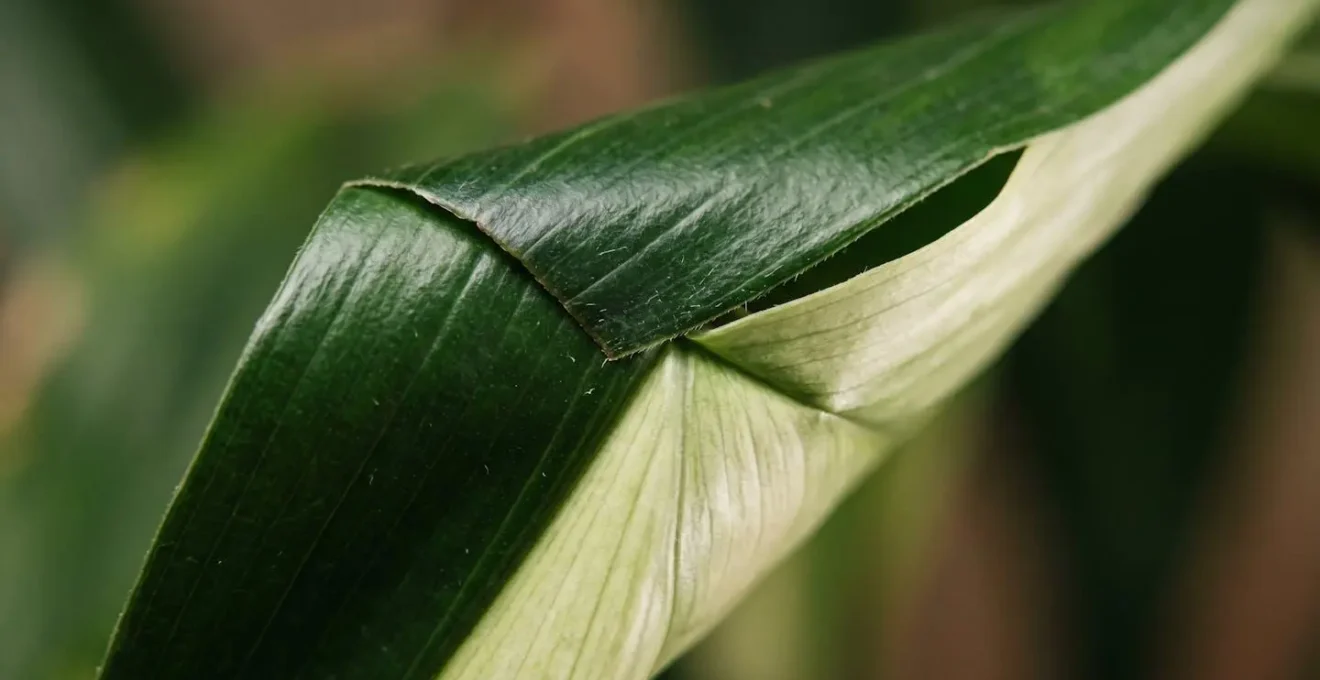
Observing a manipulated leaf up close reveals the artistry involved. The contrast between the glossy top surface and the matte underside, accentuated by a crisp fold, becomes a design element in itself. The tension along a new curve, the way light catches on a pleated edge—these are the details that move the work from arrangement to sculpture.
Action Plan: Mastering Leaf Manipulation
- Wire Backbone Method: Attach 18-gauge wire to the leaf’s underside with waterproof tape, close to the midvein, to create and hold precise, unnatural lines within a composition.
- Splitting Technique: Lightly fold the leaf, snip the midvein, and tear the margins away to create dual-unit designs from a single, connected piece.
- Ribbon Effect: Gently fold the leaf lengthwise along its main rib to create a strong linear element that introduces horizontal or vertical flow.
- Tubular Form: Roll the leaf tightly around a cylindrical object and fasten it with a staple or glue dot to build structural tubes for your sculpture.
- Woven Pattern: Cut a leaf into even strips and weave them through each other to create complex, textile-like lattice patterns.
Ultimately, leaf manipulation is the first step toward seeing the entire plant world as a source of raw material, each part possessing a unique texture, form, and structural capacity waiting to be discovered.
Dried Structures: Creating Permanent Sculptures from Willow and Grasses
While much of botanical art is ephemeral, the use of dried materials like willow, dogwood, and grasses allows the artist to create permanent sculptural forms. This process is a study in transformation, capturing the material’s flexibility when green and harnessing its rigidity when dry. A freshly harvested willow rod, soaked and pliable, can be bent into nearly any shape. Once that shape is set and the material dries, the structure tightens and hardens, creating a lasting armature. This is botanical plasticity in its most literal sense: the material is manipulated in a malleable state to achieve a permanent form.
The creation of these structures is an art in itself. Techniques borrowed from basketry, such as pairing (twisting two rods) or waling (braiding multiple rods), become sculptural methods for building volume and creating line. The framework is not a hidden mechanic but the skeleton of the sculpture, a drawing in three dimensions that will later interact with other botanical elements. An artist who understands this process also engages with the sustainable cycle of the material. The practice of coppicing, for instance, is a long-term collaboration with nature; research on sustainable willow cultivation demonstrates that it can take up to five years for a coppiced stool to reach its peak productivity, yielding the straight, strong rods ideal for sculptural work.
The resulting dried armature has its own aesthetic integrity. It possesses a linear quality and a natural texture that can stand alone as a finished sculpture or serve as the foundation for more complex works. This permanence allows the artist to move beyond the time constraints of fresh flowers, enabling a more considered and layered approach to composition. The dried structure is a testament to the artist’s ability to see potential not just in the bloom, but in the dormant strength of the branch.
By mastering dried materials, the botanical sculptor gains a new vocabulary of form and a new timescale for their creative process, bridging the gap between the fleeting and the everlasting.
Spray Paint and Dye: Is Painting Flowers Art or Sacrilege?
The question of artificially colouring flowers is a contentious one, often viewed as a violation of nature’s purity. From a curatorial perspective, however, the act of applying paint or dye is one of the most definitive ways to assert artistic intent. It is a bold statement that divorces the material from its natural state, forcing the viewer to see it not as a flower, but as a coloured form. When an artist paints a carnation metallic gold, they are not trying to “improve” the carnation; they are using its ruffled texture to create a new object entirely. This is the essence of form over flora.
The debate over artifice misses the point. Art is, by definition, artificial. The artist’s role is to transform materials to convey an idea or emotion. Painting a flower is no different from a painter applying gesso to a canvas before adding colour; it is a preparatory act that changes the material’s properties to better suit the artist’s vision. The petal becomes a surface, its original colour irrelevant, its purpose now to hold the new pigment and contribute its unique texture to the overall composition.
The choice of colorant is a critical artistic decision, as each type interacts with the botanical material differently, affecting texture, longevity, and perception. Understanding these nuances is key to controlling the final outcome.
This table outlines the distinct effects of various floral colorants, providing a technical guide for the botanical sculptor. This comparative analysis helps in selecting the right medium to achieve a specific textural or visual effect.
| Colorant Type | Application Method | Effect on Petal Texture | Longevity Impact | Environmental Consideration |
|---|---|---|---|---|
| Floral-Specific Sprays | Aerosol application from 12 inches | Creates smooth, opaque coating; may stiffen petals | Extends vase life by sealing pores | Contains VOCs; use in ventilated areas |
| Water-Based Dyes | Stem absorption or petal dipping | Maintains natural texture; color permeates tissue | Neutral to slightly reduced | Low environmental impact; biodegradable |
| Natural Pigments | Brush or mist application | Subtle color shift; preserves tactile quality | May fade faster under light | Fully sustainable; compostable |
| Metallic Finishes | Spray or brush for coverage | Completely transforms material perception (stone/metal effect) | Significantly extends durability | Often synthetic; check composition |
Therefore, painting flowers is not sacrilege; it is a powerful sculptural act. It is the artist declaring that this material, in this moment, serves a purpose beyond its biology. It is a bold move towards abstraction and a vital tool in the botanical sculptor’s arsenal.
Upside Down: Why Hanging Amaranthus Looks Better Inverted?
The simple act of inverting a flower can be a profoundly transformative gesture. With Hanging Amaranthus, this is particularly true. In its natural orientation, its drooping tassels, or “catkins,” convey a sense of gentle melancholy. Gravity pulls them downward into a familiar, weeping shape. However, when an artist hangs the stem upside down, the material is liberated from this gravitational expectation. The tassels now fall in a cascade, creating a dense, textural mass—a botanical waterfall. The focus shifts from the individual flower to the collective form, from a plant to a pure, sculptural line.
This reorientation is a deliberate defiance of convention. It forces the viewer to see the material in a new light, stripped of its common associations. The amaranthus is no longer just a “tassel flower”; it becomes an exercise in texture, volume, and movement. This approach aligns perfectly with contemporary design trends that favour the unexpected and the theatrical. As one trend report notes, this is a move toward the fantastical.
Within the ‘RAZZLE DAZZLE’ trend, textures become a whimsical blend of the bizarre and fantastical, shapes and forms defy convention and challenge typical standards.
– EMC International Trend Report, Florists’ Review – European Floral Trends 2024
This inversion is a powerful tool for the botanical sculptor. It demonstrates that radical new forms can be achieved not through complex manipulation, but through a simple change in perspective. By working with gravity in an unconventional way, the artist reveals a hidden characteristic of the material. The inverted amaranthus doesn’t “look better” out of pure aesthetics; it becomes a more compelling work of art because the artist has made a conscious choice to subvert the expected and reveal a new, more dynamic truth about its form.
This technique reminds us that sometimes the most potent artistic statement is not an addition, but a simple rotation—a 180-degree turn that changes everything.
Paving: How to Create a Carpet of Petals or Leaves?
Botanical paving, the technique of creating a “carpet” from petals, leaves, or other organic materials, pushes the concept of sculpture into the realm of land art and installation. This is perhaps the most profound expression of material deconstruction, where the individual components of a plant are used as pixels of colour and texture to create a larger image. A single rose petal is a delicate, curved form. A thousand rose petals, laid flat, become a field of colour, a pointillist painting on the ground. The original identity of the flower is completely subsumed by the new, collective form.
This technique is deeply intertwined with the concept of ephemerality. Unlike a bronze statue, a carpet of leaves is designed to be temporary. It is a collaboration with time and environment. The artist creates a moment of perfect order, knowing it will be scattered by the wind, washed away by rain, or simply wilt and decay. This is not a flaw in the medium; it is its greatest conceptual strength. The work’s transient nature forces a deeper engagement from the viewer, who understands they are witnessing a fleeting moment of beauty.
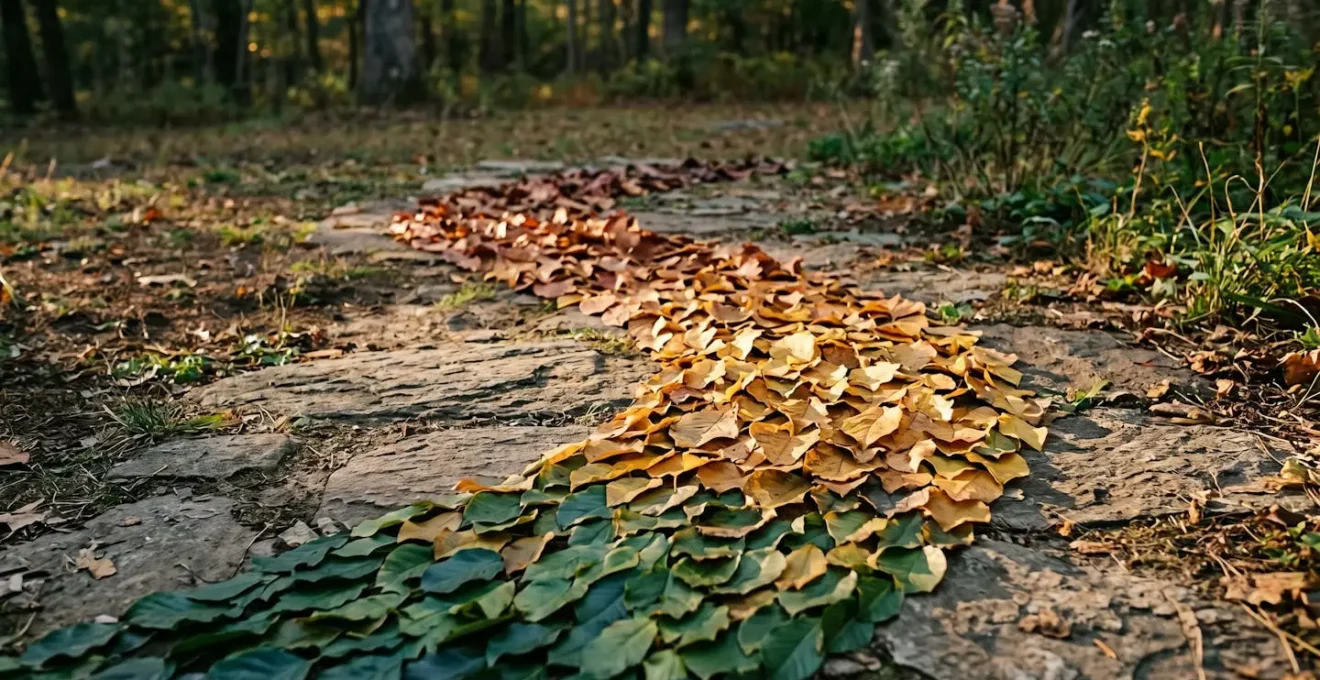
The work of artist Andy Goldsworthy is a masterclass in this practice. He uses materials found on-site to create stunning geometric or gradient patterns that exist in harmony with their landscape, only to be reclaimed by it. His process demonstrates that the documentation of the work—often through photography—can become as important as the piece itself.
Case Study: Andy Goldsworthy’s Ephemeral Leaf Installations
British artist Andy Goldsworthy creates site-specific installations using leaves, rocks, ice, and branches, documenting these ephemeral collaborations with nature through photography. His leaf works often feature gradients of colour arranged across landscapes, emphasizing the passage of time and transformation. Working with materials gathered on-site, Goldsworthy uses only his bare hands and found tools to create patterns that exist briefly before wind, rain, or natural decay reclaims them, demonstrating that the temporary nature of botanical paving can be its greatest artistic strength rather than a limitation. This concept of choreographed decay is central to his entire body of work.
For the botanical sculptor, paving is the ultimate expression of control and release. It is the patient construction of a perfect surface, and the graceful acceptance of its inevitable disappearance.
Metal Frameworks: How to Build a Shape That Dictates the Flowers?
In conventional floristry, the mechanics are meant to be hidden. The wire, foam, and containers are concealed to create the illusion of a spontaneous, natural arrangement. In abstract botanical sculpture, the opposite is often true. The framework—be it metal, wood, or plexiglass—is not a covert support system but a visible, integral component of the artwork. This creates a powerful structural dialogue between the rigid, man-made armature and the soft, organic materials it supports.
Building a framework is the first act of sculpture. The artist defines the overall shape, the lines of movement, and the negative space before a single flower is introduced. The armature dictates the form, and the botanical elements are then selected and placed to interact with this predetermined structure. They may weave through it, erupt from it, or be suspended by it. The flowers do not create the shape; they inhabit and respond to the shape that the artist has built. This method completely inverts the traditional process of arranging.
This approach allows for the creation of large-scale, gravity-defying installations that would be impossible with fresh stems alone. A metal grid can become a canvas for a tapestry of orchids; a plexiglass base with holes can create the illusion of flowers floating in mid-air. The contrast in materials—the coldness of metal against the delicacy of a petal, the transparency of glass against the opacity of a leaf—becomes a central theme of the work.
Case Study: Metal Frame and Plexiglass Base Installation
A recent 2024 trend report showcases a captivating installation combining industrial and organic elements. A stark metal frame provides the structural foundation, its clean lines contrasting with nature’s delicacy. Below it, a plexiglass base with strategically placed holes creates visual perspective and transparency. Vibrant moss branches intertwine through the framework, bridging the gap between the industrial and the organic, while exotic flowers emerge throughout. This design perfectly demonstrates how the frame becomes an integral, visible part of the sculpture, creating a dialogue between man-made structure and natural materials rather than attempting to hide the mechanics.
By embracing the framework as part of the art, the sculptor is not just arranging flowers; they are constructing a complete, self-contained aesthetic world where nature and industry coexist in a tense and beautiful harmony.
Willow or Dogwood: Which British Branches Create the Best Frameworks?
When creating organic frameworks, the choice of wood is a foundational artistic decision. For artists in Britain and similar climates, willow (Salix) and dogwood (Cornus) are two of the most valuable resources, yet they offer distinctly different properties. The choice between them is not merely practical; it is an aesthetic one that will influence the final sculpture’s character. Willow is the material of subtlety and flexibility. When harvested green and properly soaked, its pliability is unmatched, allowing the artist to create fluid, looping curves and intricate woven structures. Once dried, it holds its shape with a quiet, tensile strength. Its colour is typically a natural, earthy brown or gold, providing a neutral backdrop that complements the flowers it will eventually hold.
Dogwood, particularly the red-stemmed varieties like *Cornus alba*, is the material of drama and line. While less flexible than willow, its primary contribution is its vibrant colour. A framework made of dogwood is not a neutral support; it is a bold statement, a network of vivid red lines that becomes a primary visual element. The artist using dogwood is intentionally drawing with colour in three dimensions. Manipulating dogwood requires a greater understanding of the material’s limits, as it is more prone to snapping if pushed too far. The reward, however, is a structure that possesses an inherent energy and visual impact even before any other botanical elements are added.
The following table provides a direct comparison for the artist-sculptor, focusing on the characteristics relevant to creating structural frameworks.
This detailed comparison, drawing on principles of traditional material use, is essential for any artist working with natural armatures. The data is supported by practical guides like those from farms specializing in willow cultivation.
| Characteristic | Willow (Salix varieties) | Dogwood (Cornus alba) |
|---|---|---|
| Pliability When Green | Exceptional flexibility; bends without breaking when properly soaked | Moderate flexibility; requires careful handling to avoid snapping |
| Color Variations | Natural golden to brown tones when stripped; green to purple with bark | Vibrant red stems (especially Cornus alba); dramatic visual impact |
| Best Harvest Season | Late winter/early spring (January-March); sap rising enhances flexibility | Winter (December-February); color is most vibrant in dormant season |
| Durability for Outdoor Use | Excellent when properly dried; can last 5-10+ years in structures | Good durability; naturally resistant to decay; 3-7 years typical lifespan |
| Ease of Manipulation | Beginner-friendly after 24-hour soak; highly forgiving material | Intermediate skill level; requires understanding of branch grain and limits |
| Symbolic/Cultural Associations | Associated with flexibility, resilience, water; traditional basketry material | Symbolizes rebirth, vitality; used in traditional hedgerows and folklore |
Ultimately, willow is for the sculptor of form, while dogwood is for the sculptor of line and colour. The thoughtful artist will choose their material not for convenience, but for the specific voice it will lend to the finished work.
Key Takeaways
- Form Over Flora: The primary goal of botanical sculpture is to prioritize abstract qualities like line, texture, and shape over the recognizable identity of the flower or plant.
- Celebrate the Structure: Man-made frameworks (metal, wood) should not be hidden but integrated as a visible, intentional part of the artwork, creating a dialogue between the organic and the industrial.
- Embrace Ephemerality: The temporary nature of botanical materials, including their decay, is a powerful conceptual tool, connecting the artwork to themes of time, nature, and impermanence.
Avant-Garde Floral Shapes: Moving Beyond the Roundy-Moundy Bouquet
To move beyond the conventional bouquet is to situate one’s work within a rich and defiant artistic lineage. The avant-garde botanical sculptor is an heir to multiple movements that challenged the very definition of art. From the minimalist principles of Japanese Ikebana, we inherit an appreciation for negative space, asymmetry, and the power of a single, well-placed line. Ikebana masters understood centuries ago that what is left out is as important as what is put in, a lesson central to creating sculptural forms that breathe.
From the Land Art movement of the 1960s and 70s, we learn to see the environment as a collaborator and to embrace ephemerality. Artists like Andy Goldsworthy and Robert Smithson took art out of the gallery, using natural materials on-site to create works that were often, by design, temporary. This legacy gives the botanical sculptor permission to create for the moment, understanding that the work’s value is not tied to its permanence. It is a philosophy perfectly captured by Goldsworthy himself.
I think it’s incredibly brave to be working with flowers and leaves and petals. But I have to: I can’t edit the materials I work with. My remit is to work with nature as a whole.
– Andy Goldsworthy, Wikipedia – Andy Goldsworthy
Finally, from Abstract Expressionism, we borrow a focus on gesture, texture, and emotional resonance. When a sculptor deconstructs a flower into its component parts—using petals as pigment, stamens as texture, and stems as gestural lines—they are engaging in the same process of abstraction that defined painters like Jackson Pollock or Willem de Kooning. This convergence of influences is why minimalist and sculptural arrangements with clean lines are gaining such traction, moving from the fringe to the forefront of design.
Case Study: Tracing Botanical Sculpture’s Artistic Lineage
Contemporary avant-garde floral design draws from a rich artistic lineage spanning multiple movements. Japanese Ikebana established principles of negative space, line, and asymmetry in the 15th century. The 1960s-70s Land Art movement demonstrated how natural materials could create large-scale sculptural installations that embrace temporality. Finally, Abstract Expressionism’s focus on gesture and texture translates directly to botanical sculpture when designers deconstruct flowers into their component parts. This convergence positions botanical sculpture firmly within contemporary art discourse, far beyond the confines of traditional floristry.
By understanding this context, the artist is no longer just “playing with flowers.” They are participating in a centuries-old artistic conversation. Moving beyond the “roundy-moundy” is not just a stylistic choice; it is a declaration of artistic intent, a commitment to exploring the full, untamed potential of the botanical world as a sculptural medium.