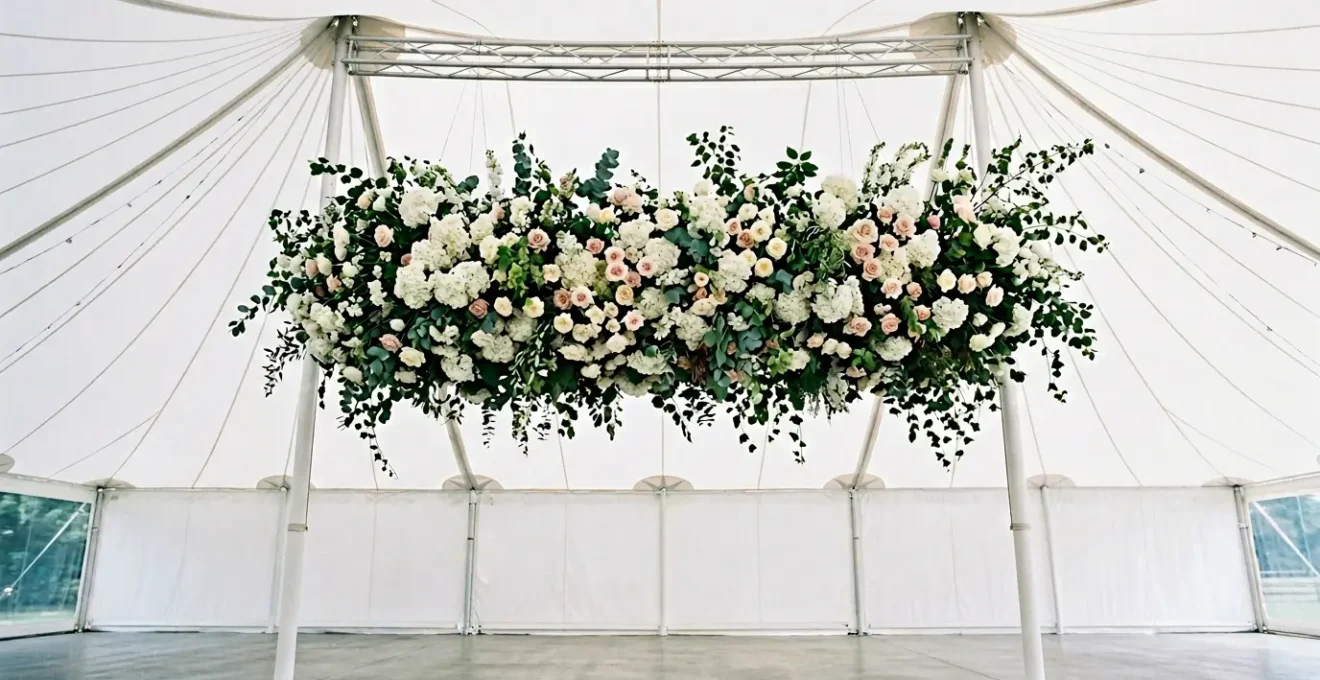
Successfully executing a suspended floral installation is a feat of engineering, not just decoration, where managing load and liability is as crucial as the design itself.
- The total weight of an installation (the ‘live load’) is dictated primarily by the saturated hydration medium, which must be precisely calculated before any design work begins.
- The venue’s certified rigging points and their specified ‘Point Load’ capacity are the absolute limit of your design, not a flexible guideline.
Recommendation: Shift your client conversations from aesthetic possibilities to a structured, safety-first process that justifies a premium price point through professional risk management.
The client wants a breathtaking floral cloud, a floating meadow suspended as the centerpiece of their marquee wedding. It’s the kind of high-impact, £5,000+ installation that defines a luxury event florist. The default approach often involves floral foam, chicken wire, and a vague hope that the marquee can handle it. This conversation usually revolves around flower types and colour palettes. But for a structure weighing hundreds of kilograms hanging over guests, this is a dangerously incomplete approach.
The common advice to “use fishing line” or “make it secure” is inadequate and positions the florist as a decorator, not the technical expert this job demands. The real challenge isn’t artistic; it’s physics and liability. But what if the key to unlocking these high-value projects wasn’t a better design eye, but a better understanding of structural engineering? What if you could speak the language of riggers, venue managers, and insurers with total confidence?
This guide reframes the task. We are not just hanging flowers; we are rigging a temporary, dynamic, suspended load in a non-permanent structure. We will move from floral design to load calculation, from simple attachments to certified rigging points, and from creative hope to engineered safety. This is the framework for executing ambitious designs that are not only beautiful but also professionally sound and insurable.
To master this, we need to dissect the process into its critical engineering and safety components. This article provides a structured approach, addressing everything from the fundamental question of weight to the non-negotiable protocols for installation and removal.
Contents: Engineering a Suspended Floral Installation
- Marquee Poles: How to Clamp Structures Without Damaging the Venue?
- Weight Loading: How Heavy Is a Wet Floral Cloud?
- Water Tubes vs Moss Sausages: Which Hydration Method Is Lighter?
- Pulley Systems: How to Raise the Installation After Designing on the Ground?
- Public Liability: Does Your Insurance Cover Falling Flowers?
- Ceiling Points: How Much Weight Can a Marquee Rigging Point Hold?
- Gravity and Balance: How to Ensure Your Hanging Installation Doesn’t Fall?
- Suspended Clouds: The Professional De-Rig Protocol
Marquee Poles: How to Clamp Structures Without Damaging the Venue?
The first point of contact with the venue structure is a moment of high liability. Marquee poles, especially in high-end sailcloth or clear-span tents, have pristine finishes. A single scratch from a metal clamp can result in a significant damage claim, instantly eroding your project’s profitability and professional reputation. The solution is to never allow metal-on-metal or metal-on-pole contact. A professional rigging approach mandates a protective barrier.
The industry standard is the ‘material sandwich’ technique. This involves layering protective materials between your clamp and the marquee pole. A typical setup would be: clamp, a layer of high-density rubber or thick felt, the marquee pole, another layer of rubber/felt, and the other side of the clamp. This method ensures that the clamping force is distributed evenly and the pole’s surface is cushioned from any abrasive hardware. Documenting this setup with pre-installation photos is a crucial part of your risk management protocol.
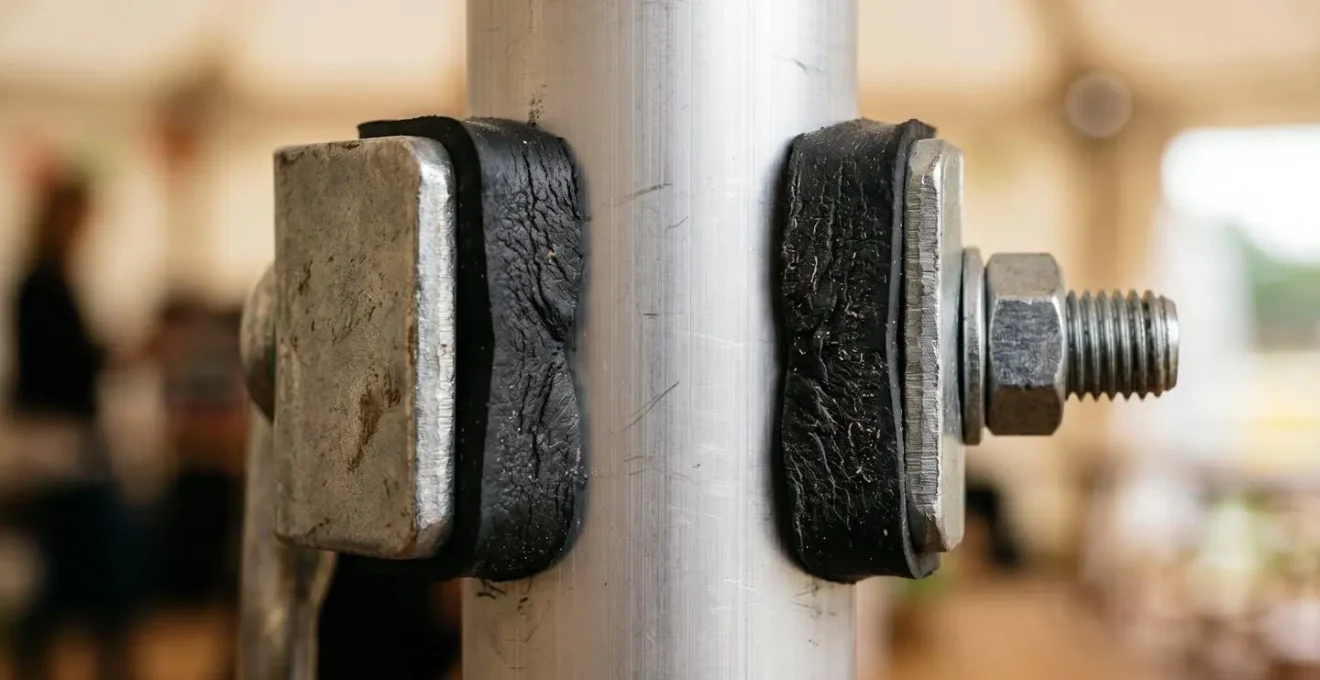
As the illustration demonstrates, the focus is on the interface between the equipment and the venue. Using rated, professional-grade clamps is only half the battle; ensuring they leave no trace is the mark of a true professional who will be invited back. This attention to detail is a key differentiator that justifies a premium service fee.
Weight Loading: How Heavy Is a Wet Floral Cloud?
This is the most critical question in the entire process, and “a rough guess” is not an acceptable answer. The weight of your installation, or its ‘live load’, is the primary piece of data you must provide to the venue manager and your insurer. The biggest variable isn’t the flowers; it’s the water. Dry floral foam and chicken wire are relatively light, but their weight transforms dramatically once saturated.
To calculate this, you must work from known quantities. A single brick of floral foam is a useful unit of measurement. According to industry specifications, a standard brick of wet floral foam absorbs 1.8-2.0 liters of water, giving it a saturated weight of up to 2.0kg. Now, extrapolate. An installation requiring 50 bricks of foam to create its shape will contain at least 100kg (220 lbs) of weight from the saturated foam alone. This is before you add a single stem, the weight of the support structure (e.g., a steel mesh), and the rigging hardware itself.
Therefore, your process must be: design the mechanics first. Determine the number of foam bricks or the volume of your hydration medium, calculate the total saturated weight, add a 25% contingency for the florals and hardware, and you have your ‘minimum live load’. This figure is non-negotiable. It dictates the type of rigging points you need, the pulley system required to lift it, and the insurance coverage you must have in place. Presenting this calculation to a client or venue manager demonstrates a level of professionalism that sets you apart.
Water Tubes vs Moss Sausages: Which Hydration Method Is Lighter?
Once you understand that water is the primary source of weight, the choice of hydration method becomes a critical engineering decision, not just a horticultural one. While floral foam is a common default, its high water-to-volume ratio makes it one of the heaviest options. For suspended works, exploring lighter alternatives is a hallmark of an advanced florist.
The sustainable floristry movement provides excellent, lighter alternatives that are often superior for suspended designs. A compelling case study comes from research into foam-free mechanics for large installations. For example, structures made from Agra-Wool or coconut coir offer comparable hydration with significant weight savings. An analysis on large-scale marquee installations showed that coconut coir can weigh approximately 30% less than saturated floral foam while providing moisture for 18-24 hours, enough for most events. This could reduce a 100kg foam-based load to a more manageable 70kg, opening up more possibilities in venues with stricter weight limits.
Furthermore, the failure mode of these materials is safer. Saturated foam, when compromised, can fragment and drop heavy, wet chunks. Coconut coir, by contrast, tends to drip slowly and more predictably, giving more warning and posing less risk. When pitching a high-value installation, proposing a lighter, safer, and more sustainable hydration method demonstrates a sophisticated approach to problem-solving that goes far beyond simple aesthetics.
Pulley Systems: How to Raise the Installation After Designing on the Ground?
Designing a 200kg floral cloud on the ground is complex. Lifting it 15 feet into the air is a high-risk maneuver that requires a mechanical solution. Attempting a “dead lift” with several people is uncontrolled, unsafe, and unprofessional. The correct method is to use a pulley system to gain a mechanical advantage.
A pulley system doesn’t reduce the actual weight of the installation, but it dramatically reduces the force required to lift it. This is the principle of mechanical advantage. A simple 2:1 system halves the required pulling force, while a 4:1 system reduces it to just a quarter. As rigging equipment specifications show, a 4:1 mechanical advantage pulley system means a 60kg installation requires only 15kg of pulling force. This is the difference between three people struggling and one person performing a smooth, controlled lift.
Using a pulley system offers three key advantages. First, safety: a controlled lift prevents sudden movements or drops that could damage the installation or, worse, injure someone. Second, precision: it allows for small, incremental adjustments to get the height and position exactly right. Third, professionalism: it is the universally accepted method for lifting heavy loads in event production. Arriving on-site with your own rated pulley system, block and tackle, and ropes shows the venue that you are a serious professional who understands and respects the forces at play.
Public Liability: Does Your Insurance Cover Falling Flowers?
This is the question that should keep any florist doing suspended work up at night. Standard public liability insurance may not automatically cover the specific risks associated with large, overhead installations. A falling flower cloud is not a simple slip-and-fall; it’s a potential catastrophic failure with immense liability implications. Assuming you’re covered is a gamble you cannot afford to take.
Your first step must be a transparent conversation with your insurer. You need to declare that you are undertaking suspended installation work. As insurance expert Maria Shepherd of Hortica notes, venues have increasingly stringent requirements:
A critical issue with weddings and other special events is carrying high enough commercial general liability limits to comply with venue requirements. In addition to general liability, we routinely see evidence of coverage requests from large venues for auto, umbrella, and workers’ compensation.
– Maria Shepherd, Account Executive, Hortica Insurance – Florist Wedding Insurance Coverage Guide
A case study from a New Jersey florist illustrates the correct, proactive approach. When faced with a high-risk installation in a Sperry tent, she didn’t just hope for the best. She contacted her insurer and paid for an additional, event-specific rider to increase her coverage. This proactive step, which cost significantly less than the potential liability, is the model for all luxury florists. It turns insurance from a passive expense into an active risk management tool. This cost should be factored into your pricing for any suspended work; it is a non-negotiable component of a professional and safe operation.
Ceiling Points: How Much Weight Can a Marquee Rigging Point Hold?
Your perfectly calculated 150kg installation is a dangerous liability if the point you hang it from is only rated for 50kg. The single most important conversation you will have with a marquee provider is about their structure’s load-bearing capacity. You must learn to speak their language to get a clear, unambiguous answer and ensure the venue’s structural integrity is not compromised.
Never accept a vague “it should be fine.” You need specific data. A professional florist, acting as a project manager, must perform a rigging point audit. The goal is to obtain certified information, not casual assurances. This means asking the right technical questions and requesting documentation. A pre-installation audit is a non-negotiable part of your process.
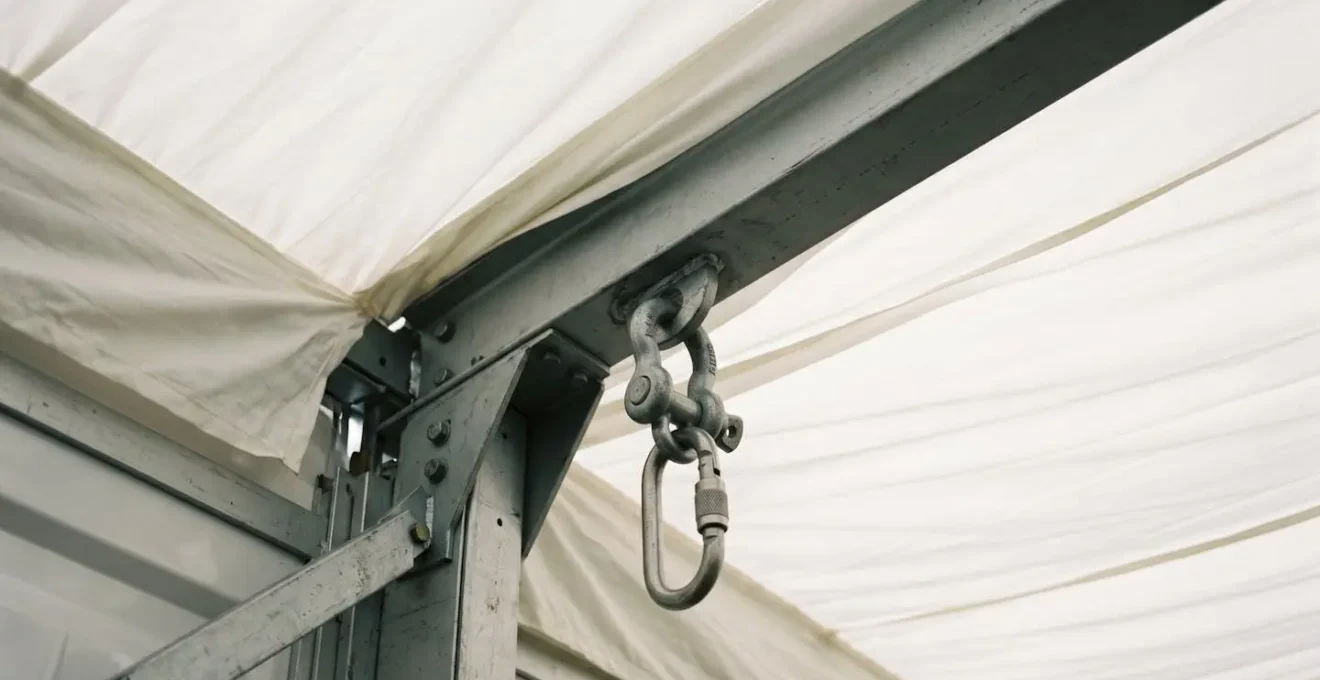
The image above shows what you want to see: a dedicated, engineered rigging point. Your job is to verify its capacity. The following checklist provides the terminology and questions to use when communicating with the marquee company or venue manager.
Venue Rigging Point Audit Checklist
- Ask for the ‘Uniformly Distributed Load‘ (UDL) capacity: the maximum weight that can be spread evenly across the entire marquee ceiling structure.
- Request the ‘Point Load‘ capacity: the maximum weight that can be suspended from a single rigging point or pole junction. This is your most important number.
- Obtain the ‘rigging plot‘: a technical drawing showing all certified rigging points, their individual load ratings, and structural beam locations.
- Inquire whether points are ‘load-bearing’ (engineered for suspension) versus ‘pole joints‘ (structural connections not rated for hanging).
- Request documentation showing the structure’s most recent structural certification and load testing results.
Gravity and Balance: How to Ensure Your Hanging Installation Doesn’t Fall?
Once you’ve confirmed weight and rigging capacity, the final physical challenge is balance. Gravity is unforgiving. An unbalanced load will tilt, swing, or place unexpected stress on rigging points, leading to potential failure. Ensuring stability is about controlling the installation’s center of gravity.
As rigging safety best practices establish, the center of gravity is the balance point where the load’s weight is evenly distributed. When you design your floral cloud on the ground, you must be mindful of this. A lopsided design, with all the heavy, dense flowers on one side and light, airy foliage on the other, will be inherently unstable. The goal is to distribute the mass symmetrically around the central support frame. The lifting points should be positioned directly above this center of gravity to ensure a straight, stable lift.
However, the hallmark of professional rigging is not just relying on perfect primary systems; it’s planning for their failure. This is the principle of redundancy. Every critical overhead installation in the entertainment industry uses a secondary safety system. For a floral cloud, this means installing discrete steel safety cables alongside your main decorative rigging. These are installed with a slight amount of slack, so they carry no load during normal operation. However, if a primary attachment point were to fail, the safety cable would immediately engage, preventing a catastrophic drop. This dual-system approach is the ultimate guarantee of safety and a mandatory practice for any work suspended over guests.
Key Takeaways
- Engineer Before You Decorate: The weight of water in your hydration medium is the single largest factor. Calculate your ‘wet weight’ first, as this determines all subsequent safety and rigging requirements.
- The Venue is the Boss: The marquee’s certified ‘Point Load’ capacity is an absolute physical limit. Your design must conform to the structure’s limitations, not the other way around.
- Liability is a Cost of Business: Proactively declare suspended work to your insurer and factor the cost of specific event riders into your pricing. It’s a non-negotiable part of professional risk management.
Suspended Clouds: The Professional De-Rig Protocol
The job is not over when the wedding ends. The de-rigging process for a heavy suspended installation is just as, if not more, dangerous than the installation. Fatigue, time pressure, and a less-crowded venue can lead to complacency. A professional rigging specialist knows that a structured and documented de-rig protocol is a non-negotiable final chapter for any suspended project.
This is not simply “taking it down.” It’s a controlled reversal of the installation process. It involves careful assessment, staged lowering, and methodical disassembly. A key part of this protocol is waste management—sorting organic matter from recyclable and non-recyclable components on-site, as per venue requirements. The final, crucial step is a post-event inspection of all rigging points, documented with photos to prove you left the venue in its original condition. This closes the liability loop and solidifies your reputation as a meticulous professional.
Post-Event De-Rig & Teardown Checklist
- Pre-De-Rig Assessment (30 mins): Survey the installation to identify any shifts or changes that occurred during the event.
- Controlled Lowering (45 mins): Use the same pulley system in reverse, lowering in stages with clear team communication.
- Ground Disassembly (60 mins): Once fully lowered, dismantle by removing florals first, then hydration media, and finally the frame.
- Waste Management (30 mins): Separate waste into organic, recyclable, and non-recyclable piles as required by the venue.
- Final Venue Inspection (15 mins): Document the post-event condition of all rigging points with timestamped photographs.
By adopting this engineering mindset—from initial weight calculation to the final de-rig checklist—you transform your service. You are no longer just a florist selling flowers, but a technical specialist executing a complex and high-value project. This is the foundation for confidently taking on, and successfully delivering, the most spectacular gravity-defying floral installations.