Blog
The professional floristry landscape has evolved dramatically in recent years. What was once viewed primarily as a creative craft has become a sophisticated business requiring expertise in design theory, sustainable sourcing, financial planning, and client psychology. Modern florists navigate complex questions daily: How do you price a single stem at £15? Why do clients pay more for designs with “empty space”? How can you source ethically without compromising profitability?
This comprehensive resource addresses the fundamental challenges and opportunities facing contemporary florists. Whether you’re establishing pricing structures that reflect true value, mastering design techniques that command premium prices, or building supply chains aligned with ethical principles, understanding these interconnected aspects is essential for building a thriving, sustainable floristry business.
Pricing Strategies and Value Communication
One of the most persistent challenges in professional floristry is articulating value to clients who may equate flower arrangements purely with stem count. The shift from volume-based to value-based pricing requires both strategic thinking and confident communication.
Labour Costing for Custom Work
When creating a bespoke living sculpture or intricate installation, labour costs often exceed material costs by a factor of three or more. Yet many florists struggle to charge appropriately for their time and expertise. The key is breaking down your creative process into measurable components: consultation time, design development, construction hours, installation, and post-event de-rigging.
A two-hour wedding setup might seem straightforward, but when you factor in the advance preparation, transportation, and the midnight de-rig requiring a full team, the true labour investment becomes clear. Charging for this invisible work separates sustainable businesses from those perpetually undervaluing their expertise.
The Single Stem Philosophy
Selling a single protea for £15 challenges conventional retail thinking, but it reflects a fundamental truth: impact doesn’t require quantity. This pricing approach values selection expertise, conditioning, presentation, and the educational guidance you provide to ensure the bloom reaches its full potential in the client’s home.
It’s not about selling one flower—it’s about curating an experience and sharing knowledge. The care card accompanying that single stem, the story of its origin, and your advice on placement and maintenance all contribute to the value proposition that justifies premium pricing.
Pricing Sustainable and Ethical Materials
Clients increasingly ask whether sustainable choices always cost more. The answer is nuanced. While certified ethical blooms or foam alternatives may carry higher unit costs, they often perform better and align with values that command premium positioning.
The conversation shouldn’t be “why does this cost more?” but rather “what additional value does this provide?” Fair-trade certification, reduced environmental impact, and support for local growers are tangible benefits that resonate with value-conscious clients willing to pay for alignment with their principles.
Modern Floral Design Principles
Contemporary floral design has embraced principles borrowed from architecture, sculpture, and Eastern aesthetics. Understanding these foundational concepts allows florists to create work that feels both current and timeless.
The Power of Negative Space (Ma)
The Japanese concept of ma—the intentional void or negative space—has revolutionized Western floristry. Clients accustomed to dense, packed arrangements may initially question paying for “empty air,” but negative space actually increases perceived value.
It allows each element to be appreciated individually, creates visual breathing room, and demonstrates restraint and sophistication. An airy cloud design spanning one meter might use fewer stems than a compact dome, yet commands higher prices because of the spatial mastery required. Photographing these designs requires particular attention to silhouette and shadow, capturing the intentional voids that make the composition breathe.
Linear Design and Premium Positioning
Linear design techniques emphasize line, form, and individual stem architecture rather than massed color. This approach naturally positions arrangements as premium products because fewer, higher-quality stems become the focus.
A single branch with exceptional movement or a sculptural stem with dramatic form can anchor an entire composition, making the arrangement about artistic vision rather than floral abundance. This philosophy challenges clients to see beyond stem count and appreciate botanical form.
Ombré and Gradient Techniques
Color storytelling through gradients and ombré effects has become a sought-after technique that clients willingly pay premium prices for. The skill lies not just in arranging flowers from light to dark, but in sourcing stems with subtle tonal variations and understanding how to capture these gradients photographically.
Lighting plays a crucial role—knowing how to illuminate subtle color shifts ensures your portfolio accurately represents the sophistication of your work. The ombré upsell works because clients recognize they’re purchasing a carefully orchestrated color narrative, not simply mixed flowers.
Sustainable and Ethical Floristry Practices
The floristry industry faces increasing scrutiny regarding its environmental and social impact. Forward-thinking professionals are responding by transforming their sourcing, materials, and business practices.
Moving Beyond Floral Foam
Perhaps no conversation in floristry is more sensitive than explaining to grieving families why you don’t use foam for funeral tributes. Floral foam, while convenient, is essentially non-biodegradable plastic that persists in landfills indefinitely.
The challenge is presenting alternatives—chicken wire, pin frogs, moss-based mechanics—not as compromises, but as superior solutions that honor both the deceased and environmental responsibility. This conversation requires empathy, education, and confidence in your methods. Many florists find that framing foam-free design as a tribute to the natural world resonates deeply with families seeking meaningful ceremonies.
Local and Seasonal Sourcing
Events like British Flowers Week have elevated awareness of locally-grown blooms, but the movement extends beyond patriotic purchasing. The farmer-florist trend and direct-from-grower buying represent a fundamental restructuring of the supply chain.
Buying direct often means better freshness, lower carbon footprint, and the ability to tell compelling origin stories. What some might dismiss as “roadside weeds” become premium local flora when contextualized with storytelling about native species, seasonal availability, and grower relationships. This narrative transforms perception and justifies premium pricing.
Transparency in Your Supply Chain
Value-conscious clients increasingly ask pointed questions about sourcing. Who pays the price for supermarket bouquets sold at £5? Understanding the true cost of cheap flowers—often involving exploitative labor practices and environmental degradation—allows you to articulate why ethical blooms deserve fair pricing.
Asking your wholesaler targeted transparency questions about their sources demonstrates due diligence and allows you to make informed purchasing decisions aligned with your values. This knowledge becomes part of your brand story and competitive advantage.
Technical Mastery and Essential Calculations
Behind every stunning arrangement lies precise mathematical and technical knowledge that separates hobbyists from professionals.
Stem count calculations form the foundation of accurate quoting and resource planning. How many carnations do you need for a twelve-inch dome? How does density affect the answer? Understanding the relationship between form, size, and stem quantity prevents costly underestimation and ensures consistent results. Similarly, texture plays a role—an airy, natural-looking cloud arrangement requires different calculations than a structured, compact design.
Care instructions represent another critical technical element. Every client should receive clear guidance on three essential points: water management, placement conditions, and longevity expectations. These care cards aren’t just customer service—they’re risk management, ensuring clients understand how to maximize their investment and reducing complaints about premature wilting.
Material selection decisions often come down to cost-benefit analysis. Is it cheaper to buy a potted plant and harvest the stems yourself, or purchase cut stems? The answer depends on yield, processing time, and your labor costs. Similarly, the price difference between garden roses and standard roses must be weighed against visual impact, longevity, and client expectations.
Commercial and Event Floristry Operations
Scaling from individual arrangements to large-scale events and corporate contracts introduces operational complexities that require systematic approaches.
Wedding floristry often demands rapid execution under pressure. Setting up a complete wedding in two hours requires meticulous advance preparation, efficient team coordination, and practiced systems. Equally important is the de-rig—the midnight or early-morning breakdown that many couples never see but which requires compensated team members and proper planning.
Corporate and hotel contracts operate on different rhythms. Weekly rotation schedules for hotel lobbies require logistical planning around access times, changing seasons, and budget constraints. Monthly invoicing with clear payment terms becomes essential for maintaining cash flow. Understanding how to structure these agreements—including provisions for public liability insurance covering scenarios like falling flowers causing injury—protects your business while delivering reliable service.
Supply Chain Innovation and Direct Relationships
The traditional floristry supply chain—grower to auction to wholesaler to florist—is being disrupted by models that shorten the distance between cultivation and customer.
The farmer-florist movement represents the ultimate integration, with growers designing arrangements from their own crops. Even for florists without growing space, building direct relationships with local farms offers multiple advantages: fresher product, reduced transport emissions, unique varieties unavailable through wholesale channels, and authentic stories to share with clients.
The CSA (Community Supported Agriculture) model, traditionally associated with vegetable farms, is being adapted for floristry. Subscribing to a farm’s harvest—committing to purchase their production—provides farmers with financial security while giving florists access to seasonal, ultra-fresh materials. This model requires flexibility and creativity, as you’re working with available harvest rather than ordering specific stems, but it builds resilience and differentiation into your business.
Legal Considerations and Professional Safety
Professional floristry involves physical risks and legal obligations that must be properly managed to protect both your team and your business.
Public liability insurance is essential, but many florists don’t realize their policies may not cover all scenarios. Does your insurance adequately cover installations where falling flowers or unstable structures could cause injury? Review your coverage specifically for installation work, suspended designs, and event scenarios. This isn’t paranoia—it’s professional responsibility.
Working at height regulations apply to florists creating installations, ceremony arches, or large-scale decorations. Understanding the legal requirements for scaffolding, ladder use, and safety equipment isn’t just about compliance—it’s about protecting yourself and your team from serious injury. These regulations vary by jurisdiction, so familiarize yourself with local requirements and invest in proper equipment and training.
The professional floristry landscape offers remarkable opportunities for those who approach it with both creative vision and business acumen. By mastering pricing strategies that reflect true value, embracing design principles that command premium positioning, committing to sustainable practices, and building robust operational systems, you can create a floristry business that is both profitable and purposeful. Each of these elements interconnects—your sourcing decisions influence your pricing, your design philosophy shapes your marketing, and your technical skills enable ambitious creative work. The florists thriving in the current market are those who see these not as separate challenges, but as integrated components of a holistic professional practice.
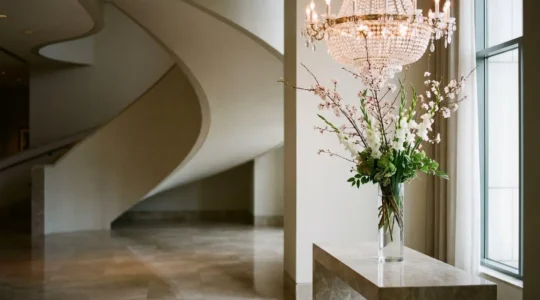
Tall Foyer Arrangements: How to Engineer a Grand Entrance Statement
A grand foyer arrangement is an operational asset, not just a decoration; its true value lies in flawless execution and planned logistics. Stability is engineered with internal mechanics and weight, not just a heavy vase. Modular design with a hardy…
Read more