Techniques & Materials
Every breathtaking floral installation, every perfectly balanced bridal bouquet, and every sculptural arrangement that seems to defy gravity rests on a foundation invisible to the guest: the techniques and materials that hold it all together. While the flowers capture attention, it’s the mechanics beneath—the wire, the tape, the framework, the cutting technique—that determine whether your design survives the ceremony or collapses before the first toast.
Understanding floral techniques and materials transforms you from someone who arranges flowers into someone who architects with them. This knowledge encompasses everything from choosing the right knife blade for woody stems to calculating the weight load of a suspended floral cloud, from transitioning to eco-friendly foam alternatives to wiring a delicate orchid head invisibly. Whether you’re creating a hand-tied bouquet or a six-foot installation piece, mastering these fundamentals ensures your designs are not only beautiful but structurally sound and sustainably made.
This comprehensive resource introduces the essential tools, mechanical systems, structural approaches, and manipulation techniques that form the backbone of professional floristry. Each section connects the dots between theory and practice, helping you understand not just how techniques work, but why they matter for your specific design challenges.
Sharp Tools, Clean Cuts: Mastering Your Floral Knife
The quality of your cuts directly impacts how long your flowers live. A crushed stem can’t draw water efficiently, leading to premature wilting regardless of how perfect your arrangement looks. Your knife is the most critical tool in your kit, yet it’s also the most misunderstood.
The debate between curved and straight blades isn’t about personal preference—it’s about matching the tool to the task. Curved blades excel at woody stems like dogwood and rose branches because the arc creates a slicing motion that parts fibres cleanly rather than crushing them. Straight blades offer more control for delicate work and precision cuts on soft stems. Many professionals carry both, switching between them as the material demands.
Keeping that blade sharp requires understanding the difference between a whetstone and a steel. A steel hones an already-sharp edge by realigning the microscopic teeth along the blade, something you might do several times during a large installation. A whetstone actually grinds away metal to create a new edge when the blade has become truly dull. Think of the steel as daily maintenance and the whetstone as a monthly deep service.
Even the sharpest knife is dangerous without proper technique. The thumb guard method—where your non-cutting hand forms a claw with knuckles forward and thumb tucked back—prevents the most common floristry injury: the sliced thumb from a stem slipping during a cut. This simple postural habit can save you from a trip to A&E in the middle of a wedding setup.
Mechanical Foundations: Tape, Wire, and Grid Systems
Before a single stem enters a vase, the mechanical foundation must be built. These invisible structures—pot tape grids, wire armatures, and anchoring systems—are what separate arrangements that hold their shape from those that collapse into chaos.
Pot Tape Grids and Surface Preparation
The humble pot tape grid is deceptively simple yet requires precision. The dry vase rule isn’t optional: any moisture on the rim prevents the adhesive from bonding, and your carefully constructed grid will pop off the moment you insert the first heavy stem. Professional florists wipe rims with methylated spirits and wait for complete evaporation before taping.
Tape width matters more than you’d think. For wide bowl vases exceeding 30cm in diameter, 12mm tape provides the structural integrity to support multiple heavy stems without sagging. Narrower 6mm tape works perfectly for standard vases but can stretch and fail under load in larger vessels. The grid itself should create squares no larger than 5cm—small enough to guide stems but large enough to allow insertion without forcing.
Concealing your mechanics is the mark of professional work. Guest should never see tape when they approach a table arrangement. Strategic foliage placement at the rim, stems angled to cover the grid intersections, and choosing clear tape over white for glass vessels all contribute to that seamless, effortless appearance that actually required meticulous planning.
Floral Wire: When and How to Use It
Wire serves two essential functions: support and construction. Knowing when to pierce the calyx (internal wiring) versus wrapping the stem (external wiring) depends on the flower’s structure and your design needs. Heavy garden roses with large heads benefit from internal wiring—a wire pushed up through the stem base into the flower head—providing invisible support. Delicate flowers risk damage from piercing and require gentle external wiring instead.
The choice between painted, anodized, and annealed wire affects longevity. In water-based arrangements, annealed (untreated) wire will rust, staining stems and potentially contaminating water. Painted or plastic-coated wire resists corrosion, making it essential for designs that must remain pristine for multiple days. For bridal work, the hook-and-return technique—where wire ends are carefully tucked back into the design—prevents sharp points from scratching skin or snagging on fabric.
For hollow-stemmed flowers like dahlias, internal straw supports provide rigidity without external mechanics. A thin wire or even a drinking straw inserted into the stem cavity prevents the dramatic head-droop that occurs when these top-heavy blooms absorb water and become even heavier.
Sustainable Mechanics: Moving Beyond Floral Foam
The floristry industry is experiencing a significant shift away from traditional floral foam toward sustainable alternatives. This transition requires learning new techniques, as eco-friendly materials behave differently than the foam many florists learned on.
Agra-wool and basalt wool have emerged as the leading foam alternatives, but they’re not direct substitutes. The cardinal rule is “float, don’t push”—these wool-based products must be allowed to sink naturally into water rather than being forced under. Pushing traps air pockets that leave sections dry, causing premature wilting in stems placed in those areas. Patience during the soaking process ensures complete saturation.
Basalt wool’s softer density compared to traditional foam presents both challenges and opportunities. Heavy stems can compress the material, losing their grip and shifting position. The solution lies in pre-making pilot holes with a dibber or thin dowel, creating a channel that compresses the surrounding material and actually strengthens the grip. This counterintuitive technique works because the compressed ring around the hole holds stems more firmly than the loose material would.
Safety considerations matter with these materials. Cutting dry agra-wool creates fine dust particles that shouldn’t be inhaled repeatedly. Professional studios treating these materials regularly should consider dust masks, particularly in enclosed spaces with limited ventilation. Once wet, the dust issue disappears, so pre-soaking before cutting is an alternative approach.
Chicken wire mechanics represent the most sustainable option: infinitely reusable, completely non-toxic, and surprisingly versatile. The pillow technique—scrunching wire into a ball that fills the vessel—creates a three-dimensional grid that holds stems at any angle. Mesh size affects performance: 25mm holes work for standard stems, while 50mm is better for large branches and woody material that needs less restraint. A tape cross over the vessel opening anchors the wire pillow and prevents it from popping out under the outward pressure of angled stems.
Structural Frameworks: Building Stability from Branches to Metal
When arrangements move beyond vase-based designs into sculptural territory, frameworks become essential. These structures range from natural materials like branches to purpose-built metal armatures.
British florists often debate willow versus dogwood for creating frameworks. Willow offers superior flexibility when fresh, allowing curved structures and woven forms, but it becomes brittle as it dries. Dogwood provides more rigidity from the start, making it ideal for structural work that must maintain exact angles, though it’s less forgiving for organic, flowing shapes. The choice depends on whether you need pliability or strength as your primary characteristic.
Pin frogs—those heavy metal discs covered in brass spikes—are experiencing a renaissance as florists seek foam alternatives. They excel at anchoring heavy branches and woody stems, but technique matters: stems must be cut at a sharp angle and pushed firmly onto multiple pins for stability. The weight of the pin frog itself helps stabilize tall arrangements, acting as a low centre of gravity that counterbalances top-heavy designs.
For large-scale work like floral arches, the wood-versus-metal frame debate centres on stability and portability. Metal frames weigh less and pack smaller, crucial for florists transporting structures to venues, but wooden frames offer superior stability outdoors where wind is a factor. The additional weight of timber creates resistance to tipping that lightweight aluminium frames can’t match without additional ballast.
Base stability calculations prevent disasters. A six-foot tall vase arrangement has a high centre of gravity that creates significant tipping force. The simple rule: the base width should be at least one-third of the total height for stable, free-standing designs. For narrower vessels, internal ballast—sand, stones, or purpose-made weights—lowers the centre of gravity and increases the tipping threshold.
Installation Mechanics: Hanging, Anchoring, and Safety
Suspended floral installations create drama, but they also create risk. The mechanics of hanging arrangements demand attention to weight, attachment points, and safety margins that ground-based designs never require.
The first question is always: how much does it weigh? A chicken wire cloud measuring just 60cm in diameter can weigh 15-20 kilograms when fully planted and saturated with water. Florists consistently underestimate the weight of water in their calculations. Moss holds approximately 8-10 times its dry weight in water, while soaked agra-wool can be even heavier. Every stem adds mass, and that mass multiplies across dozens of insertion points.
Ceiling attachment points in marquees and event spaces typically have rated load capacities, but these aren’t always clearly marked. Professional riggers recommend a safety factor of 5:1—if your installation weighs 20kg, the attachment point should be rated for at least 100kg. This margin accounts for dynamic loads (swaying, wind), degradation of materials over time, and the catastrophic consequences of failure in a space filled with people.
The choice between water tubes and moss sausages for hydration in hanging work often comes down to weight savings. Individual water tubes are heavier but offer consistent hydration to each stem. Moss sausages—cylinders of soaked sphagnum wrapped in chicken wire—are lighter overall but require regular misting to maintain hydration. For installations that must last beyond 48 hours, the reliability of individual tubes usually outweighs the weight penalty.
Pulley systems solve the logistical challenge of designing suspended pieces. Building the installation at table height allows detailed work with proper visibility, then raising it into position once complete. Simple block-and-tackle arrangements provide mechanical advantage, allowing one person to safely lift installations that would require three people to muscle overhead. Secure the lowered position with locking carabiners during design work—unexpected releases cause injuries and destroyed arrangements.
Flower Manipulation: Wiring, Conditioning, and Creative Techniques
Beyond the structural mechanics, floristry involves manipulating the flowers themselves to achieve forms and effects that don’t occur in nature.
Wiring individual flower heads—whether for bridal crowns, garlands, or statement bouquets—requires delicacy and practice. The technique varies by flower structure: daisy-form flowers are wired through the stem base just below the calyx, while multi-petaled forms like carnations can be threaded onto wire that passes through the dense centre. The goal is always invisible support that doesn’t distract from the bloom’s natural beauty.
Stem manipulation opens creative possibilities. Massaging tulip stems between your fingers gently breaks down cell walls, allowing the naturally straight stem to bend into curves without snapping. This works because tulips continue growing after cutting, and the compressed side of a bend grows more slowly than the outer side, maintaining the curve. Reflexing tulips—carefully turning each petal backward and outward—transforms the familiar tulip form into something resembling a water lily, a dramatic technique for editorial work or modern bridal bouquets.
Colour manipulation through dye techniques ranges from subtle to spectacular. Drinking dye—placing white flowers in water containing food colouring—allows stems to draw pigment into petals through their natural water uptake system. Carnations show results within hours, while roses require 12-24 hours for saturated colour. Dip-dyeing creates controlled ombré effects by briefly submerging petal tips into diluted dye, offering precision that drinking methods can’t achieve.
Leaf manipulation techniques—plaiting, folding, weaving—transform foliage from filler into feature. Aspidistra leaves are particularly amenable to manipulation: their length and pliability allow complex woven structures, folded geometric forms, and plaited borders that add architectural detail to arrangements. These techniques cost nothing except time but deliver high-impact visual interest.
Hydration in unconventional designs requires creative solutions. Orchid vials—tiny plastic tubes that cap over individual cut orchid heads—carry hidden water sources into garlands and wired work. For sculptural pieces where traditional mechanics aren’t possible, test tubes nestled into moss provide discreet water reservoirs that can keep focal flowers alive for 48 hours or more, long enough for most events.
Mastering techniques and materials in floristry is an ongoing journey rather than a destination. Each tool you sharpen, each mechanical system you build, and each flower you manipulate adds to your vocabulary of skills. The florists who create the arrangements that make people stop and stare aren’t necessarily more creative—they’ve simply developed the technical foundation that allows their creativity to manifest in structurally sound, long-lasting, professionally finished designs. Start with the fundamentals covered here, then dive deeper into the specific techniques that align with your design style and the work you aspire to create.
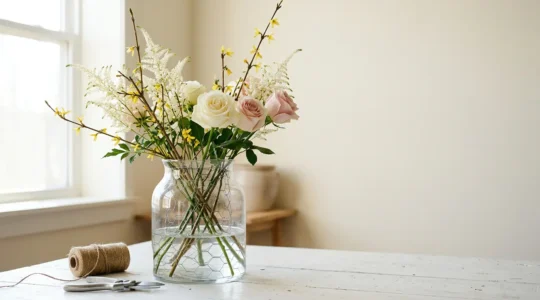
Chicken Wire Mechanics: The Reusable Skeleton of Eco-Floristry
Chicken wire is more than a foam alternative; it’s the permanent, reusable skeleton for a truly sustainable floral business. Mastering the ‘pillow’ technique provides the structural core for any vessel. A clear cleaning and storage workflow makes the system infinitely…
Read more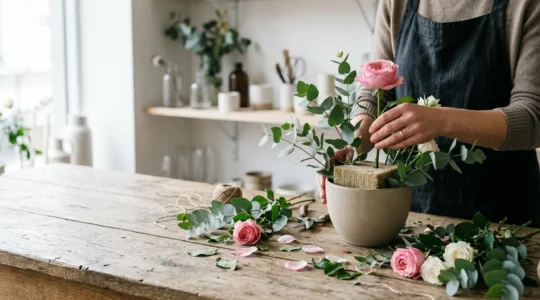
Agra-Wool vs. Floral Foam: Your Practical Guide to Mastering Sustainable Mechanics
Switching to sustainable mechanics isn’t a sacrifice; it’s a technical upgrade that secures your arrangements and your brand’s future. Agra-Wool requires a gentle “float-to-soak” method, not the forceful push used with foam, to properly hydrate its basalt fibres. Heavy stems…
Read more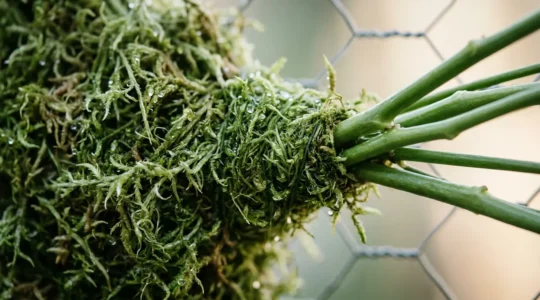
Mechanics for Longevity: Building Structures That Sustain Hydration
Your memorial wreaths wilt prematurely outdoors because you’re fighting a one-sided battle focused only on hydration. True longevity requires both a massive internal water reservoir (moss/wool) and a protective external moisture shield (compact design, anti-transpirants). The choice of foliage and…
Read more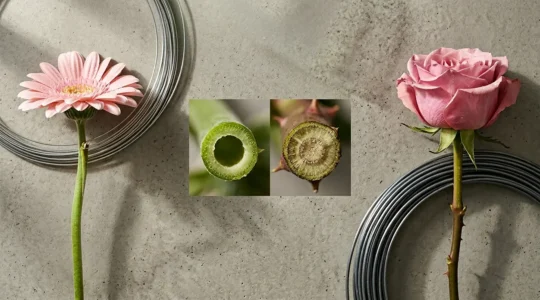
Understanding Wire Gauge: Which Thickness Do You Need for a Gerbera vs a Rose?
Mastering floral wire isn’t about memorizing gauges; it’s about understanding structural engineering principles. Wire gauge is inverse: a low number (18g) is thick and strong for structure, while a high number (32g) is fine and flexible for delicate work. The…
Read more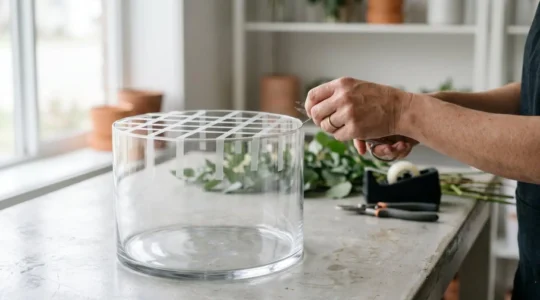
How to Use Green Tape (Pot Tape) Effectively in Mechanics?
The secret to flawless floral mechanics isn’t just practice; it’s understanding the physics of adhesion and tension to eliminate failures before they happen. A bone-dry, degreased surface is non-negotiable for achieving the molecular bond required for pot tape adhesion. The…
Read more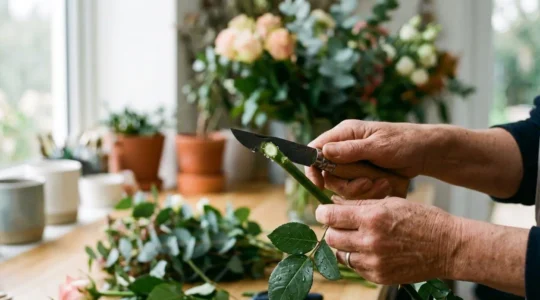
Why Is a Florist Knife Superior to Scissors for Stem Health?
Switching from scissors to a florist knife is the single most effective change you can make to extend flower vase life. Scissors inflict crushing cellular trauma on a stem’s vital water-conducting tissues (xylem), severely limiting hydration. A sharp knife creates…
Read more