Types of Floral Design
Floral design is a visual language spoken across cultures, each with its own grammar and syntax. From the structured precision of Western geometric arrangements to the philosophical minimalism of Japanese Ikebana, the world of floral design encompasses a rich spectrum of approaches. Understanding these different types isn’t just about aesthetics—it’s about choosing the right design philosophy for the right occasion, space, and emotional impact.
Whether you’re arranging flowers for a cathedral wedding, a contemporary gallery opening, or a dining table centerpiece, the design type you choose fundamentally shapes how viewers experience your work. Some styles rely on symmetry and repetition to create a sense of order and tradition, while others embrace asymmetry and negative space to evoke movement and modernity. This comprehensive overview will walk you through the major categories of floral design, from time-honored traditions to cutting-edge avant-garde techniques, giving you the foundational knowledge to recognize, appreciate, and apply each approach with confidence.
Western Geometric Floral Design
Western floral design has its roots in European traditions, particularly those developed for religious ceremonies, royal courts, and formal events. This approach treats the arrangement as an exercise in geometric composition, where balance, proportion, and structural integrity take center stage.
Symmetrical Designs and the Triangle Foundation
The symmetrical triangle is the workhorse of commercial floristry and church arrangements. Its appeal lies in predictability and visual stability—both sides mirror each other perfectly, creating a formal, dignified presence. The 3-5-8 ratio is a practical rule many florists follow: if the container is 3 units tall, the arrangement should extend 5 units wide at the base and 8 units in total height. This mathematical approach ensures proportions feel natural rather than squat or spindly.
Traditional techniques emphasize building a skeleton with foliage first, establishing the triangular outline before inserting focal flowers. Placement follows hierarchy: buds at the apex for height, half-open blooms in the middle zone, and full, heavy blooms at the base where they create visual weight and anchor the design.
Focal Point Placement and Visual Hierarchy
Western design typically positions the focal point slightly lower than center, often about two-thirds down from the top. This placement feels instinctively correct to the Western eye, trained by centuries of portraiture and classical composition. Think of it as the visual equivalent of the golden ratio—not mathematically center, but aesthetically centered.
Mass designs amplify this concept by using flowers as blocks of solid color, creating areas of concentrated visual weight. Rather than featuring individual blooms, the flowers merge into a unified field, much like pixels forming an image when viewed from the proper distance.
One-Sided and Practical Considerations
Not every arrangement needs to be viewed from all angles. One-sided designs, common in altar arrangements or buffet displays, concentrate all the visual interest on the front face. This practical approach saves both flowers and time—why perfect the back if the congregation or guests will never see it? The rear becomes a working surface of stems and mechanics, while the front presents a polished, camera-ready facade.
Japanese and Asian Design Philosophy
If Western design is about abundance and geometric order, Japanese floral design—particularly Ikebana—is about restraint and philosophical meaning. The contrast couldn’t be sharper: where Western arrangements might use fifty roses, an Ikebana piece might use a single branch and make a more powerful statement.
Ikebana Principles: Heaven, Earth, and Humanity
The foundation of Ikebana rests on three primary lines called Shin, Soe, and Hikae, representing heaven, earth, and humanity respectively. These aren’t merely decorative elements—they’re a symbolic mapping of the cosmos into a vessel. The tallest line (Shin) reaches upward, the secondary line (Soe) creates dialogue, and the shortest line (Hikae) grounds the composition in earthly reality.
This triangular structure might seem superficially similar to Western triangles, but the intention differs completely. The Ikebana triangle is asymmetrical by design, because perfect symmetry is considered stagnant—lacking the dynamic tension that mirrors natural growth and the flow of energy.
Negative Space as Active Element
Perhaps the most challenging concept for Western-trained designers to embrace is the idea that empty space isn’t wasted space—it’s an active participant in the composition. In Ikebana, the void between stems is as carefully considered as the stems themselves. This negative space allows the arrangement to breathe, creating a meditative quality that invites contemplation rather than overwhelming the senses.
The spacing between elements creates what some designers call visual music: staccato (sharp, punctuated intervals) versus legato (smooth, flowing connections). A single chrysanthemum stem might occupy the same visual weight as a dozen tightly clustered carnations, because the space around it amplifies its presence.
Line Over Mass
Asian design philosophy values the expressive power of line—the curve of a willow branch, the angular thrust of a bamboo stalk—over the cumulative effect of massed blooms. One perfectly chosen branch, allowed to express its natural growth pattern, carries more meaning than a bouquet that obscures individual character. This approach teaches designers to work with the material’s nature rather than forcing it into predetermined shapes.
Natural Vegetative Design
Natural vegetative design seeks to create arrangements that look as though they grew spontaneously in that exact configuration. This style mimics the patterns found in meadows, forests, and gardens, where plants organize themselves according to biological logic rather than human aesthetics.
The Colony Rule and Botanical Authenticity
In nature, plants of the same species typically grow in clusters—colonies that compete for the same niche. The colony rule applies this observation to floral design: group identical flowers together rather than scattering them evenly throughout the arrangement. Three daffodils clustered on one side look more convincing than three daffodils spaced at equal intervals.
This clustering creates visual rhythm and reinforces the illusion that the arrangement is a slice of landscape rather than a constructed composition. It’s the difference between a formal garden with alternating tulips and a wildflower meadow where species intermingle in organic drifts.
Canopy and Understory: Mimicking Forest Layers
Natural ecosystems organize themselves vertically into distinct layers—canopy trees, understory shrubs, ground covers. Vegetative design replicates this stratification in miniature, using taller stems to create an overhead layer, medium-height foliage for the middle zone, and low, spreading materials at the base. This layering creates visual depth and makes a bowl arrangement feel like a window into a living ecosystem.
Another key principle: all flower faces should orient toward the light source, just as they would in nature. A sunflower turned away from the window feels instinctively wrong because it violates our understanding of phototropism.
Formal Linear Architecture
Formal linear design strips floral arrangement down to its structural essence, creating compositions where individual stems function like architectural elements—columns, beams, and vertical accents. This style is particularly popular in corporate settings and modern interiors where clean lines and minimalist impact are valued.
The vertical line is the hero of linear design. A tall arrangement of gladioli or delphiniums draws the eye upward, making a room feel taller and more spacious. Unlike mass designs that fill space, linear designs punctuate space, creating focal points through height and repetition rather than volume. Think of them as exclamation marks in three-dimensional form.
Parallel design takes this concept further by organizing stems into uniform vertical bars, like the slats of a fence or the strings of a harp. Each stem maintains its individual identity while contributing to the overall pattern. This technique works beautifully with materials that have strong linear character—horsetail, bear grass, or long-stemmed calla lilies.
Zoning—grouping flowers by type rather than mixing them—creates architectural strength through clarity. Instead of a blended rainbow, you get distinct blocks of color and texture that read clearly from across a room. The negative space between these zones is just as important as the filled areas, creating visual breathing room that prevents the design from feeling cluttered.
Biedermeier Styling
The Biedermeier style, originating in 19th-century Austria and Germany, is instantly recognizable: a perfect dome of flowers arranged in concentric rings of contrasting colors and textures. It’s geometry meets gardening, creating arrangements that resemble flowering topiary or decorative spheres.
Dome Construction and the Hemisphere Challenge
Achieving a true hemisphere requires careful attention to stem length and insertion angle. Every flower must radiate from the same central point within the container, like spokes from a hub. If you imagine slicing the dome in half, the cross-section would reveal all stems converging at the center. This creates the characteristic rounded profile that defines the style.
The challenge lies in maintaining consistent curvature as you work outward from the top. Too-short stems create a flat plateau; too-long stems create a spiky, uneven surface. Many designers use a foam sphere technique, gradually building outward in concentric layers.
Concentric Rings and the Bullseye Effect
Traditional Biedermeier arrangements feature distinct rings of different flower types—perhaps red roses in the center, surrounded by white carnations, then purple statice, then a final collar of green foliage. This bullseye effect creates strong visual impact and showcases the designer’s precision. Each ring should be uniform in height, creating smooth transitions between color zones.
Texture blocking enhances this effect: smooth rose petals against fuzzy celosia, or delicate spray roses against spiky thistles. The contrast between adjacent rings creates definition and prevents the dome from reading as a homogeneous blob. Contemporary variations embrace looser, more organic interpretations—wildflower Biedermeier arrangements that maintain the dome shape but soften the strict ring structure with more natural clustering.
Abstract and Avant-Garde Approaches
Avant-garde floral design throws out the rulebook, treating plant material as sculptural medium rather than decorative element. This is where floral design intersects with fine art, fashion, and conceptual installation work.
Breaking Conventions and Redefining Beauty
Abstract botanical design might feature flowers displayed upside-down (hanging amaranthus inverted to create cascading waterfalls), dried and decomposing materials celebrated for their sculptural decay, or aggressive structural manipulations that push materials into shapes they’d never naturally assume. The goal isn’t prettiness—it’s provoking thought and emotional response.
The concept of “ugly beautiful” embraces materials traditionally considered past their prime: seed heads, dried grasses, rusted wire, even deliberately wilted blooms. In the right context, these elements create haunting, melancholic beauty that challenges conventional floral aesthetics.
Tactile Contrasts and Dynamic Balance
Avant-garde designers often juxtapose extreme textures: soft wool paired with sharp thistles, smooth river stones against feathery grasses. These tactile shocks engage viewers beyond the visual, making them want to reach out and experience the contrasts physically (even if gallery rules forbid touching).
Dynamic balance abandons symmetry entirely, creating compositions that lean heavily to one side yet maintain equilibrium through careful weight distribution. Like a dancer frozen mid-movement, these designs capture energy and motion, suggesting that the arrangement might spring to life at any moment. They require confident understanding of visual weight—how color intensity, textural complexity, and spatial positioning all contribute to perceived heaviness or lightness.
Understanding these diverse types of floral design empowers you to make intentional choices rather than defaulting to familiar patterns. Each style carries its own cultural context, technical requirements, and emotional resonance. Whether you’re drawn to the structured elegance of Western geometry, the philosophical depth of Ikebana, or the bold experimentation of avant-garde work, mastering the foundational principles of each type expands your creative vocabulary and allows you to speak fluently in the universal language of flowers.
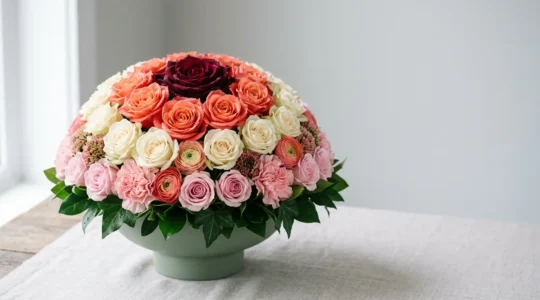
Biedermeier Styling: How to Create the Perfect Dome of Flowers
Mastering the Biedermeier style is not about learning a historical recipe; it’s the ultimate crash course in the structural and geometric principles that define all elite floristry. True Biedermeier relies on a deep understanding of “floral mechanics,” where densely packed,…
Read more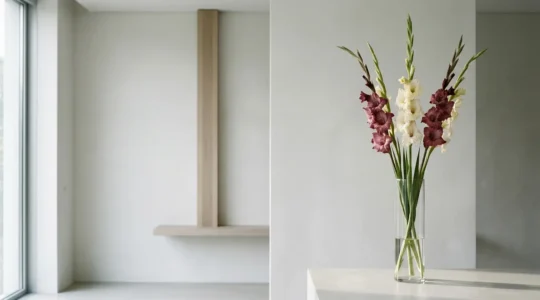
Formal Linear Architecture: Creating High-End Impact with Minimal Stems
Formal linear floristry is a strategic act of spatial engineering, transforming flowers from simple decoration into architectural assets that define a brand’s luxury identity. Success lies not in the quantity of blooms, but in the deliberate use of line, negative…
Read more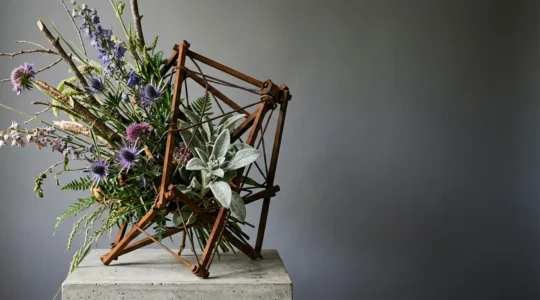
Avant-Garde Floral Shapes: Moving Beyond the Roundy-Moundy Bouquet
Winning at avant-garde floral design isn’t about randomly breaking rules; it’s about mastering a new set of rules rooted in fine art and intentional disruption. Successful designs treat flowers not just as blooms, but as sculptural elements of texture, line,…
Read more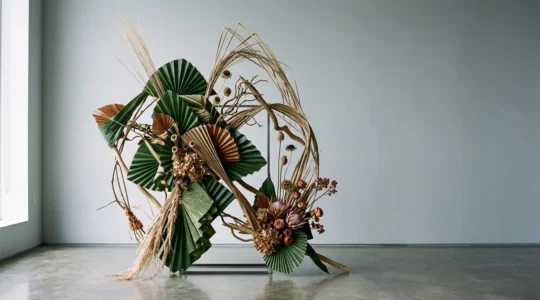
Abstract Botanical Sculpting: When Flowers Become Texture and Form
The true potential of botanical art is unlocked when the material is deconstructed from its natural identity and treated as a plastic medium for sculpture. Effective manipulation techniques—from folding leaves to inverting stems—prioritize line, texture, and form over the flower’s…
Read more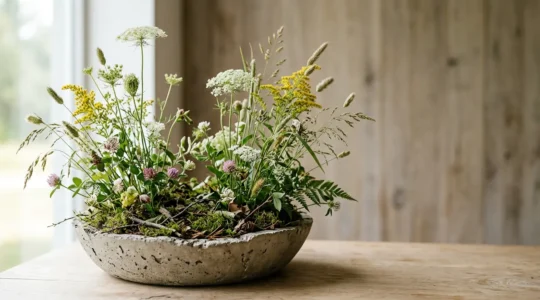
Natural Vegetative Design: Creating Arrangements That Look Like They Grew There
Vegetative design is more than creating a ‘wild look’; it’s the art of translating the fundamental rules of ecology and botany into a vase. Observing how plants group in colonies, form layers, and turn to the sun provides the blueprint…
Read more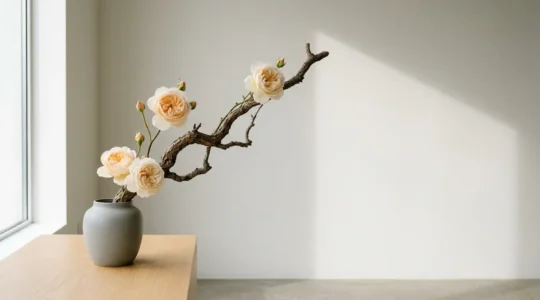
The Power of Negative Space: Why Your Arrangement Needs Room to Breathe
The most impactful element in your floral design isn’t a flower—it’s the empty space you intentionally create. It transforms crowded, ‘value’ bouquets into sophisticated, high-perceived-value luxury statements. It actively guides the viewer’s eye, making premium flowers the undisputed star of…
Read more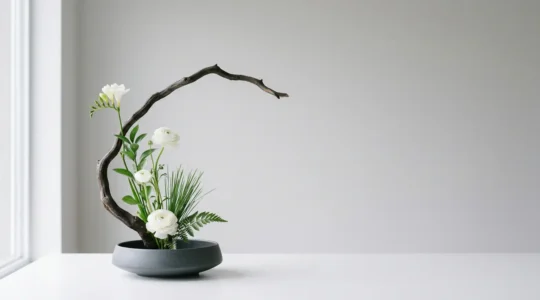
How to Apply Asian Design Principles to Contemporary Western Floristry?
Adopting Asian design principles is the key to shifting from volume-based sales to high-margin, premium artistry. Negative space (Ma) is not emptiness; it is an active design element that engineers focus and communicates luxury. Prioritizing a single, expressive line over…
Read more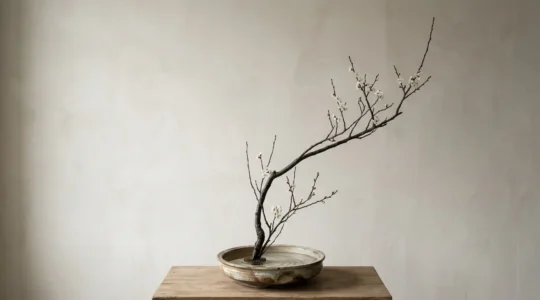
Introduction to Ikebana: The Japanese Art of Less is More
In summary: Ikebana is a meditative practice that prioritizes line, space, and asymmetry over mass and color. Core principles include the trinity of Heaven-Earth-Human (Shin-Soe-Hikae) and embracing imperfection (wabi-sabi). The empty space (Ma) in an arrangement is as important as…
Read more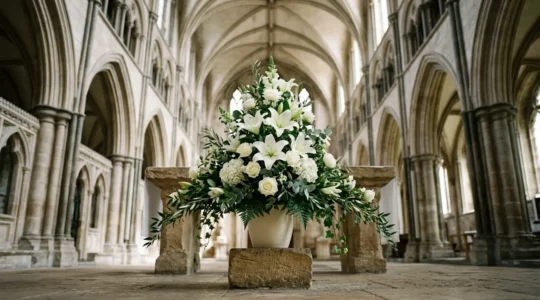
The Symmetrical Triangle: A Step-by-Step Guide for Altar Arrangements
In summary: Creating beautiful altar arrangements is not about memorizing rules, but understanding the professional principles of proportion, structure, and balance. Timeless design concepts like the Golden Ratio (the 1.5 rule) and the Fibonacci sequence (the 3-5-8 rule) are the…
Read more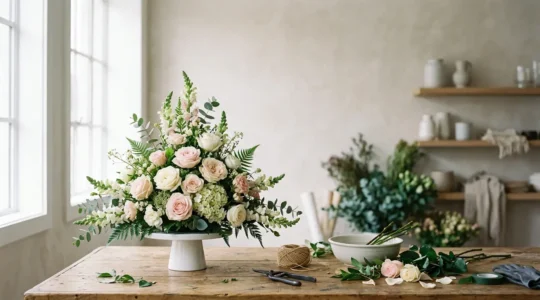
Mastering Western Geometric Principles: The Foundation of Commercial Floristry
Success in commercial floristry is not subjective art; it is objective engineering based on immutable geometric and physical principles. Traditional Western arrangements rely on mathematical ratios (like 3:5:8 and 1.5:1) for internal and external proportion, ensuring visual harmony and replicability….
Read more