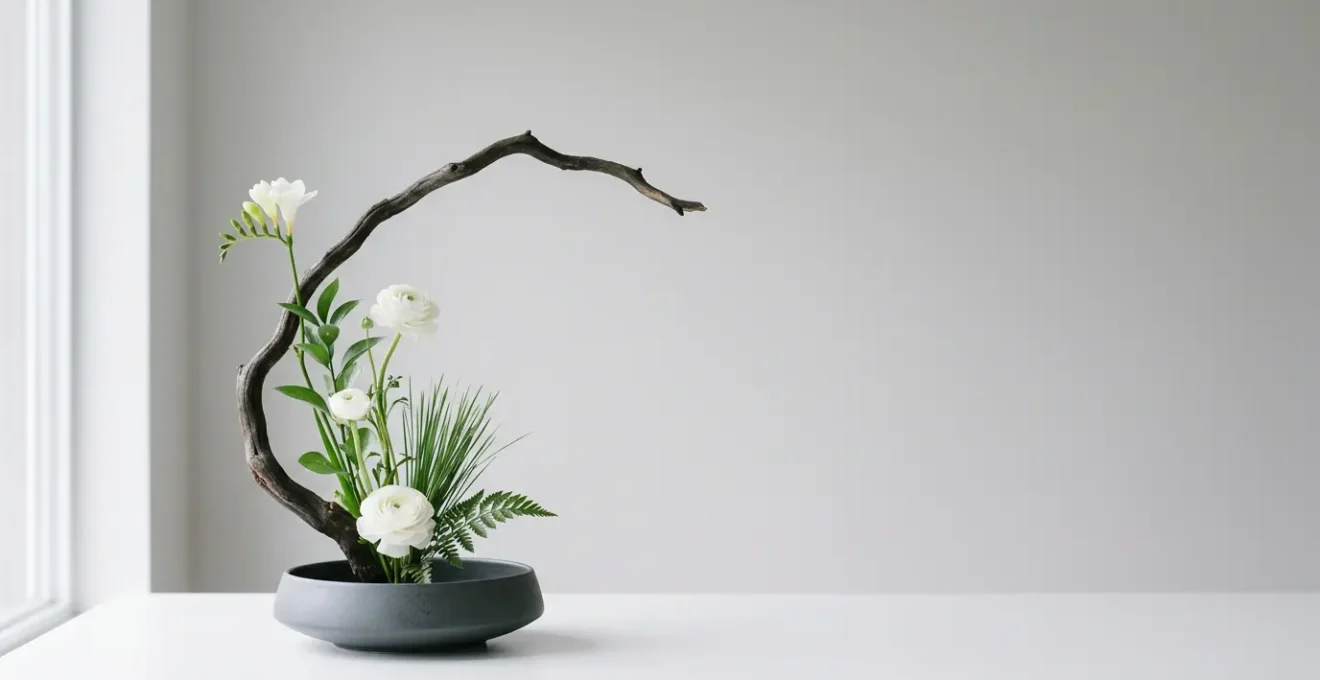
Adopting Asian design principles is the key to shifting from volume-based sales to high-margin, premium artistry.
- Negative space (Ma) is not emptiness; it is an active design element that engineers focus and communicates luxury.
- Prioritizing a single, expressive line over a mass of blooms creates more powerful emotional and visual impact.
Recommendation: Stop justifying value by stem count and start educating clients on the skill of composition, balance, and intentional design.
In the world of Western floristry, the prevailing logic has long been “more is more.” We’re taught to fill the vase, to create lush, dense arrangements where value is visibly communicated through abundance. This often leads to a competitive cycle where florists feel pressured to add more stems, more filler, and more color just to justify a price point. It’s a race to the bottom that can stifle creativity and diminish profit margins. We strive for beauty, but often end up with beautiful noise rather than a clear, resonant statement.
But what if the path to elevating your craft—and your business—isn’t about adding more, but about skillfully taking away? What if the most valuable element in your design is the space you intentionally create? This is the core lesson from centuries of Asian floral artistry, from the disciplined structure of Ikebana to the quiet philosophy of Wabi-sabi. These are not just aesthetic trends; they are sophisticated design strategies that can transform your work from merely “pretty” to profoundly impactful and, crucially, position it as a premium, high-value art form.
This guide is for the modern Western florist who is ready to move beyond volume. We will not just explore the “what” of these principles, but the “how”—how to integrate the power of negative space, linear dominance, and natural form into your contemporary style. You will learn to engineer focus, create emotional resonance, and confidently communicate the immense value of a single, perfectly placed stem. This is your roadmap to creating work that breathes, speaks, and commands a higher price.
This article provides a comprehensive framework for integrating these timeless concepts into your daily practice. The following sections break down the core principles, offering practical techniques and business-focused insights to help you refine your style.
Summary: A Guide to Fusing Eastern Principles with Western Floristry
- Ma (Negative Space): How to Sell “Empty Air” to Value-Conscious Clients?
- Line over Mass: Why One Branch Can Be More Powerful Than 50 Roses?
- Natural Growth: Why You Shouldn’t Bend a Stem Against Its Nature?
- Monochromatic Zen: Creating Impact with Green and White Only
- Minimal Materials: How Asian Principles Align with Eco-Floristry?
- Shin, Soe, Hikae: The 3 Main Lines Representing Heaven, Earth, Man
- The Frame: How Negative Space Defines the Edges of Your Design?
- The Power of Negative Space: Why Your Arrangement Needs Room to Breathe
Ma (Negative Space): How to Sell “Empty Air” to Value-Conscious Clients?
The single greatest challenge in adopting a minimalist floral style is client perception. How do you convince someone accustomed to voluminous bouquets that an arrangement with fewer stems holds more value? The answer lies in reframing the conversation from quantity to quality, from materials to artistry. You are not selling “empty air”; you are selling engineered focus and emotional resonance. The Japanese concept of Ma (間) teaches that the empty space is an active and essential part of the composition, giving each element room to be seen and appreciated.
Your task is to educate your client. Explain that the “emptiness” is where the eye can rest, allowing the beauty of a single bloom or the elegant curve of a branch to make its full impact. It’s the silence between musical notes that creates the melody. As Miami-based designer Sabrina Cohen of Neroli Blume explains, the goal is to evoke a feeling, not to overwhelm with excess. She states her philosophy in an article for Thursd about Miami’s tropical minimalism movement:
I want people to feel something when they see my work, nostalgia, calm, even a sense of personal memory. It’s about emotion, not excess.
– Sabrina Cohen, founder of Neroli Blume
This shift in language is critical. Instead of “simple,” use terms like “refined,” “curated,” or “sculptural.” Emphasize the skill and time required to find the perfect balance and tension. A design with intentional negative space isn’t easier to make; it’s often harder, as every placement is critical and every flaw is visible. This expertise is precisely what justifies a premium price.
Case Study: From Pretty to Premium Through Negative Space
To transition from volume to value, florists must change their sales strategy. An industry guide from Team Floral demonstrates how to justify higher pricing by focusing on intentional design rather than stem count. The approach emphasizes using clean lines and deliberate empty space to create focal areas. This strategy proves that a single, perfectly placed orchid can communicate more luxury and command a higher price than a dense bunch of standard blooms. Key to this is implementing tiered pricing structures and using sophisticated language that reframes minimalism as a premium, intentional design choice, not a lack of material.
Line over Mass: Why One Branch Can Be More Powerful Than 50 Roses?
Western floral design has traditionally been dominated by mass and color. We build forms by grouping flowers together, creating mounds, spheres, and cascades. Asian design, particularly Ikebana, prioritizes the power of the line. A single, dramatic branch or a gracefully arching stem can possess more visual energy and guide the eye more effectively than a dense cluster of 50 roses. This is because a line creates movement, direction, and a dynamic path for the eye to follow. It carves through space, defining its boundaries and creating a relationship between the elements and the “emptiness” around them.
Think of it in terms of visual weight. A mass of flowers has a heavy, static presence. A line, by contrast, is active and energetic. It can be delicate, strong, fluid, or sharp. By selecting materials for their linear quality—a gnarled branch, a straight-as-an-arrow gladiolus, a softly weeping willow twig—you are choosing to tell a story with form and direction. The goal is to capture the essence of the plant’s character and movement. This focus on individual form is a cornerstone of the art.
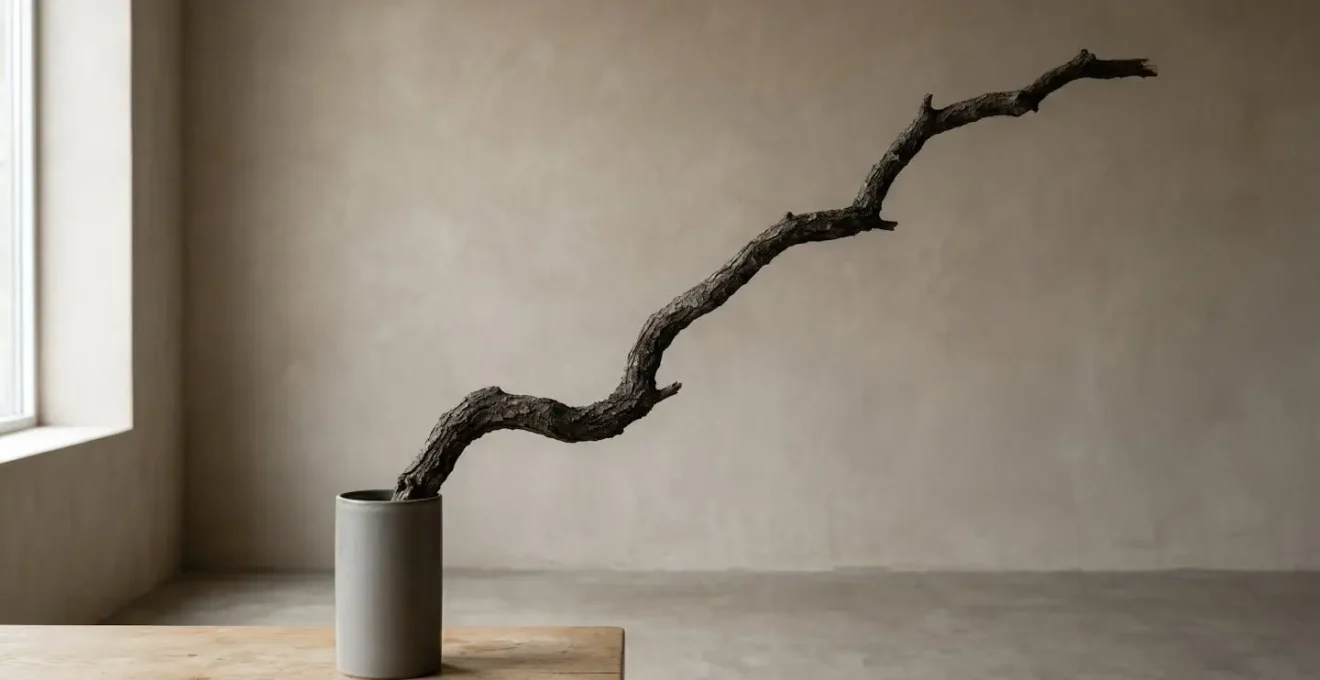
As this image demonstrates, the character of a single element can command an entire space. Its natural curvature provides all the interest and dynamism needed. In their guide to Ikebana, The Floral Society notes that this is a core tenet: the artists use these lines intentionally. The arrangement is not just a collection of pretty flowers; it’s a composition of meaningful forms. Shifting your focus from filling a space with mass to activating it with a line is a fundamental step toward this more refined and powerful design language.
Natural Growth: Why You Shouldn’t Bend a Stem Against Its Nature?
A deep respect for nature is at the heart of Asian floral design. This goes beyond simply using natural materials; it means honoring the inherent character and gesture of each stem. While Western floristry often involves wiring, taping, and forcing stems into preconceived shapes, the Eastern approach encourages the designer to listen to the material first. Before you make a single cut, you should observe the plant. How does it curve? Where does it reach? What is its natural “spirit”?
Working with, rather than against, a stem’s nature results in designs that feel more authentic, alive, and harmonious. A branch that is already leaning to the left should be placed in a way that enhances that lean, not forced to stand upright. A flower with a slightly bent head isn’t a “flaw” to be hidden; it’s a character trait to be celebrated, perhaps positioned as if it’s bowing or gazing downwards. This philosophy invites you to become a collaborator with your materials, not their commander. The result is an arrangement that feels less “arranged” and more like a captured moment of nature itself.
To integrate this into your practice, consider these guiding principles inspired by both Ikebana and the KonMari mindset of gratitude and intention:
- Observe First: Before designing, turn each stem in your hands. Notice its natural curvature, its weight, and where it seems to want to go. Let its gesture inform your design.
- Use a Kenzan: The traditional pin frog (kenzan) is key. Unlike floral foam, it allows stems to be placed at their natural angles, preserving their integrity without force.
- Embrace Imperfection: Crooked stems, leaves with insect bites, or asymmetrical blooms tell a more authentic story. These are not flaws but signs of life and are welcomed in styles like Wabi-sabi.
- Express Gratitude: Acknowledge the material before you cut or alter it. This simple mental shift fosters a deeper respect for the life you are working with.
Monochromatic Zen: Creating Impact with Green and White Only
While Western arrangements often celebrate a riot of color, a key technique in minimalist design is the power of a restrained palette. Limiting your materials to just greens and whites is not a restriction; it’s a strategy. It forces the designer—and the viewer—to focus on the more subtle elements that are often lost in a colorful composition: texture, form, and light. When the distraction of color is removed, the glossy surface of a camellia leaf, the rough bark of a branch, and the delicate translucence of a petal become the stars of the show.
A green and white palette instantly evokes a sense of calm, sophistication, and modernity. It feels clean, intentional, and architectural. This isn’t just an aesthetic preference; it has a direct impact on perceived value. As design experts confirm, a restrained color choice can elevate a design from simply “pretty” to “premium.” A study on elevating floral designs found that monochromatic and analogous color blends are perceived as upscale and refined. This makes the green-and-white palette a powerful commercial tool for florists aiming at the luxury market.
Creating impact with this limited palette requires skill. The key is to maximize contrast in other areas. Combine bold, sculptural leaves like monstera with delicate, airy ferns. Juxtapose the smooth, perfect petals of a white orchid with the gnarled texture of a bare branch. Play with scale by pairing large, dominant forms with tiny, intricate details. This approach challenges you to see your materials in a new light, moving beyond their color to appreciate the full richness of their character.
Minimal Materials: How Asian Principles Align with Eco-Floristry?
The philosophy of using fewer, more intentional materials aligns perfectly with the modern-day imperative of sustainability. For today’s eco-conscious consumer, a design that celebrates the beauty of a few carefully chosen elements is far more appealing than an opulent display that feels wasteful. Asian design principles offer a powerful framework for creating stunning, environmentally friendly floral art. This is not about scarcity; it’s about resourceful elegance.
First, the emphasis on individual stems and branches naturally reduces the overall volume of plant material required, leading to less waste. When every piece is a star, there’s no need for “filler.” This philosophy encourages sourcing locally and seasonally—a single dramatic branch foraged from your own backyard can become the centerpiece of a design, reducing the carbon footprint associated with imported flowers. Second, the mechanics are inherently sustainable. The traditional kenzan, or pin frog, is a reusable, durable tool made of metal that completely eliminates the need for single-use, petroleum-based floral foam, which is a significant source of microplastic pollution.
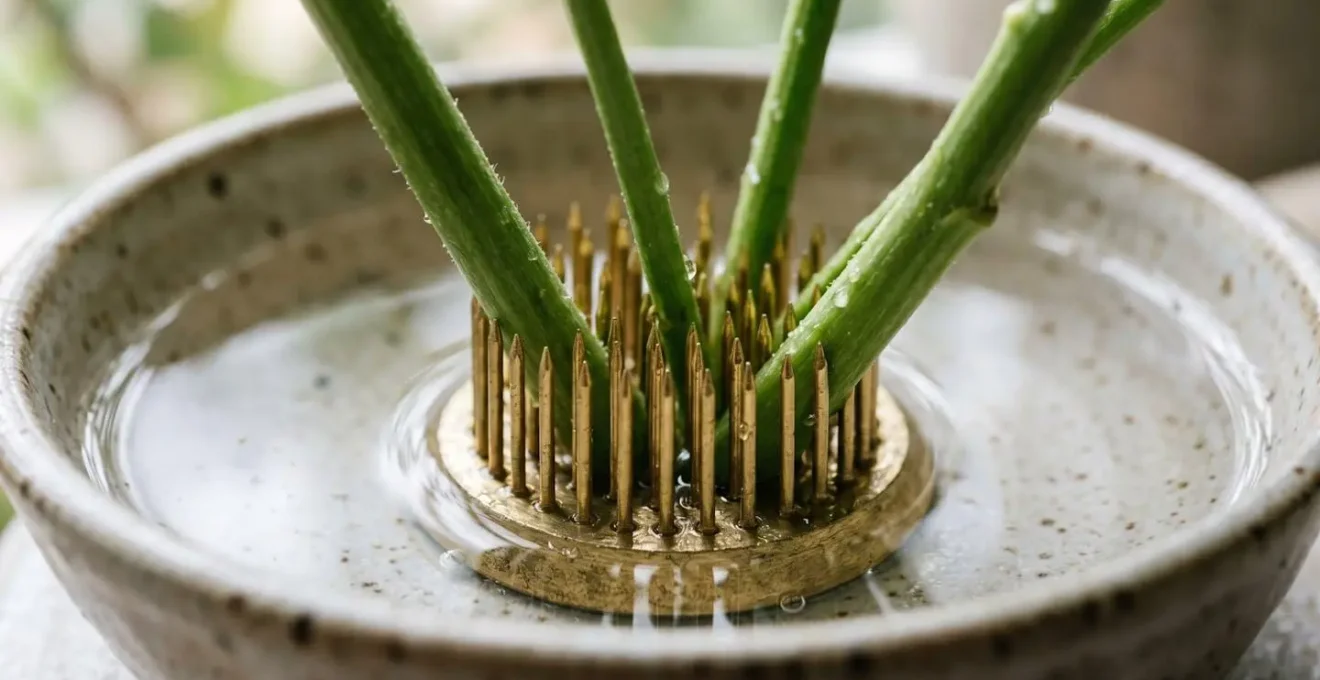
Embracing these mechanics not only benefits the planet but also enhances the design. Using a kenzan in a shallow vessel allows the water to be visible, reinforcing the connection to nature and adding an element of life and transparency to the arrangement. This approach offers a compelling story for your brand: you create not just beautiful work, but thoughtful, responsible art that is in harmony with nature. This narrative of sustainable luxury is a powerful differentiator in today’s market.
Shin, Soe, Hikae: The 3 Main Lines Representing Heaven, Earth, Man
While the idea of using lines can feel abstract, the Japanese art of Ikebana provides a concrete structural framework known as Shin, Soe, and Hikae. This foundational triad is the backbone of many traditional arrangements. It’s not just a set of rules but a symbolic system for creating balance, asymmetry, and depth. Understanding this structure can provide a powerful tool for bringing intention and order to your minimalist designs. The three main elements represent the connection between the divine, humanity, and the natural world.
According to The Floral Society’s guide to Ikebana, these three branches are the primary structural elements in many styles. The highest branch is Shin (天), representing heaven. It is the strongest, tallest line in the arrangement. The middle branch is Soe (人), representing man. It is placed in a supporting role to Shin, creating a bridge between heaven and earth. The lowest and shortest branch is Hikae (地), representing earth. It grounds the composition and provides balance.
Together, these three lines form an asymmetrical triangle, which is dynamic and creates a sense of movement. This structure is not meant to be a rigid cage but a starting point. By learning to identify and place these three key lines, you can move from randomly placing stems to building a thoughtful, balanced, and meaningful composition. It gives your linear designs a proven architectural foundation.
Your Action Plan: Finding the Shin-Soe-Hikae Lines
- Select Your Shin (Heaven): Choose your tallest, sturdiest element, often a branch or woody-stemmed flower. This is your primary line.
- Add Your Soe (Man): Select a secondary element, roughly two-thirds the height of Shin. This can be a flower or greenery that supports and complements the main line.
- Place Your Hikae (Earth): Choose your tertiary element, about half the height of Shin. This grounding element can be another flower, moss, or a broad leaf.
- Position with Angles: For a classic structure, tilt Shin slightly (e.g., 15° left), angle Soe more sharply (e.g., 45° left), and angle Hikae in the opposite direction for balance (e.g., 75° right).
- Check the Asymmetry: When viewed from above, the three tips should form a scalene (asymmetrical) triangle, ensuring the design has dynamic movement and depth.
The Frame: How Negative Space Defines the Edges of Your Design?
In minimalist floral design, the arrangement doesn’t begin when you place the first stem; it begins when you choose the vessel. The vase is not a mere container. It is an integral part of the composition that acts as the primary frame for your negative space. The shape of its opening, its height, its width, and even its texture all dictate the initial boundaries and possibilities of the design you will create within and around it.
A tall, narrow opening forces a vertical, linear design. A wide, shallow bowl invites a more sprawling, asymmetrical composition that interacts with the water’s surface. The edge of the vase becomes the first line of your drawing, the border against which all your other elements will react. Acknowledging the vessel as a compositional partner, rather than a functional afterthought, is a fundamental shift in perspective. It forces you to consider the totality of the object: flower, stem, water, and container, all working in harmony.
This concept is central to Ikebana, where the selection of the vase (utsuwa) is a critical artistic decision. The vessel’s role is to both support the materials and enhance the overall aesthetic, defining the initial canvas of negative space.
Case Study: The Vase as a Compositional Frame
In traditional Ikebana, the vessel is chosen with extreme care, as it is considered a core element of the final piece. A guide from The Floral Society explains that the vase’s shape and opening create the initial boundaries of negative space that the artist must work with. Ikebana vases are themselves aesthetically pleasing and must be balanced within the overall design. Crucially, they are often designed to leave the surface of the water visible, fulfilling the principle of imitating plants growing in nature. Therefore, the choice of vessel directly impacts how negative space is framed and perceived, making it a proactive design decision, not a passive choice of container.
Key Takeaways
- True minimalism is not about less material, but more intention, skill, and focus.
- Negative space is an active element that directs the eye, creates drama, and communicates luxury.
- Shifting your design focus from mass to line creates more dynamic, emotionally resonant, and valuable work.
The Power of Negative Space: Why Your Arrangement Needs Room to Breathe
We’ve explored how to sell negative space and how it’s framed, but it’s essential to return to its fundamental purpose: to give your design room to breathe. In a crowded, mass-market arrangement, no single flower can truly be appreciated. Each one is lost in the crowd, contributing to an overall impression of color and texture but losing its individual identity. Negative space solves this problem. It acts as a silent spotlight, isolating and elevating each element you choose to include.
This “breathing room” allows the unique form of a parrot tulip, the delicate freckles on an orchid’s throat, or the graceful curve of a single blade of grass to be seen and admired. It invites the viewer to slow down and look closer, engaging with the piece on a more intimate level. This is a concept that applies to all forms of design, but it is especially potent in floristry, where the materials are living and have their own unique character.
There’s beauty in negative space, and you want to give each individual element room to shine.
– These Four Walls Blog
Creating this breathing room is a balancing act. It requires the confidence to stop adding material, to trust that the spaces between the elements are working just as hard as the elements themselves. This can be challenging for florists trained to “fill the space,” but it is the final and most important step in transitioning to a more refined, sculptural style. When you master the art of negative space, you are no longer just arranging flowers; you are composing with space, light, and form.
To begin integrating these principles, start not by designing a new arrangement, but by editing an existing one. Take a standard bouquet and ask yourself: “What can I remove to make what’s left more beautiful?” That single act of intentional subtraction is the first step toward transforming your craft and your business.