
Mastering the Biedermeier style is not about learning a historical recipe; it’s the ultimate crash course in the structural and geometric principles that define all elite floristry.
- True Biedermeier relies on a deep understanding of “floral mechanics,” where densely packed, short stems create a self-supporting architectural dome.
- The visual impact comes from deliberate “textural dialogue,” pairing smooth, light-reflecting petals with rough, light-absorbing textures to create depth.
Recommendation: Approach this style as a technical exercise in precision, and you will master skills applicable to every other form of Western floral design.
To the modern florist, the Biedermeier arrangement can seem like a relic—a tight, almost unnaturally perfect dome of flowers. One might look at its rigid, concentric circles and wonder: is this artistry or merely engineering? It’s a valid question. The common perception is that creating a Biedermeier is a simple, if tedious, task of arranging flowers in rings, a style governed more by mathematical precision than by creative spirit. Many guides will simply tell you to pack flowers tightly into floral foam and call it a day, reducing a master technique to a paint-by-numbers exercise.
But what if this perceived rigidity is actually a masterclass in disguise? What if mastering the Biedermeier is the single best way to internalize the core principles of all Western floral design—geometric purity, textural nuance, and structural integrity? This is the perspective we will adopt. We will move beyond the superficial “how-to” and delve into the “why.” This is not just about making circles; it is about understanding the floral mechanics that allow a dome of petals to hold its shape, the science of texture that creates visual depth, and the precise math required for a flawless finish.
This guide deconstructs the Biedermeier style not as a historical artifact, but as a foundational lesson for the serious floral artist. By treating it as a training ground, you will emerge with skills that elevate every other piece you create. We will explore the techniques for achieving perfect rings, the science behind texture blocking, the calculations for stem counts, and the architectural principles that make the perfect hemisphere possible.
This article provides a comprehensive exploration of the Biedermeier style, breaking down its core components into actionable techniques and foundational principles. The following summary outlines the key areas we will cover, guiding you from the basic building blocks to the advanced concepts that define this masterclass in floral design.
Summary: Deconstructing the Architecture of a Biedermeier Dome
- The Bullseye Effect: How to Arrange Flowers in Perfect Rings?
- Texture Blocking: Why Smooth Roses Next to Rough Thistles Work in Biedermeier?
- Stem Count Math: How Many Carnations for a 12-Inch Dome?
- Leaf Collars: How to Frame Your Dome with Galax or Salal?
- Contemporary Biedermeier: Can You Do It with Wildflowers?
- The Biedermeier Dome: How to Achieve a Perfect Hemisphere?
- Petal Ruffle: How to Group Carnations to Look Like Peonies?
- Mastering Western Geometric Principles: The Foundation of Commercial Floristry
The Bullseye Effect: How to Arrange Flowers in Perfect Rings?
The most recognizable feature of Biedermeier design is its concentric rings—a perfect “bullseye” of color and texture. Achieving this precision is not about luck; it’s about a systematic approach to construction. The foundation is everything. While modern florists often use floral foam, the traditional method using wet sand offers unparalleled stability and control. This technique forces you to consider each stem’s placement as a structural component, not just a decorative one. The key is to establish a clear guide and build methodically from the outside in, or by creating an “X” guide for larger arrangements to maintain symmetry.
Each ring should be completed before moving to the next, ensuring clean delineations. You must use flowers with distinct, rounded heads like roses, carnations, or zinnias, as their form lends itself to creating a tight, seamless pavé surface. The goal is to eliminate all negative space within each band, creating a solid, uninterrupted circle of color. This dense packing is fundamental to the style’s structural integrity. The macro-level detail in the rings, where one texture meets another, is where the design truly comes to life.
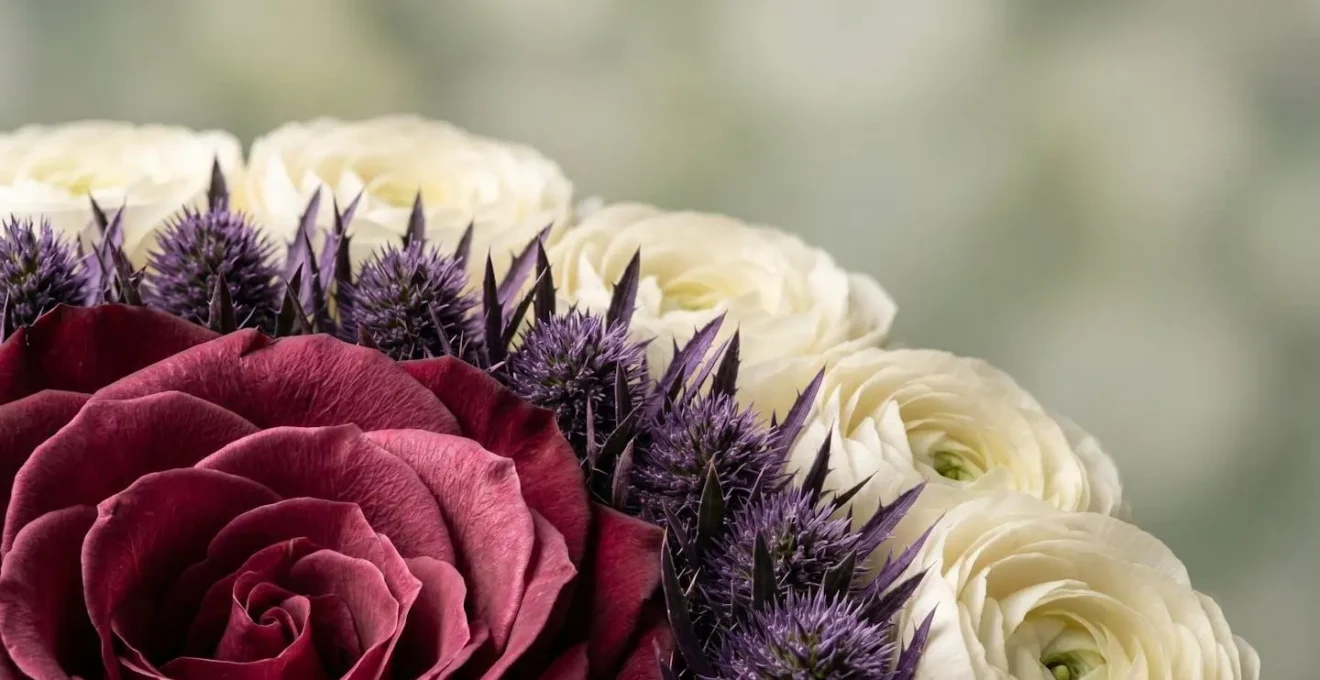
As you can see in the detail, the junction between different rings is sharp and intentional. This visual precision is a direct result of a disciplined construction process. Whether you use sand or foam, the principles remain the same: establish your pattern, build in deliberate stages, and ensure each flower is placed with purpose to contribute to the overall geometric form.
Action Plan: The Wet-Sand Foundation Technique
- Foundation Shaping: Mound dry sand into your desired dome shape on top of your vessel.
- Moisture Infusion: Create a “volcano well” at the top of the sand mound and pour water in slowly until the sand is uniformly moistened.
- Structural Guides: For a solid guide, create a row of your chosen flowers from the bottom edge to the center, or form an ‘X’ guide across the dome for larger pieces.
- Systematic Assembly: Begin arranging the bottom row of flowers first, working your way up to the center. Place larger, heavier blooms at the bottom and smaller, more delicate ones on top.
- Maintenance: Check the sand’s moisture level every few days, adding water by gently pouring it into the arrangement’s central point.
Mastering the bullseye effect is your first step toward understanding the rigorous geometry at the heart of the Biedermeier style.
Texture Blocking: Why Smooth Roses Next to Rough Thistles Work in Biedermeier?
If concentric rings form the skeleton of a Biedermeier arrangement, texture is its soul. Simply creating circles of different colors is not enough; a master florist engineers a textural dialogue between the rings. This is the principle of “texture blocking,” where bands of smooth, velvety petals are deliberately placed next to bands of rough, spiky, or complex surfaces. This isn’t just for visual variety; it’s a technique rooted in the physics of light.
Texture defines the contrast, harmony, and balance within a floral arrangement, elevating it beyond a simple collection of blooms.
– Remi + Gold Floral Design, The Role Texture Plays in Floral Arrangements
The secret lies in how different surfaces interact with light. A ring of smooth rose petals will reflect light, creating soft highlights and a sense of luminescence. A neighboring ring of rough thistles or craggy celosia, by contrast, will absorb light, creating micro-shadows and a feeling of depth and gravity. This juxtaposition is what gives the arrangement a three-dimensional, almost sculptural quality. Without this deliberate contrast, the dome can appear flat and lifeless—a mere pattern rather than a dynamic form.
Case Study: The Smooth vs. Rough Pairing Technique
Professional florists have long understood that pairing smooth textures (like velvety lamb’s ear or glossy leaves) with rough ones (like curly willow or succulents) creates a powerful effect. An analysis of this method reveals why: the smooth surfaces act like mirrors, reflecting light and creating bright spots, while the complex, rough textures trap light, creating shadows. This interplay of light and shadow is what creates tactile contrast and visual depth. This is not random; it is a technique known as textural contrast that tricks the eye into seeing more dimension, making the overall composition feel balanced, harmonious, and deeply interesting.
Therefore, when planning your Biedermeier, think like a painter. Don’t just choose colors; choose surfaces that will talk to each other through the language of light.
Stem Count Math: How Many Carnations for a 12-Inch Dome?
Moving from theory to practice requires us to address a crucial question: how many flowers do you actually need? While artistry is paramount, Biedermeier design is also a game of numbers and geometry. Answering “how many carnations for a 12-inch dome” requires moving beyond generic stem counts and thinking in terms of surface area and density. General guidelines for a standard, looser centerpiece are often misleading here. For example, some sources suggest a general recipe of about 20 stems for a medium arrangement, but this is for a mixed design with filler and greenery, not a dense Biedermeier dome.
To calculate for a Biedermeier, you must think in terms of surface area. A 12-inch dome is a hemisphere. The surface area of a sphere is 4πr², so a hemisphere is 2πr². With a 12-inch diameter, the radius (r) is 6 inches. So, the surface area is approximately 2 * 3.14 * (6*6) = 226 square inches. Now, you must factor in the diameter of a fully bloomed carnation (let’s say 2.5 inches). The area of one carnation head is πr², or 3.14 * (1.25*1.25) ≈ 4.9 square inches. By dividing the dome’s surface area by the flower’s area (226 / 4.9), we get a rough estimate of around 46 carnations. This is a starting point.
This calculation doesn’t account for the dense, overlapping pavé effect where blooms are packed so tightly they compress slightly. Therefore, a professional would likely add a 10-15% buffer, bringing the total closer to 50-55 carnations for a dense, flawless 12-inch dome. This mathematical approach demystifies the process, turning a daunting task into a predictable formula. It’s this blend of geometry and practical experience that separates an amateur from a master.
Always err on the side of having too many stems. Nothing is worse than being three flowers short of completing that final, perfect ring.
Leaf Collars: How to Frame Your Dome with Galax or Salal?
The final structural element of a classic Biedermeier is the “collar”—a clean, crisp ring of foliage that frames the dome, provides a visual resting point, and cleanly defines the boundary of the arrangement. This is not an afterthought or a way to hide messy mechanics; it is an integral design feature. The choice of leaf is critical. While salal (lemon leaf) is a workhorse, the round, glossy, and bold silhouette of Galax leaves is exceptionally suited for this purpose.
As noted by floral design experts, the role of such leaves in contemporary work is often that of a primary feature, not a secondary filler. A single, well-placed leaf can fundamentally alter the character of an arrangement. In a Biedermeier, the collar of Galax leaves acts as a formal pedestal, elevating the floral dome above it. The leaves should be layered like shingles on a roof, creating a continuous, uninterrupted band of green. Their natural shine contrasts beautifully with the matte or velvety textures of the flowers above them, reinforcing the principle of textural blocking.
Technique Spotlight: The Galax Leaf Collar
Galax leaves are prized in high-end design for their strong, heart-like shape and glossy surface. When used for a Biedermeier collar, they are not treated as filler but as a deliberate framing device. To be effective, the leaves must be well-conditioned to remain flexible and stored in a cool place to maintain their signature shine. They are inserted last, tucked just under the bottom-most ring of flowers, angled slightly downwards to create a clean, crisp edge. Their modern aesthetic pairs perfectly with the structured geometry of the Biedermeier, creating a look that is both classic and contemporary. As Fiore Designs states, ” One leaf placed well can change the whole look of an arrangement,” and nowhere is this truer than in the precise application of a Biedermeier collar.
The collar is the final punctuation mark. It signals that every element of the design, from the center bloom to the outermost edge, has been considered and perfected.
Contemporary Biedermeier: Can You Do It with Wildflowers?
The question inevitably arises: must the Biedermeier style remain a prisoner of its own history, forever bound to formal roses and carnations? Or can it be adapted for a modern, more natural aesthetic using elements like wildflowers? The answer is a resounding yes, but with a crucial caveat. To create a “wildflower Biedermeier,” you must understand which rules to break and which to preserve. The core principle of geometric purity must remain, but the interpretation can be loosened.
A contemporary Biedermeier might trade perfect, single-flower rings for “color-blocked” rings of mixed textures. Imagine a ring of various small blue flowers (cornflowers, delphinium florets, forget-me-nots) next to a ring of mixed yellow blooms (ranunculus, craspedia, chamomile). The bullseye effect is still present, but it’s softened, more painterly. The key is that the flowers within each ring must share a similar scale and the overall dome shape must be impeccably maintained. You cannot simply arrange a loose bunch of wildflowers and call it Biedermeier.
Furthermore, innovation can be introduced within the structure itself. As floral historian L. H. mentions, modern interpretations can move beyond simple circles.
Modern arrangements can depart from the traditional Biedermeier technique in arranging the flowers in spiral or linear patterns.
– French Gardener Dishes, Biedermeier Flower Arranging: a Tutorial
This opens up fascinating possibilities: a Biedermeier dome with a swirling spiral of color, or one with radiating lines instead of concentric rings. Using wildflowers in such a design creates a compelling tension between the untamed nature of the materials and the strict discipline of the form—a dialogue between wildness and order that is thoroughly modern.
So yes, you can make a Biedermeier with wildflowers. In doing so, you are not just recreating a style; you are participating in its evolution.
The Biedermeier Dome: How to Achieve a Perfect Hemisphere?
We’ve discussed the components—rings, textures, and collars. But how do these elements unite to form that iconic, flawless hemisphere? The answer lies in floral mechanics, a term that accurately describes the engineering principles underpinning the design. The perfect dome is not a happy accident; it is the direct result of a rigorous construction method that creates a self-supporting, interlocking structure.
The first rule is to cut all stems extremely short, typically only 2-3 inches long. This is non-negotiable. Long stems create instability and prevent the dense packing required. Each flower is then inserted into the medium (foam or sand) at a consistent angle, radiating out from the dome’s central point. The arrangement is built systematically from the outer, bottom ring upwards and inwards to the center top. Each subsequent ring of flowers interlocks with the one below it, creating a web of compression and support.
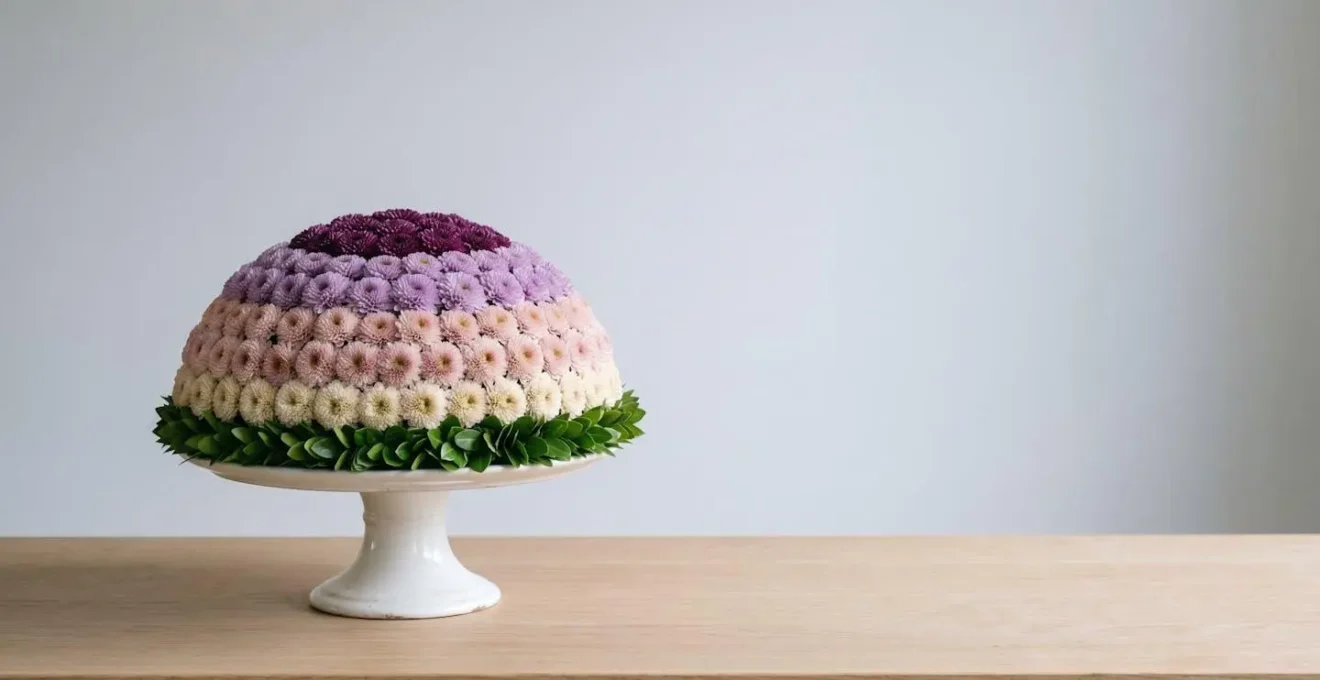
This process creates a dense, pavé effect where no mechanics or negative space are visible. This is crucial for stability. The mass of tightly packed flower heads distributes weight evenly, creating a structure that is remarkably stable. As one analysis on the style’s construction explains, the dome’s stability is akin to an architectural arch.
The Structural Mechanics of a Floral Dome
The stability of a Biedermeier dome is achieved through its precise assembly. By building from the bottom up and cutting stems short, each flower head rests against its neighbors, creating a self-supporting mass. A deep dive into the method shows that as subsequent stems are inserted at angles towards the center, they create a web of compression. This works on a principle similar to that of an architectural keystone, where each block presses against the next to support the overall structure. The final, central flower acts like the keystone itself, locking the entire hemisphere into place. This is why Biedermeier construction is a lesson in the structural integrity of floral design.
Achieving the perfect hemisphere requires you to think less like a decorator and more like an architect, building with petals instead of stones.
Petal Ruffle: How to Group Carnations to Look Like Peonies?
One of the most refined techniques in a florist’s arsenal is the creation of a “composite flower”—a bloom made by grouping smaller flowers to mimic a single, larger, more luxurious one. The Biedermeier style, with its focus on mass and form, is the perfect canvas for this technique. The classic application is grouping humble carnations to achieve the lush, ruffled look of a high-end peony. This is the “petal ruffle” effect, and it’s a brilliant way to manage costs while maximizing visual impact.
The technique is precise. You take several carnations—professional florists recommend using 3-4 carnations grouped together—and wire their stems together tightly. The key is to “fluff” the petals of each carnation first, gently separating them to maximize their volume. As you cluster them, you manipulate the petals to intermingle, blurring the lines between the individual flowers. From a short distance, the cluster reads as one large, multi-petaled bloom.
Placing these composite forms within a Biedermeier ring adds a layer of sophisticated deception. You can create a ring of “peonies” next to a ring of actual roses, and the textures will play off each other beautifully. This technique is particularly useful for achieving a high-impact look in the lower, wider rings of a large dome, where a single, large focal point is needed to anchor the design. It is a testament to the idea that in floral design, the whole can truly be greater than the sum of its parts.
Mastering the petal ruffle is not just about imitation; it’s about demonstrating control over your materials to create new and beautiful forms.
Key takeaways
- Biedermeier’s stability comes from “floral mechanics,” using short, angled stems to create a self-supporting pavé dome.
- Visual depth is achieved through “texture blocking”—juxtaposing smooth, light-reflecting surfaces with rough, light-absorbing ones.
- Mastering Biedermeier isn’t about copying a style; it’s a technical exercise that teaches the geometric precision foundational to all commercial floristry.
Mastering Western Geometric Principles: The Foundation of Commercial Floristry
Ultimately, we must return to our guiding thesis: the Biedermeier style is more than a historical footnote; it is the ultimate training ground for mastering the principles of Western geometric design. Every rule, every technique we have discussed—from the mathematical precision of the rings to the architectural stability of the dome—is a concentrated lesson in the fundamentals of commercial floristry. In a world of loose, organic, “garden-style” arrangements, the discipline required by Biedermeier is more valuable than ever.
The style forces the florist to confront the raw elements of design: line, form, space, and texture. There is no room for error. As one textbook on the subject succinctly puts it, the effect is one of total control.
Concentric rings of floral materials create strong rhythms with no negative space.
– Principles of Floral Design Textbook, Biedermeier Design Principles
This elimination of negative space and the creation of strong rhythm are foundational skills. A florist who can create a perfect Biedermeier dome can create any geometric shape. They have demonstrated mastery over stem placement, density, and the creation of a stable, self-supporting structure. They have shown an understanding of how to use color and texture to create depth and interest within a constrained form.
Case Study: Biedermeier as the Ultimate Training Ground
The Biedermeier style is often seen as the pinnacle of geometric control in floristry. It forces the designer to reduce flowers to their essential forms and use them as building blocks. By embracing this structured approach, a florist learns how to balance tight, formal precision with the inherent organic beauty of the flowers. This duality—simultaneously formal and relaxed, engineered and beautiful—makes it the ultimate training ground for florists. The mastery of perfect circles, spheres, symmetry, and rhythm in this style translates directly to all other Western design forms, from topiaries to symmetrical bridal bouquets.
Therefore, the next time you approach a Biedermeier, do not see it as a chore or a creative constraint. View it as a practice session—a floral kata. Execute it with precision, focus on the underlying principles, and you will emerge a stronger, more disciplined, and more capable floral designer.