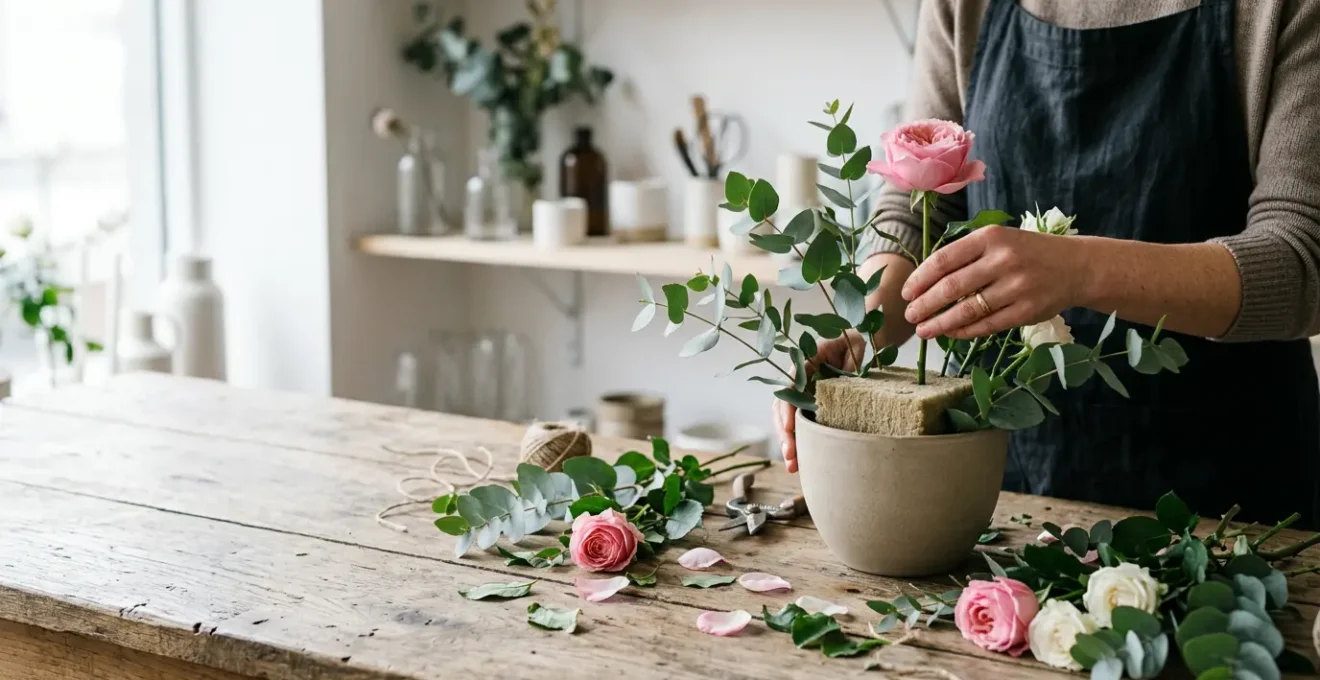
Switching to sustainable mechanics isn’t a sacrifice; it’s a technical upgrade that secures your arrangements and your brand’s future.
- Agra-Wool requires a gentle “float-to-soak” method, not the forceful push used with foam, to properly hydrate its basalt fibres.
- Heavy stems are secured through “internal scaffolding” techniques like tape grids and wire armatures, not by relying on the medium’s density alone.
Recommendation: Embrace the new techniques outlined in this guide to transition with confidence, eliminate microplastics from your work, and elevate your craft.
For the conscientious florist, it’s a familiar feeling of conflict. That block of green floral foam is a reliable base, a thirsty and firm foundation that has underpinned decades of design. Yet, the knowledge that it’s a single-use plastic, shedding formaldehyde and microplastic particles with every use, creates a growing unease. You want to change, to align your work with the sustainable values you hold. But the fear is real and practical.
The alternatives can seem intimidating. Will that new base hold the weight of heavy branches? Is it going to be messy, dusty, or unsafe? And frankly, will switching to an eco-friendly option cripple your profit margins? These are the valid, professional concerns that keep so many talented florists tethered to a material they’d rather leave behind. The conversation often stops at “foam is bad” and “just use chicken wire,” ignoring the nuanced mechanical challenges you face daily.
But what if the transition wasn’t about finding a lesser substitute, but about mastering a superior technique? This guide is designed to be your personal sustainable mechanics tutor. We’re moving beyond the simple “why” and diving deep into the “how.” This is your workshop session to overcome the practical fears and technical hurdles of switching to Agra-Wool. We will address every common concern, from soaking and dust safety to securing heavy stems and understanding the true cost, so you can make the change with confidence and skill.
This comprehensive guide breaks down the transition from floral foam to Agra-Wool into a series of practical, easy-to-understand steps. We will address each of your primary concerns, providing you with the knowledge and techniques to make the switch seamless and successful. The table of contents below outlines the key mechanical and practical challenges we’ll solve together.
Contents: A Florist’s Guide to Agra-Wool Mechanics
- Float don’t Push: Why Agra-Wool Soaks Differently to Foam?
- Dust Safety: Do You Need a Mask When Cutting Dry Agra-Wool?
- Softer Density: How to Secure Heavy Stems in Basalt Wool?
- Composting: Does Agra-Wool Really Break Down in a Home Compost?
- Price per Brick: Is Sustainable Always More Expensive?
- The Pillow Technique: How to Scrunch Wire for Maximum Grip?
- Bio-Foam: Is It Really Biodegradable or Just Breaks Down Faster?
- Why Is Floral Foam Toxic and What Are the UK Regulations?
Float Don’t Push: Why Agra-Wool Soaks Differently to Foam?
Your first interaction with Agra-Wool will immediately highlight a fundamental difference from foam: how it drinks. With traditional foam, you’ve been trained to float the brick and let it sink under its own weight, never pushing it down. Pushing creates dry pockets. With Agra-Wool, the principle is similar but the material science is completely different. It’s a matter of capillary action versus absorption. Agra-Wool is made of spun basalt rock fibres, creating a web of tiny channels. It doesn’t absorb water into its structure like a sponge; it holds water between its fibres.
This is why you must let the wool float and gently submerge. It needs time for water to wick up through the fibrous network. Pushing it under will trap air, just like with foam, but the effect can be more pronounced. A fully saturated brick of Agra-Wool holds water exceptionally well, providing a consistent source of hydration for your stems. It can take a few minutes to saturate completely, so patience is key. Think of it as allowing a natural spring to fill rather than forcing water into a sealed container.
Furthermore, the material itself is inert, which provides a distinct advantage for sensitive flowers. It doesn’t alter the water’s chemistry. This is a significant improvement over foam, which can have a direct impact on vase life and water quality. As the New Age Floral Research Team notes:
Agra-Wool is inert basalt, whereas foam can acidify the water and leach formaldehyde, affecting sensitive stems and requiring more frequent water changes.
– New Age Floral Research Team, The Surprising Truth: Is Floral Foam Bad for You and the Environment?
This inert quality means cleaner water for your flowers, potentially extending their freshness and vibrancy without the need for special water treatments to counteract the effects of the base medium.
Dust Safety: Do You Need a Mask When Cutting Dry Agra-Wool?
One of the most immediate concerns when handling a new material is safety. When you cut dry Agra-Wool, you may notice some fine dust, which can be unsettling. This dust consists of tiny basalt fibres. While the material is not classified as hazardous in the same way as asbestos, handling any fine particulate matter requires a professional and sensible approach. The official guidance from the manufacturer focuses on skin sensitivity rather than respiratory danger for typical studio use.
As Agra-Wool International clarifies, the legal requirements for labeling are strict. They state that “only in people with sensitive skin can it irritate the skin slightly.” This indicates that for the average user, the risk is minimal and primarily dermatological. However, as a professional, your goal should be to minimize exposure and maintain a clean workspace, regardless of the material. A dust mask is generally not required for cutting a few bricks in a well-ventilated studio, but adopting a low-dust workflow is a mark of professionalism.
Instead of fearing the dust, implement a simple studio protocol to eliminate it entirely. By making small adjustments to your process, you can work with Agra-Wool as cleanly as any other material in your studio. This isn’t about avoiding a danger, but about maintaining a pristine and professional creative environment. The following checklist provides a simple workflow to manage and contain any potential particles effectively.
Your Low-Dust Workflow for Agra-Wool
- Containment Cutting: Cut the wool while it’s still in its plastic wrapper to contain the majority of particles.
- Score and Snap: Use a knife to score the surface deeply, then snap the brick along the line. This produces far less dust than sawing.
- Pre-Wetting: Lightly mist the surface with a water sprayer before cutting to eliminate airborne dust entirely.
- Smart Cleanup: Use a damp cloth or a vacuum with a HEPA filter for cleanup instead of sweeping, which can kick particles into the air.
- Bulk Processing: Only consider wearing protective clothing and masks if you are processing large, industrial quantities in a confined space.
Softer Density: How to Secure Heavy Stems in Basalt Wool?
This is perhaps the biggest fear for florists considering the switch: stem security. You’re used to the firm, reassuring grip of foam. Agra-Wool has a softer, more fibrous density, and simply pushing a heavy branch into it will not provide the same level of support. Trying to use it like foam will lead to wobbly stems and frustration. The key is a crucial mental shift: Agra-Wool is a water source, not a structural anchor. You must create the structure yourself.
This is where your skills as a mechanic and designer truly shine. You will use techniques like chicken wire wraps, tape grids, and internal armatures to create what we call “internal scaffolding.” This hidden structure does the heavy lifting, holding stems exactly where you want them, while the Agra-Wool simply provides a constant source of hydration. For example, creating a grid over the top of your container with waterproof floral tape provides precise insertion points that offer significant lateral support.
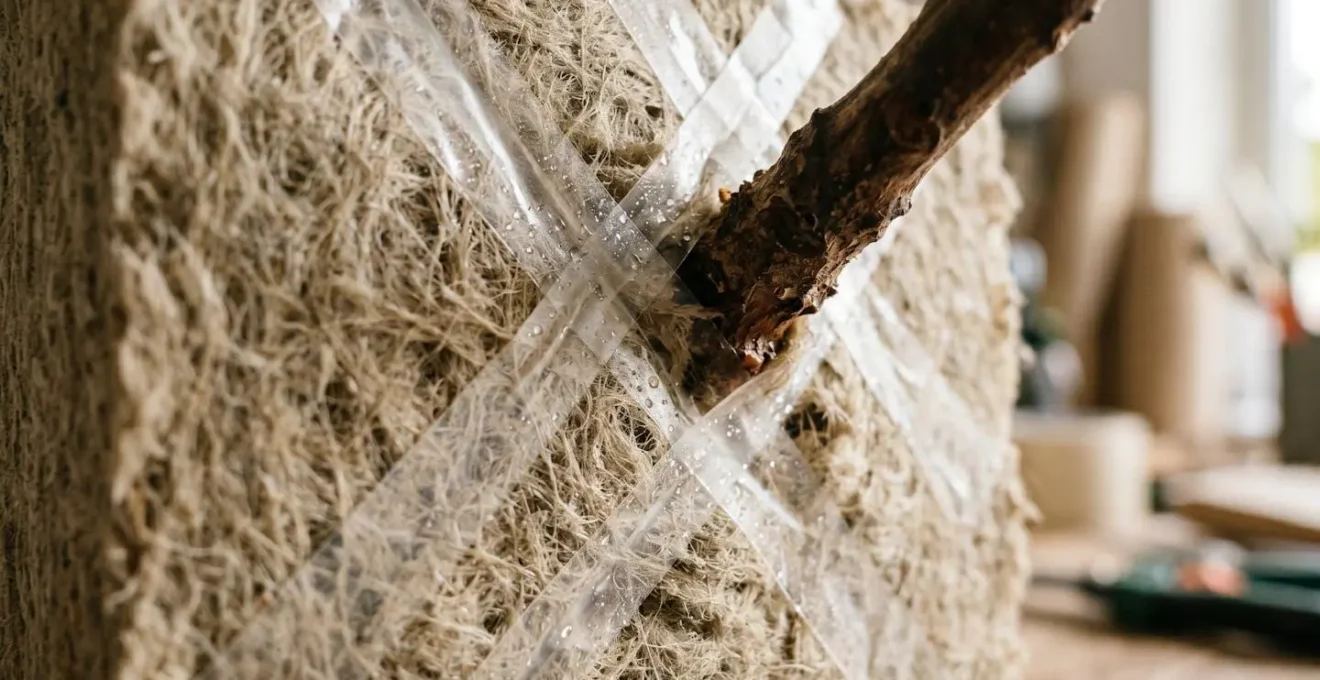
The image above demonstrates how a simple tape grid creates a secure intersection point. The stem is held by the tape, not just the wool. This technique transforms the wool from a soft base into a component of a highly engineered system. This approach is not a compromise; it’s a more resilient and often more secure method of construction, as proven by florists working in demanding conditions.
Case Study: Outdoor Wedding Success with Combined Mechanics
A professional florist shared their experience using Agra-Wool for large-scale outdoor wedding arrangements. For long baby’s breath runners, they combined a chicken wire base with blocks of Agra-Wool. Despite high temperatures, the stems were inserted easily into the hydrated wool, and the entire structure remained stable and hydrated throughout the event. This demonstrates that combining an external support structure (chicken wire) with Agra-Wool’s hydration capabilities is a highly effective strategy for securing arrangements, even in challenging environments.
Composting: Does Agra-Wool Really Break Down in a Home Compost?
The promise of a “biodegradable” alternative is a major draw, but it’s important to understand what that means. Agra-Wool will not break down in your compost bin in the same way a banana peel does. It is not organic matter. It’s crucial to be precise: Agra-Wool is made of basalt, a type of volcanic rock. Composting it is a process of degradation, not decomposition. The sucrose binder (about 3% of the product) will be consumed by microbes, but the basalt fibres (97%) will simply break down into their mineral state: basalt sand.
Thinking of it as a “disappearing act” is incorrect. A better way to frame it is as a soil conditioner. Instead of creating a waste product that harms the environment (microplastics), you are creating a soil amendment that can improve it. Basalt sand is known to be beneficial for soil health. As noted by the floral blog The Botanic Edit (formerly Miller Rose Botanic), this end-of-life process is a significant benefit: “Sideau is 100% biodegradable; the only product that remains when it breaks down is basalt sand. Basalt sand has been found to boost crop production, improve soil health and increase nutrient availability.”
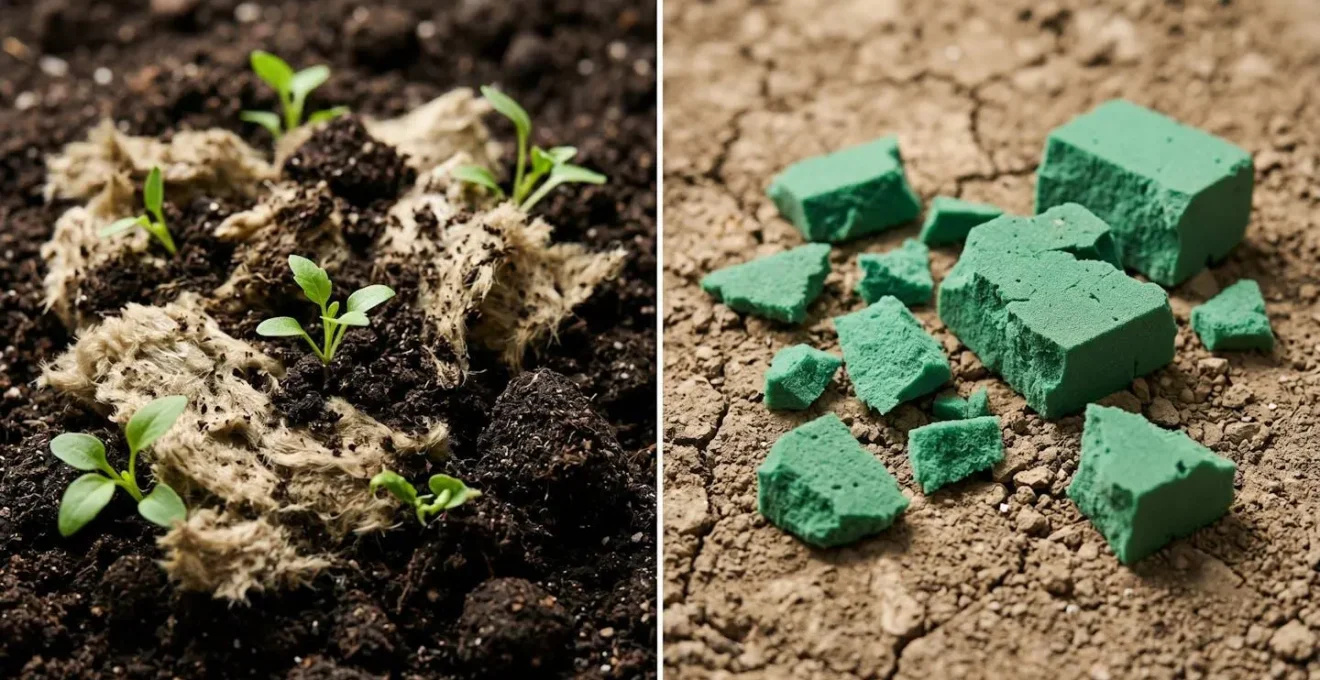
The visual contrast is stark. On one side, you have a material that integrates back into the earth, returning minerals to the soil. On the other, you have a plastic that fragments into ever-smaller toxic particles, creating permanent pollution. To aid this process, you can help the Agra-Wool break down faster by increasing its surface area. Breaking it into small chunks and adding it to a hot compost pile will accelerate the degradation of the binder. Alternatively, you can crumble it directly into your garden beds, where it will function similarly to perlite or vermiculite, improving aeration and drainage while slowly releasing beneficial minerals.
Price per Brick: Is Sustainable Always More Expensive?
Let’s address the bottom line. Yes, on a per-brick basis, Agra-Wool has a higher initial cost than traditional floral foam. A quick search reveals that, as cited by Miller Rose Botanic, “you can get Oasis foam for just over $1 a block.” The upfront investment for a sustainable alternative is undeniably larger. However, focusing solely on the initial price per brick is a misleading way to calculate the true expense. A professional florist must consider the Total Cost of Ownership (TCO).
Floral foam is a single-use product. Every arrangement requires a new brick, a new expense. After one use, its destiny is the landfill, where it contributes to long-term pollution. Agra-Wool, when handled correctly, can be reused. By wrapping it in chicken wire to maintain its form, the same block can be re-hydrated and used for multiple arrangements. This immediately begins to amortize the initial cost. Furthermore, there’s the disposal cost of foam—not just landfill fees, but the less tangible, yet increasingly significant, cost to your brand’s reputation.
Today’s clients, particularly in the wedding and event space, are actively seeking vendors with demonstrable sustainable practices. Being able to market your business as “foam-free” is a powerful differentiator that can attract premium clients and justify higher price points. The “cost” of Agra-Wool should be weighed against the marketing value it generates. When you factor in reusability, disposal, and brand positioning, the financial equation looks very different.
This table from a comparative analysis by The Botanic Edit helps to visualize the Total Cost of Ownership beyond the simple sticker price:
| Cost Factor | Traditional Floral Foam | Agra-Wool/Sideau |
|---|---|---|
| Price per brick | ~$1+ per block | Higher initial cost per brick |
| Reusability | Single-use only | Can be reused with chicken wire wrap |
| Disposal cost | Landfill fees, environmental guilt | Free composting or soil amendment |
| Marketing value | None | Premium eco-friendly positioning |
| Long-term cost per use | Higher due to single-use | Lower when amortized across multiple uses |
The Pillow Technique: How to Scrunch Wire for Maximum Grip?
For arrangements in low or wide vessels where tape grids aren’t practical, the “chicken wire pillow” is your most powerful tool. This isn’t just about loosely stuffing wire into a vase; it’s a structured technique that creates a robust and flexible armature for your stems. The goal is to create a dense, springy mesh that both holds stems in place and allows you to reposition them as you design. The real artistry comes from layering different gauges of wire for both strength and ease of use.
The core principle is to use a heavier gauge wire for the outer structure and a lighter, more pliable wire for the inner “scrunch.” The outer wire, perhaps a 1-inch mesh, can be shaped to the vessel and taped securely in place. This forms a rigid cage. Inside this cage, you scrunch up a lighter gauge wire to create the dense pillow that will actually grip your stems. This inner pillow provides the thousands of contact points needed for a secure hold.
A pro-level refinement of this technique involves creating strategic “locks” within the wire pillow. When you are scrunching the inner wire, intentionally leave a few wire ends pointing upwards. After you insert a particularly heavy or important stem, you can simply find one of these nearby upward-pointing ends and bend it over the stem, locking it firmly in place. This provides an incredible amount of security, preventing even the heaviest stems from shifting.
One critical reminder for all wire-based mechanics: the wire provides support, but not water. You must ensure all your stems are long enough to reach the water reservoir at the bottom of the vessel. Your arrangement will only be as long-lasting as its shortest stem’s access to water. Mastering this layered wire technique gives you complete creative freedom, allowing for airy, gestural designs that are impossible to achieve with the rigid confines of foam.
Key Takeaways
- Mastery over foam is about technique, not just material swapping. Agra-Wool is a water source, requiring you to build external or internal support structures.
- The end-of-life for Agra-Wool is an environmental asset (a mineral-rich soil conditioner), whereas foam’s end-of-life is a permanent liability (microplastic pollution).
- So-called “bio-foams” often represent a greenwashing trap, breaking down into microplastics even faster than traditional foam and posing a greater immediate risk to wildlife.
Bio-Foam: Is It Really Biodegradable or Just Breaks Down Faster?
In the search for sustainable alternatives, a category of products often marketed as “biodegradable foam” or “bio-foam” has emerged. These products can be tempting, offering the familiar density and function of traditional foam with a seemingly green halo. However, this is a critical area where florists must be exceptionally vigilant. The term “biodegradable” can be deeply misleading. Most of these products are still polyurethane-based plastics, simply engineered to break apart more quickly.
The problem is that they don’t biodegrade into harmless natural components. They just fragment into microplastics faster. This arguably makes them even more dangerous to the environment than traditional foam. A solid block of foam might be collected and sent to a landfill (which is still a problem), but a foam that rapidly disintegrates into microscopic particles creates an immediate and widespread pollution issue, easily ingested by wildlife.
This is not an opinion; it is a scientific reality confirmed by researchers. As leading microplastics researcher Dr. Thava Palanisami states, the danger is acute: “Products like this can be even more damaging if they end up in the environment as they turn into microplastics faster.” He goes on to explain that the specific conditions required for these plastics to fully break down are rarely, if ever, met in a natural environment, meaning they persist indefinitely as micro-contaminants.
Therefore, it is essential to look beyond marketing claims and investigate the material science of any product you use. A truly sustainable alternative should not be petroleum-based and should not result in microplastic, regardless of how quickly it breaks apart. The following matrix compares the real-world end-of-life impact of common mechanic choices.
| Mechanic Type | Material Source | Water Retention | Reusability | Home Compostable | End-of-Life Impact |
|---|---|---|---|---|---|
| Traditional Floral Foam | Petroleum-based (phenolic resin) | Excellent | No – single use | No – landfill only | Permanent microplastics + toxic leaching |
| Bio-Foam | Polyurethane + additives | Excellent | No – single use | No – breaks into microplastics faster | Accelerated microplastic formation |
| Agra-Wool/Sideau | 97% basalt + 3% sucrose binder | Very Good | Yes – with chicken wire | Yes – becomes basalt sand | Beneficial soil amendment |
| Chicken Wire | Metal | None (water in vessel only) | Yes – indefinitely | N/A – recyclable metal | Recyclable, no pollution |
Why Is Floral Foam Toxic and What Are the UK Regulations?
The case against floral foam isn’t just about its physical form as a microplastic; it’s also about its chemical composition. Floral foam is a phenolic resin plastic, which contains a cocktail of chemicals, including formaldehyde, a known human carcinogen. When you soak a brick of foam, these chemicals can leach into the water, which is then absorbed by the flowers and can be inhaled by you, the florist, from the dust. The U.S. Environmental Protection Agency classifies formaldehyde as a probable human carcinogen. This presents a direct health concern for professionals who handle the product daily.
This toxicity, combined with the undeniable environmental impact of its microplastic pollution, has led major horticultural institutions to take decisive action. In the UK, the most significant move came from the Royal Horticultural Society (RHS), which, after extensive research and consultation, took a firm stance. As confirmed by the Royal Horticultural Society, floral foam was banned from all RHS Shows from 2021. This landmark decision sent a powerful message throughout the global floristry industry: high-level, award-winning floral design no longer requires this toxic material.
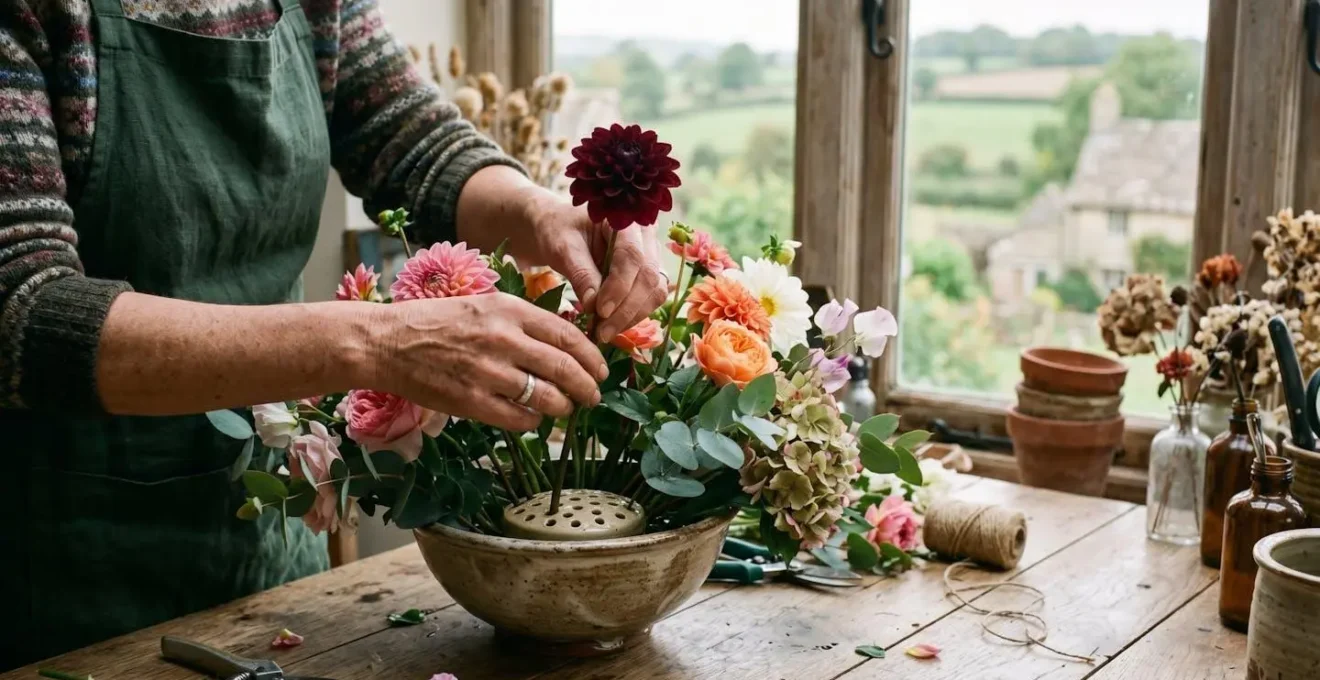
The ban proved to be a catalyst for creativity, not a limitation. It forced designers to rediscover and innovate with sustainable mechanics, from traditional pin frogs (kenzans) and chicken wire to newer materials like Agra-Wool. The results were spectacular, proving that excellence and sustainability are not mutually exclusive.
Case Study: Gold Medals Without Foam at RHS Chelsea
At the 2021 RHS Chelsea Flower Show, the first year of the foam ban, designers rose to the challenge magnificently. The National Association of Flower Arrangement Societies (NAFAS), a pillar of the floral design community, created a breathtaking series of floral sculptures under the theme ‘Nature’s Sculptures.’ Using entirely foam-free mechanics, their designs were not only structurally sound and beautiful but also earned a coveted gold medal. This triumph demonstrated unequivocally to a global audience that the highest standards of floral artistry can be achieved—and celebrated—without resorting to traditional floral foam.
Your journey to sustainable floristry starts not with a purchase, but with a commitment to learning new skills. By embracing these techniques, you’re not just eliminating a harmful product; you are actively investing in the longevity of your craft, the health of your clients, and the future of the planet. Begin practicing these mechanics today, and transform your work from the base up.