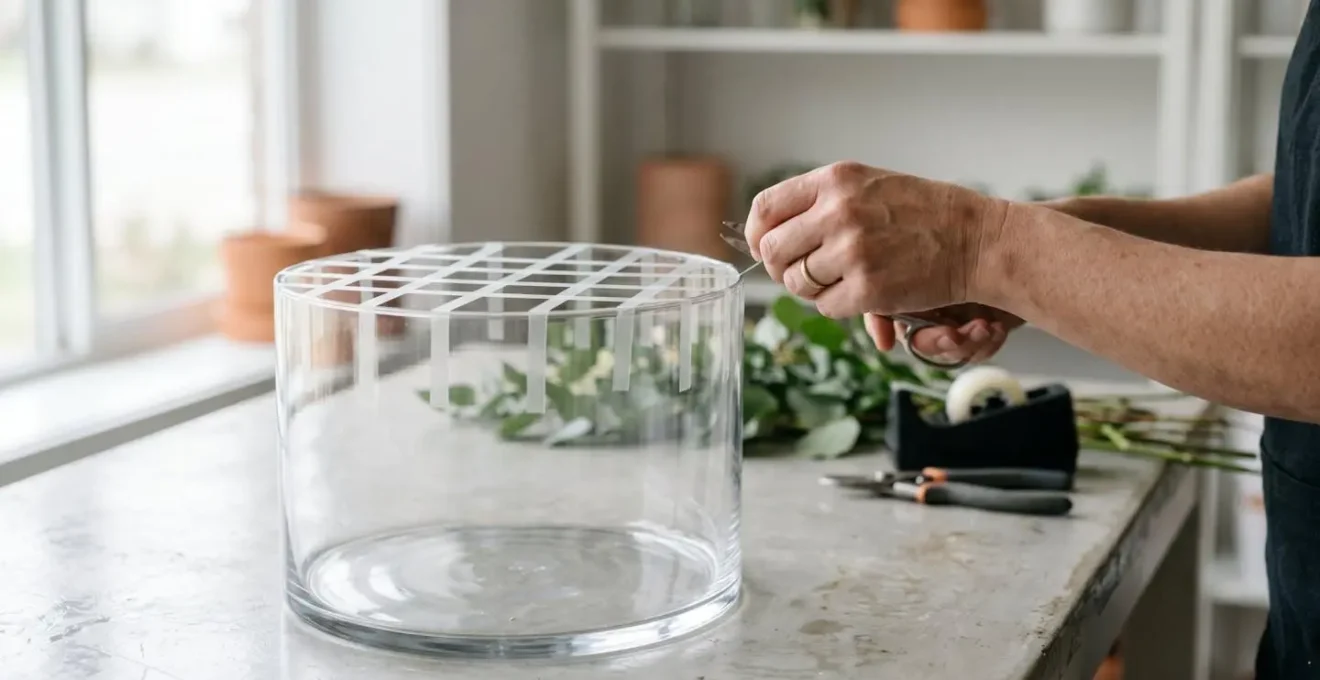
The secret to flawless floral mechanics isn’t just practice; it’s understanding the physics of adhesion and tension to eliminate failures before they happen.
- A bone-dry, degreased surface is non-negotiable for achieving the molecular bond required for pot tape adhesion.
- The choice between 6mm and 12mm tape is a structural engineering decision based on stem weight and grid density.
- Redundant systems, like the ‘Belt and Suspenders’ method, are the professional standard for high-stakes event work.
Recommendation: Stop blaming the tape. Start mastering surface preparation and tension engineering to build a reputation for indestructible, invisible mechanics.
Every florist knows the feeling. A sinking stomach as you watch waterproof tape—your primary structural support—begin to peel away from a cold, damp vase. It’s a moment of quiet panic that undermines confidence and threatens the integrity of your entire design. The common advice is to “make sure the vase is dry,” but for a professional, this platitude is insufficient. When your reputation depends on arrangements that can withstand transport, temperature changes, and the long hours of an event, you need more than rules of thumb; you need to master the underlying science.
This is where we move from amateur habits to professional engineering. The failure of pot tape is rarely about the quality of the tape itself, but almost always a failure in understanding the physics of adhesion and the mechanics of tension. A truly flawless finish, where the mechanics are both indestructible and completely invisible to the guest, doesn’t come from luck. It comes from a technical, systematic approach to building your arrangement’s hidden skeleton.
This guide is not another basic tutorial. It is a technical manual for the working florist. We will dissect the critical decisions you make in the workroom, from selecting the correct tape width for specific load-bearing tasks to the chemistry of removing stubborn adhesive without damaging expensive glassware. We will explore the engineering principles behind anchoring structures and introduce sustainable, reusable mechanics that deliver both performance and eco-conscious credentials. Prepare to move beyond simply using tape and start engineering your floral designs for absolute success.
This article provides a comprehensive technical breakdown of essential floral mechanics. Explore the detailed sections below to elevate your craft from foundational principles to advanced applications.
Summary: A Technical Deep Dive into Floral Pot Tape Mechanics
- 6mm vs 12mm: Which Tape Width Is Best for Grid Mechanics on Wide Vases?
- Dry Vase Rule: Why Must the Surface Be Bone Dry Before Taping?
- Foliage Covering: How to Conceal Your Tape Grid So the Guest Never Sees It?
- Oasis vs Generic: Is Branded Pot Tape Worth the Extra Cost?
- Sticky Vases: How to Remove Tape Glue Without Damaging Glass?
- Tape Cross: How to Anchor Your Wire Pillow so It Doesn’t Pop Out?
- Cable Ties vs Wire: How to Secure Foam Cages to the Arch?
- Chicken Wire Mechanics: The Reusable Skeleton of Eco-Floristry
6mm vs 12mm: Which Tape Width Is Best for Grid Mechanics on Wide Vases?
The choice between a 6mm (1/4 inch) and a 12mm (1/2 inch) pot tape is not a matter of preference, but a critical engineering decision. The width of the tape directly impacts its surface area of adhesion and its tensile strength, dictating the weight and type of stems it can reliably support. A narrow 6mm tape offers a minimal visual footprint, making it ideal for delicate work in clear glass where invisibility is paramount. However, its lower surface contact means it’s best suited for lightweight stems and smaller grids.
Conversely, the 12mm tape provides a significantly larger surface area, resulting in superior adhesion and torque resistance. This makes it the non-negotiable choice for creating the primary structural grid on wide-mouthed vases intended to support heavy blooms like hydrangeas, or woody branches. It provides the robust foundation needed for dense, large-scale arrangements. For very large or complex designs, a professional technique involves creating a hybrid system. First, establish a primary grid with 12mm tape for strength, then add a secondary layer of 6mm tape to create finer grid squares for precise placement of more delicate stems.
The following table breaks down the technical differences and best applications, allowing you to make an informed, data-driven choice for each specific design challenge.
| Characteristic | 6mm (1/4 inch) Tape | 12mm (1/2 inch) Tape |
|---|---|---|
| Best Use Case | Lightweight designs, delicate stems, clear vases where invisibility is paramount | Heavy stems (hydrangeas, branches), opaque vases, dense structural arrangements |
| Surface Area & Adhesion | Lower surface contact, suitable for minimal weight distribution | Greater surface area provides superior adhesion and torque resistance |
| Visibility in Clear Glass | Minimal visual footprint, nearly invisible from distance | More visible but easily concealed with proper foliage techniques |
| Structural Integrity | Moderate – ideal for stems under 50g per grid square | High – supports heavy blooms and creates a stable grid foundation |
| Grid Spacing Options | Allows tighter, more numerous grid lines for precise stem control | Best for standard 2-3 inch grid spacing on wide vases |
| Professional Application | Bridal bouquets, minimalist designs, small-to-medium vases | Event installations, large centerpieces, wedding ceremony arrangements |
Dry Vase Rule: Why Must the Surface Be Bone Dry Before Taping?
The “dry vase rule” is the most repeated yet least understood principle in floral mechanics. The requirement for a ‘bone dry’ surface is not about preventing the tape from getting wet later; it’s about achieving a perfect molecular bond at the moment of application. Waterproof tape adhesive is designed to create a powerful bond with a clean, dry, non-porous surface like glass or ceramic. Any intervening layer—be it visible water droplets, microscopic condensation, dust, or even fingerprint oils—will catastrophically compromise this bond.
Think of the adhesive as microscopic hooks seeking to latch onto the glass. Water molecules act as a lubricant, filling the microscopic valleys on the glass surface and preventing the adhesive’s hooks from ever making contact. This is why a tape that feels sticky to the touch can fail completely on a damp vase. For professional applications, especially in high-humidity environments or with vases taken from cold storage, a simple wipe-down is insufficient. The surface must be chemically degreased and dehydrated to guarantee a fail-proof foundation.
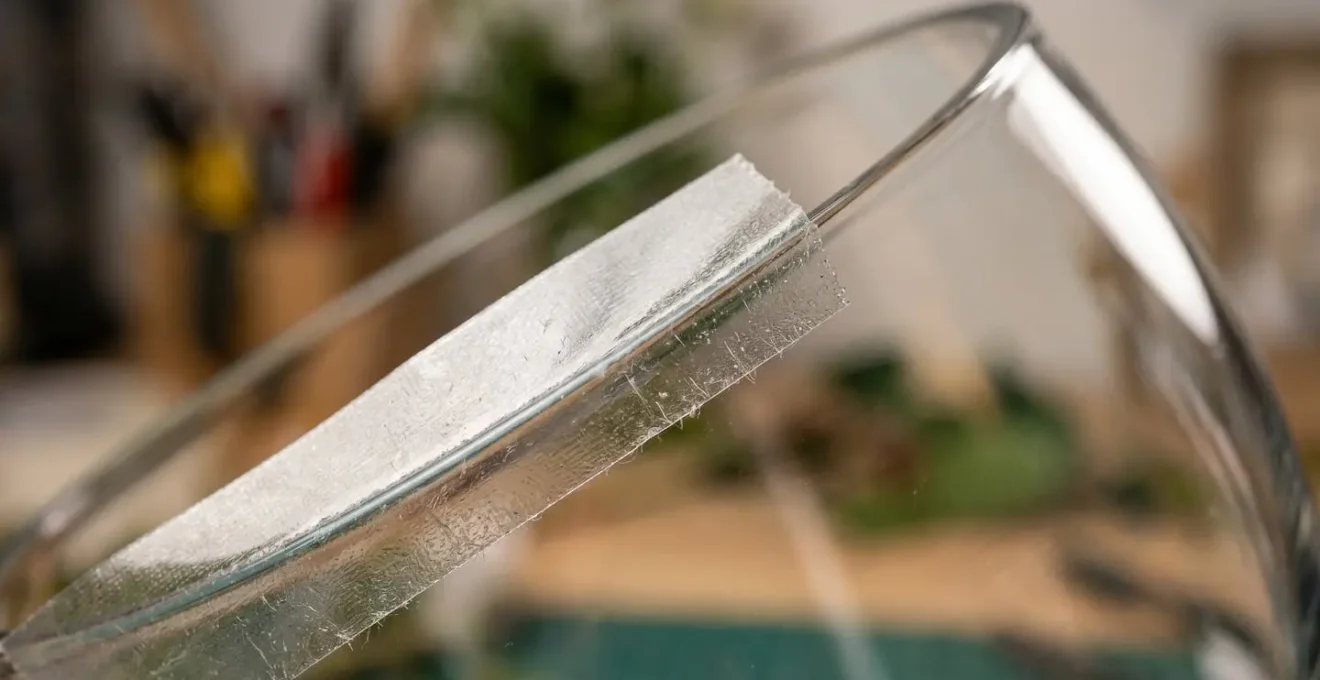
This macro view illustrates the goal: perfect, uninterrupted contact between the adhesive and the glass. Without this foundational bond, all subsequent mechanics are built on a point of failure. The sharp, resonant “snap” of a properly tensioned tape during the ‘Flick Test’ is the audible confirmation of this perfect molecular bond.
Your Action Plan: Ensuring a Perfect Molecular Bond
- Thoroughly wipe the vase rim with a lint-free microfiber cloth to remove any visible moisture, dust, or fingerprint oils.
- For high-humidity environments or cold vases, apply a small amount of isopropyl alcohol (70% or higher) to a clean cloth and wipe the entire rim surface to displace microscopic moisture and degrease the glass.
- Allow the alcohol to fully evaporate (15-30 seconds) until the surface is completely dry to the touch. Do not rush this step.
- Perform the Flick Test: After applying the tape grid under tension, gently flick each tape line. A sharp, resonant snap sound confirms a strong bond; a dull thud indicates poor adhesion and requires immediate re-application.
- Document points of failure: If a tape fails, analyze the cause. Was the surface truly dry? Was the vase cold? Treat each failure as a data point to refine your technique.
Foliage Covering: How to Conceal Your Tape Grid So the Guest Never Sees It?
Once your structural mechanics are securely in place, the art of floristry takes over from the science of engineering. The goal is to make the perfectly constructed grid disappear completely, ensuring the guest’s experience is one of pure, uninterrupted beauty. The most effective and professional method for this is the ‘Foliage Collar’ technique. This involves creating a dense ring of foliage around the perimeter of the vase opening, which serves the dual purpose of hiding the tape and creating a lush, natural-looking base for the rest of the arrangement.
The key to a successful foliage collar is selecting the right material. Low-profile, sturdy leaves with flat backs, such as Salal, Camellia, or Leather Leaf, are ideal. These leaves sit flush against the vase rim and can be layered effectively. The process begins by inserting an initial ring of foliage at an outward angle through the outermost grid squares. A second, denser layer is then added slightly higher and more vertically to completely obscure any view of the tape lines from above or the side.
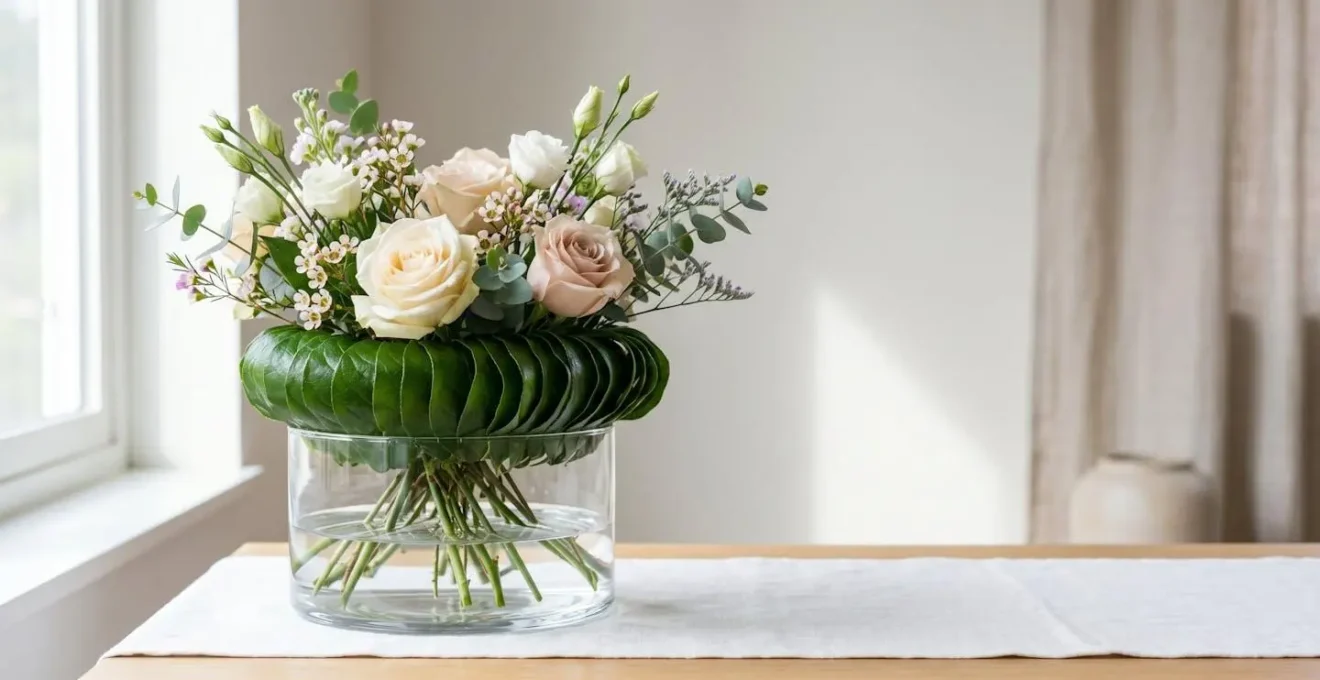
For clear vases, the challenge extends below the waterline. Here, concealment becomes a design element. The tape grid, while strong, can be visually distracting. Professionals turn this into an opportunity by adding decorative elements inside the vase. A layer of polished river stones, a suspension of seasonal cranberries, or elegant slices of citrus not only hide the mechanics but also add a layer of sophistication and visual interest, drawing the eye and completing the illusion of effortless design.
Oasis vs Generic: Is Branded Pot Tape Worth the Extra Cost?
In a professional setting, material selection is a form of risk management. While generic pot tape may seem like a cost-saving measure, its inconsistent performance presents a significant business risk. Branded tapes, such as those from OASIS, are engineered for consistency. They undergo rigorous quality control for tensile strength, adhesive formulation, and performance across a range of temperatures—factors that are often unpredictable in cheaper alternatives. The extra cost of branded tape is not for the name; it’s an investment in reliability and, by extension, your professional reputation.
A generic tape might hold perfectly in your cool workroom but become brittle and snap on a cold vase in a church, or lose its tackiness and peel away in the heat of an outdoor event. Branded tapes are formulated with acrylic adhesives designed for a wide operational temperature range and clean removal, whereas generic tapes often use cheaper rubber-based adhesives that can leave a stubborn, sticky residue. Rather than taking a supplier’s word for it, a true professional understands their materials by testing them. Conducting a simple stress test can provide objective data to justify the investment in premium materials.
Case Study: Wedding Florist Risk Management
For a high-stakes event, material failure is not an option. A case study of a boutique wedding florist highlights this perfectly. By exclusively using branded OASIS waterproof tape for all grid mechanics in shallow vases, the florist ensured that even heavy blooms remained perfectly positioned during transport and throughout the entire event. This eliminated the risk of costly, stressful, last-minute repairs on-site. The slightly higher upfront cost of the branded tape was insignificant compared to the value it provided as ‘event insurance,’ safeguarding the final product, the client’s experience, and the florist’s professional reputation.
Ultimately, while generic tape may suffice for practice, for any project that carries your name and impacts your business, the consistent, predictable performance of a branded product is a non-negotiable component of professional risk management.
Sticky Vases: How to Remove Tape Glue Without Damaging Glass?
The event is over, but the florist’s work is not. One of the most tedious and potentially damaging tasks is removing adhesive residue from expensive rental vases. Aggressive scraping can scratch glass, and harsh chemicals can damage delicate finishes like frosting, paint, or antique lusters. The professional approach to adhesive removal is a tiered protocol that starts with the gentlest method first, escalating only as needed. This minimizes the risk of damage and saves time and frustration.
The first step is always mechanical and thermal. Soaking the vase in hot, soapy water softens the adhesive, often allowing it to be lifted with a non-scratching tool like a plastic scraper or an old credit card. If residue remains, the next step is oil-based dissolution. Common kitchen oils can effectively break down the molecular structure of many adhesives, allowing them to be wiped away easily. The final resort is a chemical solvent like isopropyl alcohol, which is highly effective but must be used with caution. Always patch-test on an inconspicuous area, as alcohol can strip certain decorative finishes.
However, the most professional technique is not about removal, but prevention. The ‘Courtesy Tab’ is a simple, elegant trick that demonstrates foresight and streamlines cleanup. Before the event, by simply folding the last centimeter of each tape strip back on itself, you create a non-sticky tab. After the event, this tab allows for clean, one-pull removal of the entire tape strip, often leaving zero residue behind. It’s a small detail that saves significant time and elevates your service from simply providing flowers to delivering a seamless, professional experience from start to finish.
Tape Cross: How to Anchor Your Wire Pillow so It Doesn’t Pop Out?
When using a chicken wire “pillow” as a sustainable alternative to floral foam, the primary mechanical challenge is preventing it from being pushed out of the vase by the buoyant force of the stems being inserted. The solution lies in tension engineering, using waterproof tape to create a harness that converts this upward force into lateral tension against the strong rim of the vase. The most fundamental and effective harness is the ‘Tape Cross’ or ‘X-Anchor.’
This technique involves applying two strips of taut tape diagonally across the vase opening, forming a perfect ‘X’ that presses down on the wire pillow. The key to success is maximum tension. The tape must be stretched to near its breaking point during application. A loose tape cross is useless; it allows the pillow to shift, which will eventually lead to mechanical failure. For larger or heavier mechanics, this basic X-anchor can be escalated to a ‘Hashtag Anchor’ (#) by using two parallel strips in each direction, distributing the anchoring force across more points on the vase rim.
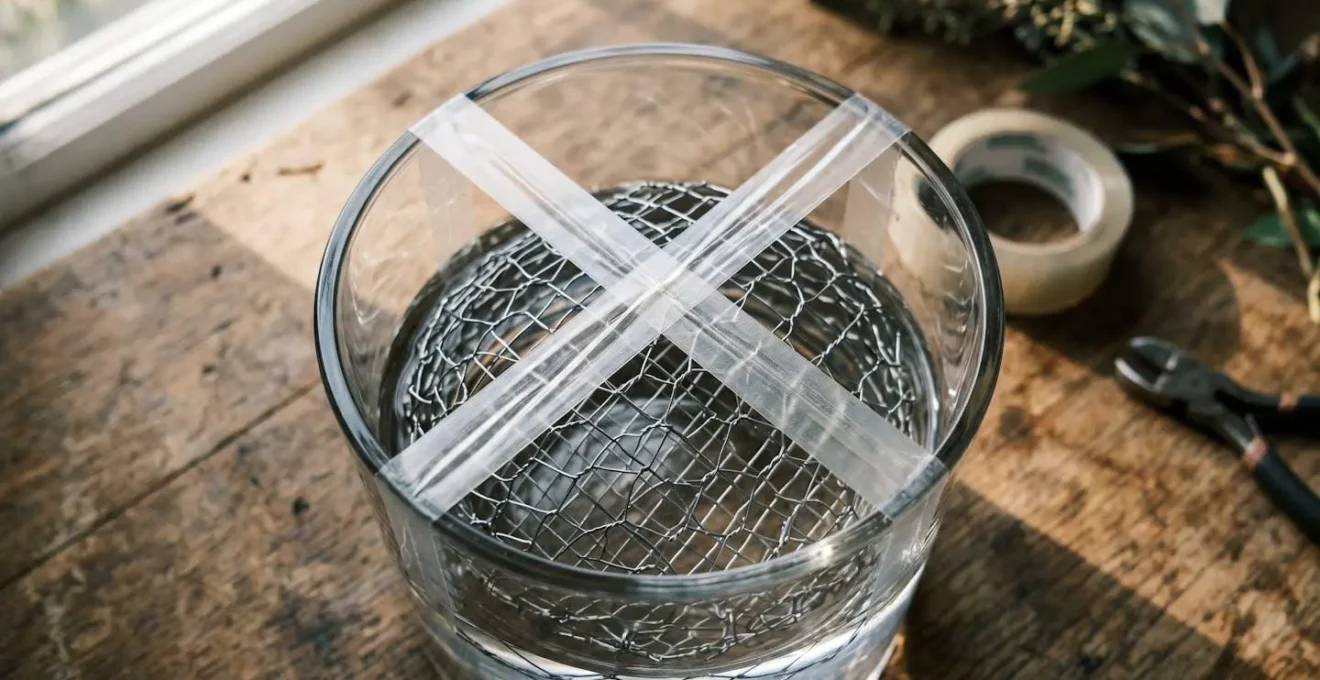
Of course, this tension engineering is entirely dependent on the foundational principle of a perfect molecular bond. Even a perfectly tensioned tape cross will fail within hours if it was applied to a wet or oily surface. The two most common points of failure for wire pillow anchors are insufficient tension during application and inadequate surface preparation. Mastering both is essential for creating a secure, foam-free foundation that will not fail under pressure.
Key Takeaways
- Surface Is Everything: A chemically clean, bone-dry surface is the absolute, non-negotiable foundation for all reliable tape mechanics.
- Engineer Your Grid: The choice of tape width (6mm vs. 12mm) is a structural decision based on load-bearing requirements, not aesthetics.
- Embrace Redundancy: Professional, high-stakes designs rely on dual-attachment systems (‘belt and suspenders’) to guarantee mechanical integrity under all conditions.
Cable Ties vs Wire: How to Secure Foam Cages to the Arch?
When scaling up mechanics for large installations like wedding arches, the choice of fastening material becomes critical. The two industry standards, cable ties (zip ties) and floral wire, each have distinct advantages and are best suited for different applications. The decision is a trade-off between speed, adjustability, and surface compatibility. Cable ties offer unparalleled speed and uniform tension. They are perfect for securing foam cages to smooth, uniform structures like metal or PVC arch frames, where a quick, tight grip is needed. Their main drawback is that they are single-use; once tightened, they must be cut to be adjusted or removed.
Floral wire, on the other hand, offers maximum adjustability. It can be loosened, repositioned, and re-tightened multiple times, making it ideal during the design process. It also ‘bites’ into textured surfaces like wood or bamboo, providing extra grip where cable ties might slip. While slower to install, its reusability makes it a more eco-friendly and cost-effective choice in the long run. The professional choice often depends on the context of the event: high-volume installations on rental arches may favor the speed of cable ties, while custom work on owned structures benefits from the adjustability and sustainability of wire.
The following decision matrix outlines the key factors to consider when choosing your attachment method for arch mechanics.
| Factor | Cable Ties (Zip Ties) | Floral Wire |
|---|---|---|
| Installation Speed | Very fast – simply thread and pull tight in seconds | Slower – requires wrapping, twisting, and securing technique |
| Adjustability | Single-use – once tightened, must be cut to adjust or remove | Highly adjustable – can be loosened, repositioned, and re-tightened multiple times |
| Surface Compatibility | Best on smooth surfaces (metal poles, PVC arch frames) where uniform tension is needed | Best on natural/textured surfaces (wood, bamboo) where wire can ‘bite’ into material for extra grip |
| Holding Strength | Consistent, uniform tension – rated for specific weight loads (check packaging) | Variable strength depending on wire gauge and wrapping technique – allows custom tension |
| Visual Aesthetics | Cleaner appearance – low profile and available in multiple colors (white, green, clear) | Can be less visually appealing – may require more foliage concealment |
| Reusability & Eco Impact | Single-use plastic – faster event breakdown (just cut and discard) but creates waste | Infinitely reusable – unwrap and reuse for multiple events, eco-friendly choice |
| Professional Recommendation | Indoor events, rental arches, high-volume installations where speed is critical | Owned arches, outdoor installations, eco-conscious clients, adjustable setups |
The ‘Belt and Suspenders’ Rule for Outdoor Installations
For large-scale outdoor installations where wind and other environmental factors create unpredictable stress, many professionals refuse to choose between wire and cable ties. Instead, they employ a redundant dual-attachment system. According to industry best practices detailed by floral suppliers, this ‘Belt and Suspenders’ method uses floral wire as the primary, adjustable anchor (the ‘suspenders’) and adds cable ties as secondary reinforcement (the ‘belt’). This provides the adjustable grip of wire during setup and the rock-solid, vibration-proof stability of cable ties during the event, ensuring absolute mechanical security.
Chicken Wire Mechanics: The Reusable Skeleton of Eco-Floristry
In the push for more sustainable practices, chicken wire has re-emerged as a cornerstone of eco-conscious floristry. Unlike single-use floral foam, chicken wire is infinitely reusable, malleable, and ultimately biodegradable as it rusts. This makes it an attractive and responsible choice. Its cost-effectiveness is also a major factor; with a cost of approximately 30 cents per foot when purchased in bulk, it represents a minimal long-term investment for a studio.
The true mastery of chicken wire, however, lies not just in its use but in its full life-cycle management: preparation, use, cleaning, and storage. Proper prep is crucial to avoid damaging expensive vases or your hands; all cut edges must be meticulously folded inward. After an event, the wire must be thoroughly cleaned of all organic matter and disinfected—a soak in a vinegar solution is effective—before being completely dried to prevent rust that could stain future vessels. Storing the cleaned wire balls organized by size makes them a ready-to-use asset for future designs.
As floral expert Dr. James M. DelPrince of the Mississippi State University Extension Service notes, the appeal of this material goes beyond its practical application:
Chicken wire is reusable… it is malleable and can be formed into multiple shapes and sizes… it rusts and disintegrates, which is attractive to floral designers who want to use eco-friendly products.
– Dr. James M. DelPrince, AIFD, PFCI, Mississippi State University Extension Service
The ultimate level of mastery combines sustainability with stability. By using a chicken wire pillow as the primary internal structure and then using a minimal tape cross (as detailed in section 15.3) simply to anchor it, you get the best of both worlds: a reusable, eco-friendly foundation with the rock-solid stability of professional-grade tape mechanics.
By integrating these technical principles—from the molecular science of adhesion to the engineering of tension and the adoption of sustainable systems—you move beyond simply arranging flowers. You begin to engineer beautiful, resilient structures, building a reputation for quality and reliability that is as indestructible as your mechanics.