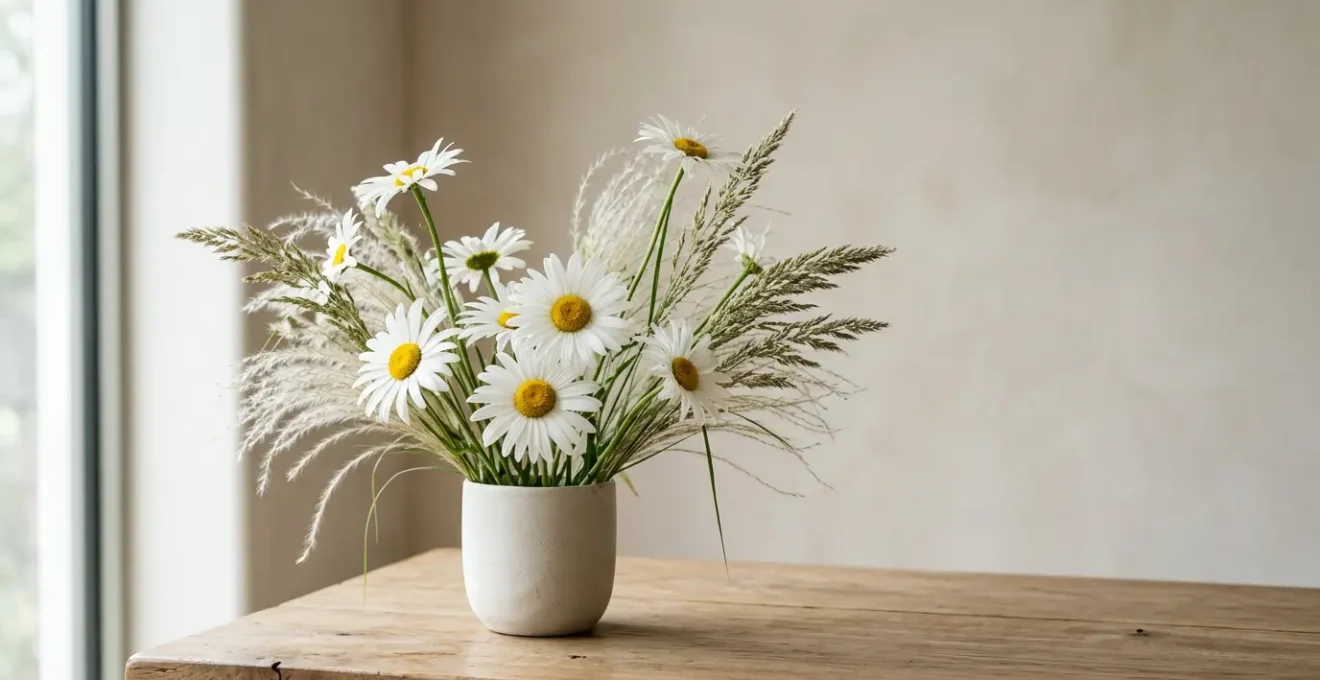
In summary:
- Elevating the common daisy to high-end status depends on sophisticated, often invisible, professional techniques.
- Mastering conditioning, mechanics, and context is essential to move beyond the simple “meadow” look.
- True luxury in floral design now intertwines aesthetics with sustainability and authenticity.
- The most effective designs create a textural dialogue between the daisy and its companion plants.
The daisy. It’s the flower of childhood chains, of “he loves me, he loves me not,” a symbol of cheerful, uncomplicated innocence. For a designer, this very accessibility can feel like a creative dead end. How do you take an element so common, so fundamentally simple, and incorporate it into a design that feels luxurious, intentional, and new? Many will simply group them for a rustic-chic effect or scatter them into a wildflower mix, hoping for the best. This approach, however, often misses the point and results in a look that feels more accidental than artful.
The true challenge—and opportunity—lies in transcending the daisy’s humble reputation. But what if the secret wasn’t to mask the daisy’s simplicity, but to celebrate it through a framework of immense technical skill? What if the most breathtaking “natural” arrangements were, in fact, the product of sophisticated, hidden mechanics and a deep understanding of form, texture, and plant physiology? This isn’t about faking nature, but about curating it with an expert hand.
This guide moves beyond the platitudes of meadow aesthetics. We will deconstruct the techniques required to transform this ubiquitous bloom into a statement of sophisticated naturalism. We will explore how to ensure its longevity, how to pair it for maximum effect, the technical skills for intricate work, and the philosophical approach that underpins a truly high-end, vegetative design style. This is the art of making the simple, sublime.
Explore the professional secrets to elevating the humble daisy. This article details the specific techniques and design principles that transform meadow charm into high-end art.
Summary: A Meadow Stylist’s Guide to High-End Daisy Design
- Sear or Dip: How to Stop Daisies Wilting in 1 Hour?
- Grasses and Daisies: The Perfect Combo for a Country Look
- Ox-Eye vs Shasta: Which Daisy Variety Holds Up Best in Foam?
- Daisy Chains: How to Wire Individual Heads for a Bridal Crown?
- Pressed Daisies: How to Dry Them Flat for Art Projects?
- Weed or Wildflower: How to Use Cow Parsley and Ox-Eye Daisies?
- Bulbs on Roots: Why Leaving the Bulb On Adds Authenticity?
- Natural Vegetative Design: Creating Arrangements That Look Like They Grew There
Sear or Dip: How to Stop Daisies Wilting in 1 Hour?
The number one reason designers hesitate to use daisies, particularly wilder varieties like the Ox-eye, is their notorious tendency to wilt. A drooping head can undermine an entire design within an hour, betraying a lack of technical mastery. The cheerful bloom becomes a symbol of fleeting beauty in the worst way. However, this is a solved problem in professional floristry. The secret isn’t a prayer; it’s a precise conditioning process that requires an understanding of the plant’s vascular system. Preventing wilting is the first and most critical piece of invisible mechanic work you must master.
Many daisy varieties, especially those foraged, release a milky sap when cut. This sap can clog the stem’s vascular tissue (the xylem), preventing water uptake and causing the head to droop. The solution is to seal these cells immediately. This can be done by briefly searing the cut end with a flame or dipping it into boiling water for about 15 seconds. This process, known as cauterization, stops the sap flow and keeps the water-absorbing channels open. Subsequent placement in tepid water with flower food allows the stem to hydrate fully, a step which research on flower conditioning demonstrates can increase vase life by a third. It’s a non-negotiable first step for a high-end result.
Your Action Plan: Conditioning Daisies for Longevity
- Stem Cutting: Cut all stems at a sharp 45-degree angle to create the maximum surface area for water absorption.
- Cell Sealing: For any variety with milky sap, immediately sear the cut stem end with a match or dip it in boiling water for 15 seconds.
- Initial Hydration: Place the conditioned stems in a deep bucket of tepid water containing professional cut-flower food. Let them rest in a cool, dark place for several hours.
- Waterline Hygiene: Before arranging, strip away any and all leaves that will sit below the waterline in the final vase to prevent bacterial growth that fouls the water.
- Structural Support: For daisies with hollow stems, consider inserting a thin wire or a piece of a stronger stem inside to provide extra support and prevent kinking.
This rigorous preparation is what separates a fleeting, homemade bunch from a lasting, professional arrangement. It is the foundational technique upon which all other design work is built.
Grasses and Daisies: The Perfect Combo for a Country Look
Pairing daisies with other bold, traditional flowers can often diminish their charm, making them feel like a filler rather than a feature. To truly capture that sophisticated country aesthetic, the modern meadow stylist thinks less about color and more about texture and movement. This is where ornamental grasses become the daisy’s most crucial partner. The combination creates a textural dialogue: the soft, flat plane of the daisy petals against the airy, linear form of the grass.
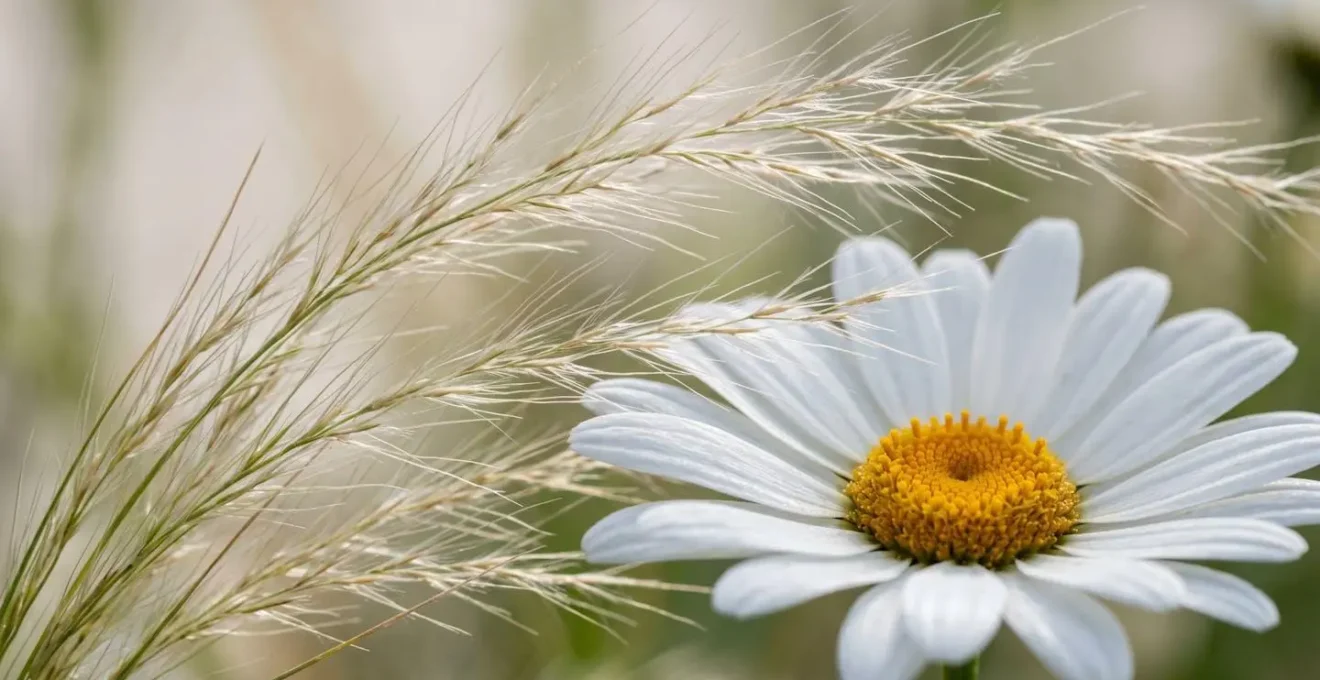
As you can see, the wispy seed heads of a grass like Stipa tenuissima (Mexican feather grass) or the delicate panicles of a Briza media (quaking grass) add a layer of translucence and kinesis to the arrangement. They catch the light and move with the slightest breeze, creating a sense of life that static blooms alone cannot achieve. This approach aligns with the “Meadow Modernism” trend, which, as noted by a recent analysis of contemporary floral design, focuses less on the blooms themselves and more on a study of texture, movement, and negative space. It’s about creating an atmosphere—a feeling of standing in a sunlit meadow—rather than just presenting a collection of flowers.
The key is intentional placement. Let the grasses weave through the daisies, some taller, some shorter, to create depth and a rhythm that feels natural yet deliberately composed. This is curated wildness in its purest form.
Ox-Eye vs Shasta: Which Daisy Variety Holds Up Best in Foam?
The choice between daisy varieties is a crucial decision that impacts both aesthetics and mechanics. The two most common white daisies present a classic “wild vs. cultivated” dilemma. The Ox-eye daisy (Leucanthemum vulgare) is the true wildflower of European meadows. It has a finer, more delicate petal structure and a wiry, resilient stem. The Shasta daisy (Leucanthemum × superbum), a hybrid created by Luther Burbank, is its garden cousin—larger flowers, a more robust and fleshy stem, and a more uniform appearance. For a designer, the question often becomes: which performs better?
Traditionally, the answer was tied to the use of floral foam. The Shasta’s thicker stem inserts more easily and securely into foam, while the Ox-eye’s thinner stem can be more difficult to anchor. However, the modern, high-end designer must confront a more pressing issue: the sustainability of their materials. The conversation around floral foam has shifted dramatically, with environmental experts noting that one block of floral foam is equal to ten plastic bags in terms of microplastic pollution. This single fact has made a reliance on foam untenable for many luxury brands and eco-conscious clients.
This shifts the question entirely. It’s no longer “Which holds up best in foam?” but “How can I create stunning designs without foam?” This is where the supposedly “weaker” Ox-eye daisy shines. Its natural hardiness and lighter weight make it ideal for more sustainable, “invisible mechanics” like chicken wire armatures, pin frogs (kenzan), and interwoven stems. The challenge moves from a simple insertion into foam to a more skillful, thoughtful construction—a hallmark of true high-end design. The Ox-eye, in this context, becomes the more authentic and sophisticated choice.
Ultimately, embracing foam-free techniques not only produces more environmentally sound work but also encourages designs that are more dynamic, airy, and truly reflective of how plants grow in nature.
Daisy Chains: How to Wire Individual Heads for a Bridal Crown?
There is perhaps no greater test of elevating a simple flower than in wearable floral art. A bridal crown made of daisies must be more than a simple childhood daisy chain; it must be an intricate, durable, and comfortable piece of botanical jewelry. This is where the florist’s skill in fine wiring and taping comes to the forefront, transforming a field flower into an object of ephemeral luxury. The goal is to create a structure that is both strong and completely invisible, allowing the daisies to appear as if they are magically floating in place.
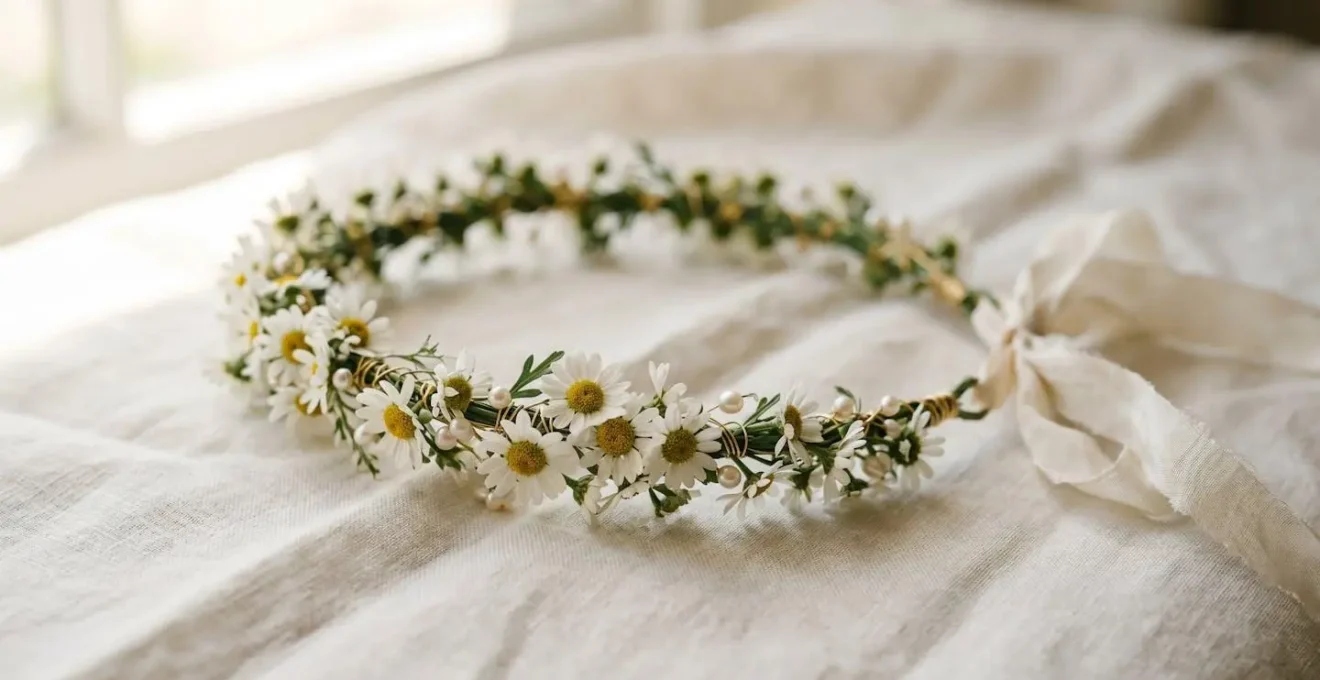
The technique involves individually wiring each daisy head. The process, known as piercing, uses a very fine-gauge florist wire (typically 24 or 26 gauge). The wire is passed through the firmest part of the flower’s calyx, just beneath the head, creating a new, flexible “stem.” This wire is then bent down and often secured with green floral tape (parafilm), which seals in moisture and conceals the mechanics. Once each daisy has its own posable wire stem, they can be intricately woven and attached to a more robust, fabric-wrapped base wire that has been shaped to the wearer’s head. This is also the stage where a designer can introduce other textures, like the tiny freshwater pearls or sprigs of gypsophila shown here, to elevate the design from rustic to refined.
This meticulous, time-consuming process is the definition of high-end floral craft. It’s a testament to the idea that true luxury isn’t about using the most expensive flower, but about applying the highest level of skill to the humblest of materials.
Pressed Daisies: How to Dry Them Flat for Art Projects?
The beauty of the daisy can be preserved long after the fresh-cut season ends through the art of pressing. For a designer, pressed flowers offer a completely different medium, opening doors to creating framed botanical art, delicate stationery, and embedded resin objects. But achieving a perfectly flat, color-true pressed daisy is a science. The key is a rapid removal of moisture while maintaining gentle, even pressure. Any delay or unevenness will result in browning, mold, or wrinkling—the enemies of a polished final product.
While the classic method of pressing flowers in a heavy book works, professional results often require more specialized techniques to maximize color and shape retention. Here are the primary methods used by artists:
- Book Press Method: Place flowers between layers of absorbent parchment paper inside a heavy book. To prevent mold, it’s crucial to change the paper every couple of days for the first week. This slow process (2-3 weeks) is excellent for retaining texture.
- Microwave Flower Press: For faster results, a specialized microwave press (consisting of ceramic plates and felt pads) can dry flowers in minutes. This speed is excellent for preserving the white of daisy petals, which can yellow with slower methods.
- Silica Gel Desiccation: Though typically used for 3D preservation, fine, sand-like silica gel can be used to press flowers by carefully layering them in a shallow container and covering them completely. It provides superior color preservation for fine art applications.
This craft has a rich history, epitomized by the Japanese art of Oshibana. Emerging in the 16th century, Oshibana elevates flower pressing into a discipline of patience and harmony with nature. As the history of this art form shows, modern artists now use advanced technologies like vacuum-sealing and desiccant papers to create breathtakingly detailed and long-lasting works of art. This context transforms a simple craft into a venerable artistic tradition.
Whether for a simple framed piece or a complex Oshibana-inspired mosaic, the quality of the final artwork is determined at the pressing stage. It is a process that rewards patience and precision.
Weed or Wildflower: How to Use Cow Parsley and Ox-Eye Daisies?
What is the difference between a weed and a wildflower? For a meadow stylist, the answer is simple: design intent. Plants like Cow Parsley (Anthriscus sylvestris) and the Ox-eye daisy are often found growing wild in ditches and pastures, frequently dismissed as common or even invasive. However, in the hands of a skilled designer, these very plants are being rebranded as the epitome of a new, sustainable luxury. This shift in perception is at the heart of the “foraged florals” trend, a movement that champions locality, seasonality, and the beauty of the overlooked.
This approach is about seeing the inherent beauty in a plant’s authentic form, free from the constraints of mass cultivation. The delicate, umbelliferous clouds of Cow Parsley provide a perfect textural foil to the bold faces of daisies, creating arrangements that feel airy, light, and deeply connected to their environment. As highlighted in a trend report on foraged florals for luxury weddings, clients are increasingly drawn to botanicals that could be gathered from their own backyards. This desire for authenticity and personal narrative is a powerful driving force in modern luxury. As industry floral trend analysts for The Knot state:
Couples are embracing greenery in ways that reflect their individual tastes, transforming foraged elements into bespoke quality through their ephemeral nature and organic provenance.
– Industry floral trend analysts, The Knot – 2026 Wedding Flower Trends
The “ephemeral nature” and “organic provenance” are the key value propositions. A foraged Ox-eye daisy isn’t just a flower; it’s a piece of a specific place and a specific moment in time. This makes it, paradoxically, more valuable than a generic, mass-produced bloom that is available year-round. It is this act of curatorial selection—the vision to see a wildflower, not a weed—that defines the high-end foraged aesthetic.
Using these materials requires confidence and a strong design vision, turning what others discard into something deeply desirable.
Bulbs on Roots: Why Leaving the Bulb On Adds Authenticity?
In the pursuit of arrangements that feel truly natural, designers are looking beyond the bloom and incorporating the entire life-cycle of the plant. While daisies don’t grow from large bulbs like tulips or daffodils, the principle of showcasing a plant’s origins is directly applicable. The vegetative design philosophy encourages showing plants as they would grow in nature, and for many meadow flowers, including daisies, this means growing in clumps with exposed roots and soil. This technique adds a profound layer of authenticity and storytelling to a design.
The concept, borrowed from the world of bulb flowers, is about honesty and a connection to the earth. Instead of a sterile stem emerging from a vase, an arrangement featuring a clump of daisies with their roots still lightly dusted with soil tells a complete story—from the ground up. It creates a powerful visual narrative that speaks of sustainability, seasonality, and the beauty of the entire organism, not just its flower.
Executing this requires careful technique to ensure the plant remains hydrated and stable:
- Harvesting: The clump must be dug carefully to keep the root ball as intact as possible.
- Cleaning: Gently wash the roots to remove excess soil, but leave enough for visual effect and authenticity. The goal is to see the intricate root structure.
- Hydration: The roots themselves cannot absorb enough water. You must ensure that the cut stems or the base of the plant’s crown are submerged in a hidden water source, like a small dish or a pin frog in a shallow pool of water.
- Mechanics: A heavy, soil-laden root ball requires a stable base. A low, wide vessel and a heavy pin frog (kenzan) are essential to anchor the clump securely and provide a water reservoir.
By showing the roots, the designer makes a bold statement, celebrating the unglamorous, hidden part of the plant’s life and, in doing so, creating a work of profound and earthy beauty.
Key takeaways
- High-end meadow design is defined by technical mastery, not the cost of the flower.
- The most effective arrangements create a dialogue between texture, movement, and negative space.
- Sustainable, foam-free mechanics are becoming a hallmark of modern floral luxury.
Natural Vegetative Design: Creating Arrangements That Look Like They Grew There
We arrive at the synthesis of all these techniques: the philosophy of natural vegetative design. This is the ultimate goal for the meadow stylist. It is the creation of an arrangement that is so authentic, so true to the spirit of the plants, that it appears to have simply grown in place. It’s a breathtaking illusion, where the hand of the designer becomes completely invisible, and nature itself seems to be the sole artist. This style is not about randomness; it is about a deeply studied and masterfully executed form of naturalism.
A true vegetative design respects each plant’s natural growth habit. Daisies are not forced into rigid domes but are allowed to express their individual heights and slight curves. Grasses aren’t clumped symmetrically but are woven through the arrangement as they would be in a field. The design often features a single point of emergence, mimicking how a clump of plants would sprout from the soil. This requires impeccable technical skills, because as the Sustainable Floristry Network points out, this look is a beautiful deception:
The most ‘natural’ looking designs often require the most complex, hidden mechanics—showcasing advanced techniques like hidden water sources and internal armatures used to create the illusion of effortless nature.
– Sustainable Floristry Network, Floral Foam Alternatives Design Principles
This is the central paradox and the ultimate achievement. The “invisible mechanics”—the pin frogs, the chicken wire armatures, the carefully hidden water sources—are all in service of this illusion of effortlessness. The final piece is a statement of contrast: the wild, ephemeral beauty of the meadow contained within a piece of intentional, long-lasting art.
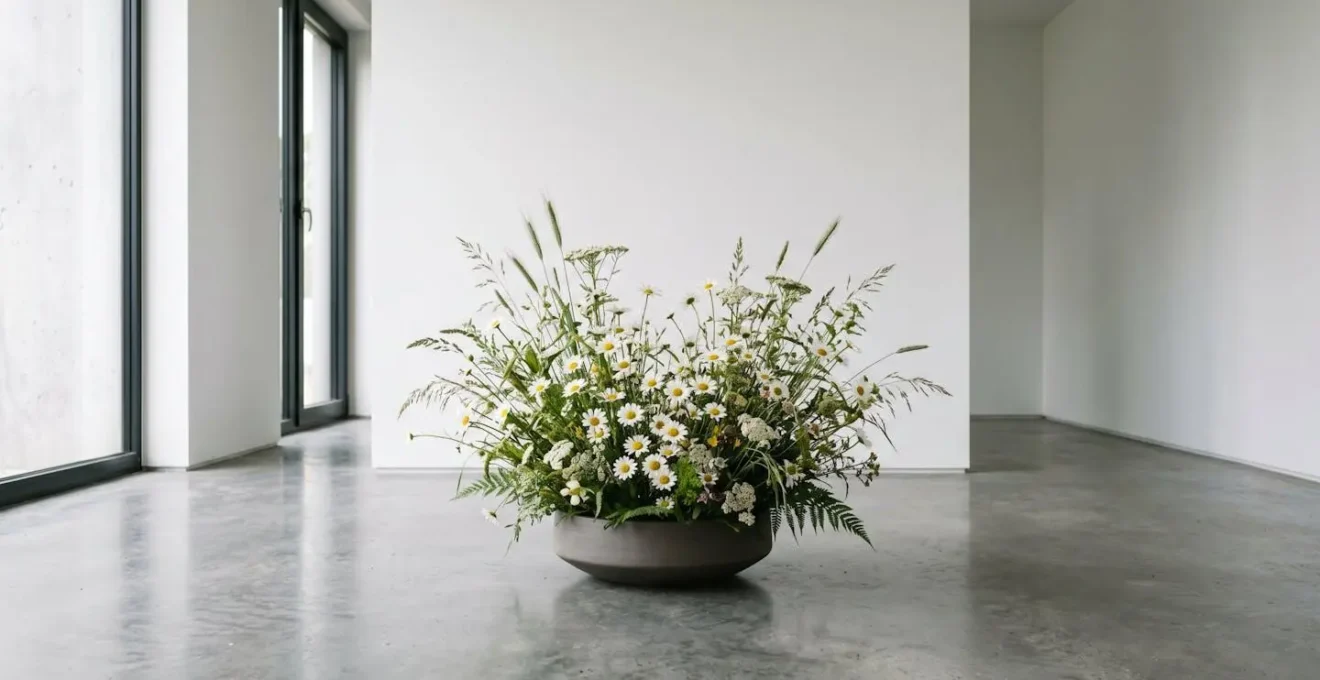
By mastering the techniques of conditioning, wiring, and sustainable mechanics, and by adopting a philosophy that honors the plant’s true character, you can elevate the humble daisy. You transform it from a simple wildflower into a powerful component of sophisticated, living art.