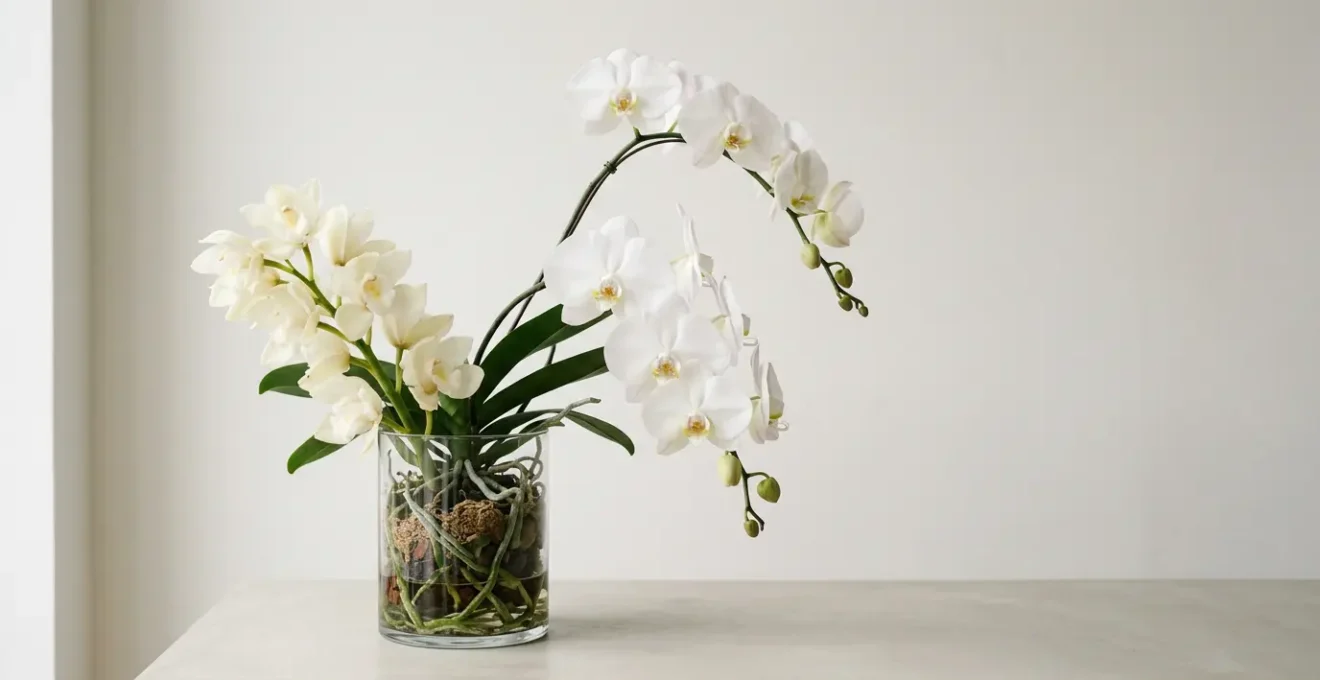
The key to successful corporate floral design isn’t just choosing beautiful flowers, but engineering them for maximum weekly return on investment (ROI).
- Phalaenopsis and Cymbidium orchids offer superior longevity, but only if their specific mechanics—from hydration to temperature control—are professionally mastered.
- Shifting the client conversation from initial price to “cost-per-day-of-enjoyment” justifies the investment in high-quality orchids and demonstrates tangible value.
Recommendation: Adopt a cost-benefit approach by comparing potted plants vs. cut stems, and consider a hybrid rotation model to deliver consistent luxury while controlling long-term costs.
For the corporate florist, the brief is always the same: create something spectacular that elevates a space. Yet, underneath this simple request lies a complex challenge. The client wants luxury, but they also expect longevity. A wilting reception desk arrangement by Wednesday is not just a floral failure; it’s a poor reflection on their brand and your service. While many flowers can provide a fleeting moment of beauty, orchids—specifically Phalaenopsis and Cymbidium—offer a unique proposition for the discerning specialist.
The common wisdom is that orchids are simply an elegant, if expensive, choice. But this view barely scratches the surface. Their true value for corporate environments lies not just in their aesthetic appeal, but in their remarkable engineering potential and economic efficiency. Mastering these flowers requires moving beyond basic floristry and embracing the mindset of a tropical specialist, understanding the intricate mechanics and biological nuances that allow you to deliver predictable, long-lasting luxury. It’s about strategic hydration, temperature control, and a deep understanding of botanical ROI.
This guide moves past the platitudes. We will deconstruct the specific techniques and strategic thinking required to transform orchids from a simple decoration into a high-performance botanical asset. We will explore the mechanics of wiring and water sources, analyze the cost-benefit of cut stems versus potted plants, and reveal the strategies that ensure your designs look as pristine on Friday as they did on Monday.
This article provides a complete framework for mastering orchids in a corporate setting. By exploring the specific mechanics, economic considerations, and care protocols, you will be equipped to deliver not just beautiful arrangements, but strategic, high-value solutions for your clients. The following summary outlines the key areas we will cover.
Summary: A Strategist’s Guide to Phalaenopsis & Cymbidium
- Taping and Wiring: How to Put a Single Orchid Head in a Wedding Bouquet?
- Underwater Orchids: How Long Do They Last Submerged in a Vase?
- Orchid Vials: How to Hide the Water Source in a Garland?
- Cut or Plant: Is It Cheaper to Buy a Plant and Cut the Stems?
- Air Roots: Should You Hide Them or Feature Them in the Design?
- Tropical Care: Why You Should Never Put Orchids in the Fridge?
- The Monday-Friday Rule: Choosing Flowers That Last the Working Week
- Strategic Floral Rotations: The Art of the Hybrid Model
Taping and Wiring: How to Put a Single Orchid Head in a Wedding Bouquet?
The ability to use a single, perfect Phalaenopsis bloom as a floating accent in a bridal bouquet or intricate arrangement is a mark of a true technician. This isn’t achieved by simply pushing a stem into foam; it requires a precise mechanical process of wiring and taping to provide both structural support and a hidden hydration source. Without this technique, the delicate bloom would wilt within hours. The most reliable method is the “hairpin” technique, which creates a stable, artificial stem that can be seamlessly integrated into any design.
This paragraph introduces the core concept of floral mechanics. To truly understand its application, it is helpful to visualize the intricate details involved. The illustration below highlights the precision required in this process.
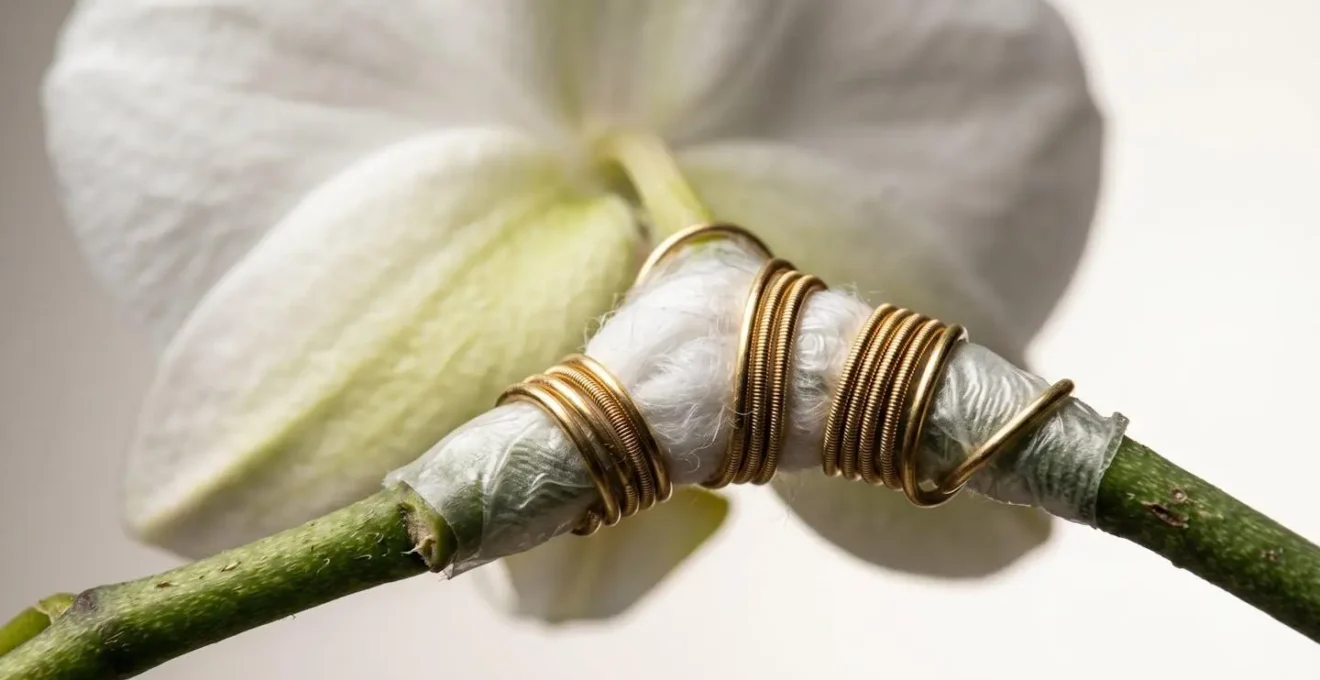
As the image suggests, the process is akin to jewelry making. A U-shaped wire is carefully positioned under the orchid’s throat, a small, wet cotton ball is placed at the end of the natural stem, and the entire assembly is meticulously wrapped with floral tape. This creates a self-contained life support system. Using a 24-26 gauge wire provides the ideal balance of strength and flexibility. The final touch for event work is a light misting with a floral sealant like Crowning Glory, which slows dehydration and preserves the bloom’s pristine appearance throughout a long day.
Underwater Orchids: How Long Do They Last Submerged in a Vase?
Submerged orchid centerpieces create a stunning, modern visual, but they raise an immediate practical question for any florist: how long can they possibly last? The idea of completely submerging a tropical flower feels counterintuitive. However, for certain robust orchids like Cymbidium and Phalaenopsis, this technique is surprisingly effective for short-term, high-impact events. The water acts as a magnifier, enhancing the flower’s color and form while creating a unique, bubble-filled aesthetic.
The key to longevity is water quality and the flower’s condition at the time of submersion. Using distilled water is crucial, as it is free of the minerals and microorganisms found in tap water that can cause cloudiness and accelerate decay. The flowers should be fresh, fully hydrated, and free of any blemishes. While not a long-term solution, this method reliably delivers a flawless presentation for the duration of a typical event. In fact, many professionals have found it surprisingly resilient. As one experienced florist noted in a discussion on event work:
I can honestly say that my centerpieces have lasted a full week this way.
– Professional florist, WeddingWire
This durability makes submerged designs a viable option for weekly corporate contracts, provided the vases are meticulously cleaned and the water changed during weekly service. For a corporate reception, a submerged Cymbidium arrangement can easily hold its pristine look from Monday to Friday, proving that with the right technique, even unconventional designs can meet the demands of engineered longevity.
Orchid Vials: How to Hide the Water Source in a Garland?
Creating lush, flower-dense garlands or large-scale installations presents a significant hydration challenge. How do you keep dozens of individual orchid blooms fresh when they are far from a central water source? The answer lies in one of the most essential tools of the trade: the orchid vial or water tube. These small, capped plastic tubes act as individual life-support systems for each bloom, providing a discreet and reliable water source that can be cleverly hidden within any design.
Case Study: Water Tubes for Cymbidium Orchids in Floral Foam Designs
Professional florists utilize specialized water tubes, particularly for short-stemmed blossoms like Cymbidium orchids, to ensure continuous hydration in complex arrangements. The technique involves securely setting the filled water tube into floral foam alongside other elements. For added height or specific placement, the tube can be taped to a dowel or stake, creating an extender. In delicate wired bouquets, the water tube itself is first wired and taped before being incorporated, guaranteeing that the mechanics are both functional and completely invisible in the final design.
The technique is simple but transformative. Each orchid stem is cut to the desired length and placed in a water-filled tube with a rubber cap that seals around the stem to prevent leaks. These tubes, often available in green or clear plastic, are easily camouflaged with foliage or other decorative elements. For garlands, they can be wired directly onto the base structure. For larger arrangements, they can be tucked into floral foam. While standard water picks are common, true specialists know that industry suppliers offer specialized 2-inch orchid tubes, which are perfectly proportioned for the delicate stems of Phalaenopsis and Dendrobium, ensuring a snug fit and preventing damage. This method of strategic hydration is fundamental to executing ambitious, long-lasting floral installations.
Cut or Plant: Is It Cheaper to Buy a Plant and Cut the Stems?
This is a central economic question for every corporate florist and their client. On the surface, a potted Phalaenopsis plant seems more expensive than a few cut stems. However, a strategic analysis reveals a different story. The concept of Botanical ROI (Return on Investment) requires looking beyond the initial purchase price and evaluating the cost-per-day of enjoyment. When viewed through this lens, the potted plant is almost always the more economical and sustainable choice for long-term contracts.
A cut orchid stem may last for 10-14 days under ideal conditions. A potted Phalaenopsis plant, on the other hand, can remain in bloom for two to three months. After a resting period, it has the potential to rebloom for years. This dramatic difference in lifespan fundamentally changes the value proposition. The following table breaks down the approximate costs, highlighting the stark contrast in daily value.
| Format | Initial Cost | Lifespan | Cost Per Day | Rebloom Potential |
|---|---|---|---|---|
| Potted Phalaenopsis Plant | $60-$90 | 60-90 days bloom + years of reblooming | $0.66-$1.50 (first bloom only) | High – reblooms annually |
| Cut Orchid Arrangement (3-5 stems) | $80-$150 | 10-14 days | $5.70-$15.00 | None |
| Single Cut Stem | Variable (per stem pricing) | 10-14 days | Depends on stem cost | None |
As the data shows, the daily cost of a potted plant is a fraction of a cut arrangement. As Pink Clover Florist aptly puts it, “Per day of enjoyment, plants are dramatically cheaper.” For a corporate client with a weekly floral budget, purchasing elegant potted orchids and rotating them offers a far more sustainable and impressive solution than constantly replacing short-lived cut flowers. Some florists even offer a “lease” program, where they rotate blooming plants for the client and care for the dormant ones off-site, ensuring a continuous display of peak-condition flowers.
Air Roots: Should You Hide Them or Feature Them in the Design?
The wild, silvery-green aerial roots of a Phalaenopsis orchid often puzzle designers accustomed to clean, neat arrangements. The instinct can be to trim them or hide them within the container. However, for a specialist who understands the biology and aesthetics of orchids, these roots are not a flaw to be concealed; they are a unique design element to be celebrated. These roots tell the story of the orchid’s natural habitat and its fundamental nature.
As orchid hobbyist Larry Vierheilig explains, “Most orchids are epiphytes, which means that they cling to other plants or rocks and pull moisture and nutrients out of the air, rather than the soil.” Those “messy” air roots are, in fact, vital, highly specialized organs. Their velvety, greenish-white coating, called velamen, acts like a sponge, absorbing humidity and nutrients directly from the atmosphere. Hiding them completely by packing them into a dense medium can actually suffocate them and lead to rot.
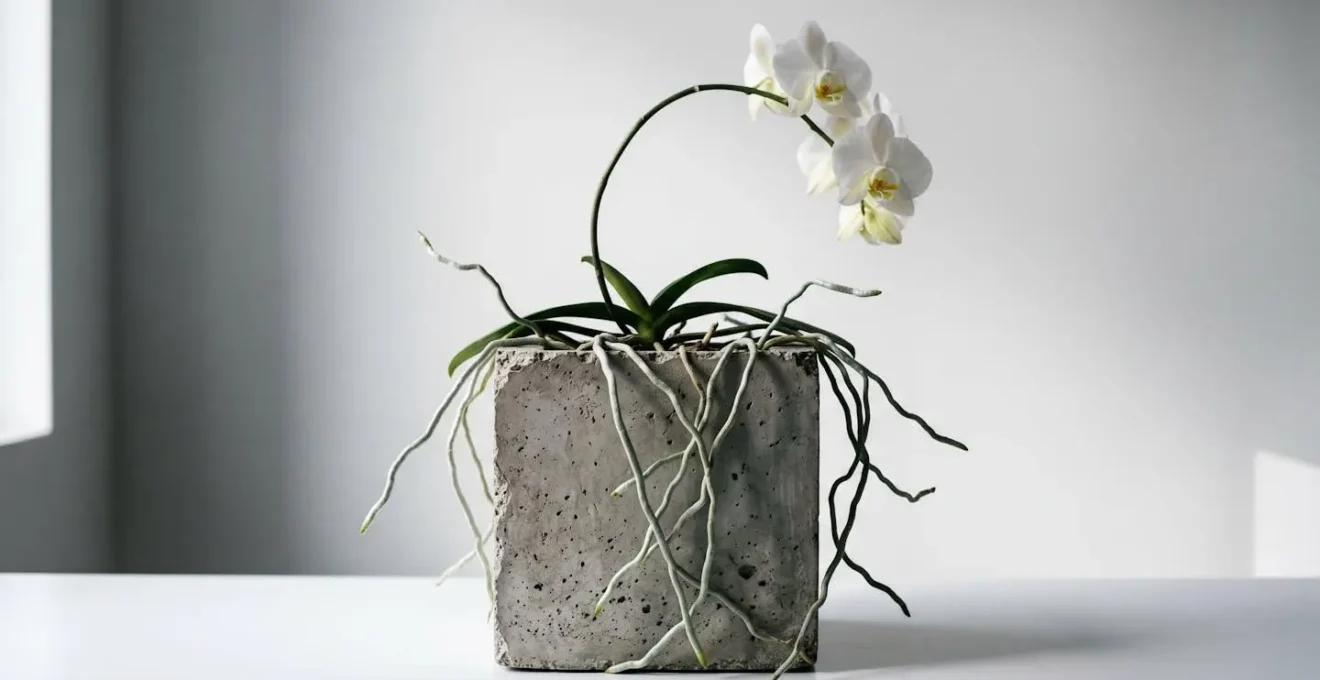
From a design perspective, featuring these roots introduces a powerful element of organic texture and authenticity. In the Japanese aesthetic of wabi-sabi, which finds beauty in imperfection, these untamed roots are the perfect expression of natural, uncontrived elegance. Cascading over the side of a sleek, modern pot, they create a stunning contrast between the wild and the refined. Rather than hiding them, a skilled designer can use them to guide the eye, add movement, and create a composition that feels more alive and deeply connected to the plant’s true character.
Tropical Care: Why You Should Never Put Orchids in the Fridge?
A standard floral cooler, typically kept between 34-38°F (1-3°C), is a death sentence for tropical orchids. While this temperature range is ideal for preserving roses and carnations, it will cause irreversible “chill injury” to Phalaenopsis and Cymbidium blooms. This is a critical piece of biological knowledge that separates a general florist from a tropical specialist. Orchids are not temperate flowers; their cellular structure is not built to withstand cold.
When exposed to low temperatures, the water in the orchid’s cells can freeze, causing membranes to rupture. Even if the temperature is above freezing, the cold can trigger a physiological response that leads to translucent or blackened petals, limpness, and a dramatically shortened vase life. The damage is often not immediately visible upon removing the flower from the cooler, but it will manifest within a day, leading to a frustrated client and a damaged reputation. The absolute minimum safe temperature is a crucial number to know, as floral preservation research indicates that 50°F (10°C) is the critical threshold for most tropicals.
However, this doesn’t mean all coolers are off-limits. The key is temperature control. As Leanne Kesler, Director of the Floral Design Institute, clarifies, there is a nuanced approach for professionals:
They don’t like to be very cold, but if you have a warmer cooler, something more close to 50 degrees, then yes, you could put this in a vase of water, then set it in a plastic bag, completely cover it, creating a hydration chamber.
– Leanne Kesler, Floral Design Institute
This expert advice highlights the principle of modified atmosphere storage. By using a warmer “tropical” cooler and enclosing the orchid to create a high-humidity environment, you can safely hold blooms for an extended period. But the standard, all-purpose floral fridge is, and always will be, the enemy of the orchid.
The Monday-Friday Rule: Choosing Flowers That Last the Working Week
In corporate floristry, the “Monday-Friday Rule” is an unspoken contract. The arrangement delivered at the start of the week must look just as fresh and impressive at the end of the week, withstanding the rigors of office air conditioning, variable heating, and incidental neglect. This is where Phalaenopsis and Cymbidium orchids truly excel, establishing themselves as the gold standard for weekly corporate accounts. Their natural longevity is simply unmatched by most other cut flowers.
While a bouquet of tulips or hydrangeas might struggle to make it to Wednesday, a well-conditioned Cymbidium or Phalaenopsis stem is just getting started. It’s not an exaggeration when professional florists confirm that Phalaenopsis orchids can easily last 2 weeks or more in a vase. This inherent robustness makes them a reliable, low-risk investment for high-visibility areas like reception desks and boardrooms. They project an image of enduring quality—a subtle but powerful message for any corporate brand.
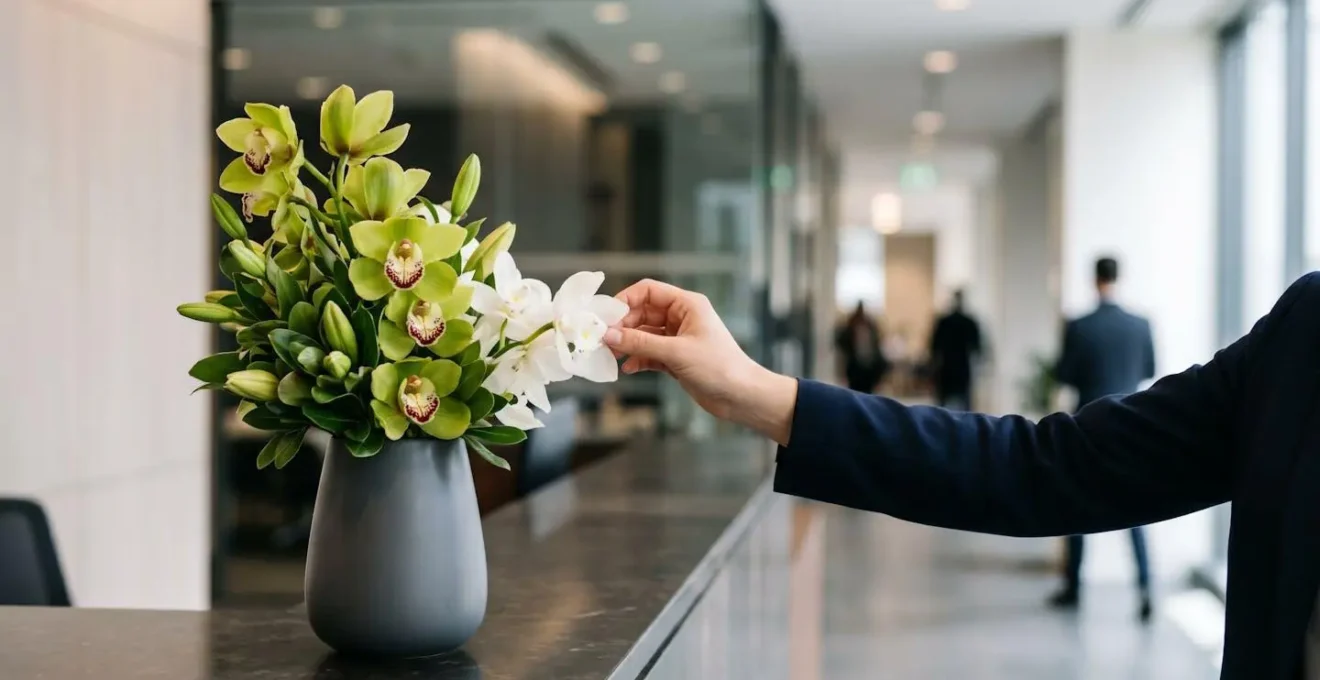
However, professional service doesn’t rely on the flower’s natural strength alone. A true specialist enhances this longevity with a simple but effective weekly maintenance ritual, often performed on a Friday to prepare the arrangement for the weekend and ensure it’s perfect for Monday morning. This proactive care demonstrates a commitment to excellence and justifies the value of a professional service contract.
Action Plan: The Friday Refresh for Monday Perfection
- On Friday afternoon, trim approximately 1 cm (0.5 inch) from the stem bases using sharp, sterilized shears.
- Completely change the water, ensuring the vase is cleaned of any bacterial buildup that may have formed.
- Refill with just enough fresh water to submerge the stems by only 1-2 inches, minimizing stem rot.
- Lightly mist the blooms with clean water to restore humidity lost to office HVAC systems.
- If possible, position the arrangement away from areas affected by weekend HVAC shutdowns or intense sunlight.
- On Monday morning, perform a quick check of the water level and top it off if needed for a pristine appearance.
Key Takeaways
- Shift your mindset from aesthetics to engineering; the value of an orchid is in its mechanical potential.
- Frame the cost conversation around “cost-per-day of bloom” to demonstrate the superior ROI of orchids over other flowers.
- Treat robust orchids like Cymbidiums as long-term architectural elements, not disposable decorations.
Strategic Floral Rotations: The Art of the Hybrid Model
For large corporate spaces with ambitious design goals and finite budgets, the concept of weekly rotations takes on a strategic dimension. The challenge is to maintain a sense of freshness and visual impact across multiple high-traffic areas without the exorbitant cost and waste of replacing every single arrangement each week. This is where the hybrid rotation model, anchored by the architectural presence of Cymbidium orchids, becomes a game-changing strategy.
Cymbidiums, with their tall, stately stems and incredibly long-lasting blooms, are uniquely suited to serve as semi-permanent “anchor” pieces in a corporate setting. Their strong vertical lines and substantial presence allow them to function as architectural elements, humanizing large spaces like atriums and lobbies. A design consultant for Prestige Botanicals captured this perfectly, stating, “Cymbidiums are nature’s skyscrapers—they command vertical space in ways that completely reshape a room’s energy flow.”
Case Study: The Hybrid Rotation Model for a Corporate Headquarters
Faced with a new headquarters featuring 20-foot ceilings, a tech company sought an organic element to “humanize the space” within a tight budget. The solution was a strategic hybrid floral system. Large, dramatic arrangements of long-lasting Cymbidium orchids were installed as permanent statement pieces in high-impact anchor locations. These were then supplemented by smaller, rotating weekly arrangements of fresh-cut stems in secondary spaces like reception areas and conference rooms. This approach significantly reduced cost and waste while maintaining a dynamic and fresh visual experience throughout the building, proving that Cymbidiums can serve as powerful, standalone architectural features.
This model is the pinnacle of strategic floristry. It balances cost, longevity, and impact by using the most robust flowers as a foundational layer of design. The weekly service then focuses on refreshing the smaller, more transient “accent” arrangements. This creates a perception of constant renewal at a fraction of the cost of a full weekly replacement, delivering maximum value for the client and positioning the florist as a savvy strategic partner, not just a decorator.
By shifting the focus from simple aesthetics to engineered longevity and economic strategy, the true value of orchids is unlocked. Mastering these tropical wonders is not about knowing they are beautiful; it is about understanding how to make that beauty a reliable, high-performing asset for your corporate clients. Start thinking like a botanical strategist and evaluate your next project not just on its initial cost, but on its engineered lifespan and visual ROI.