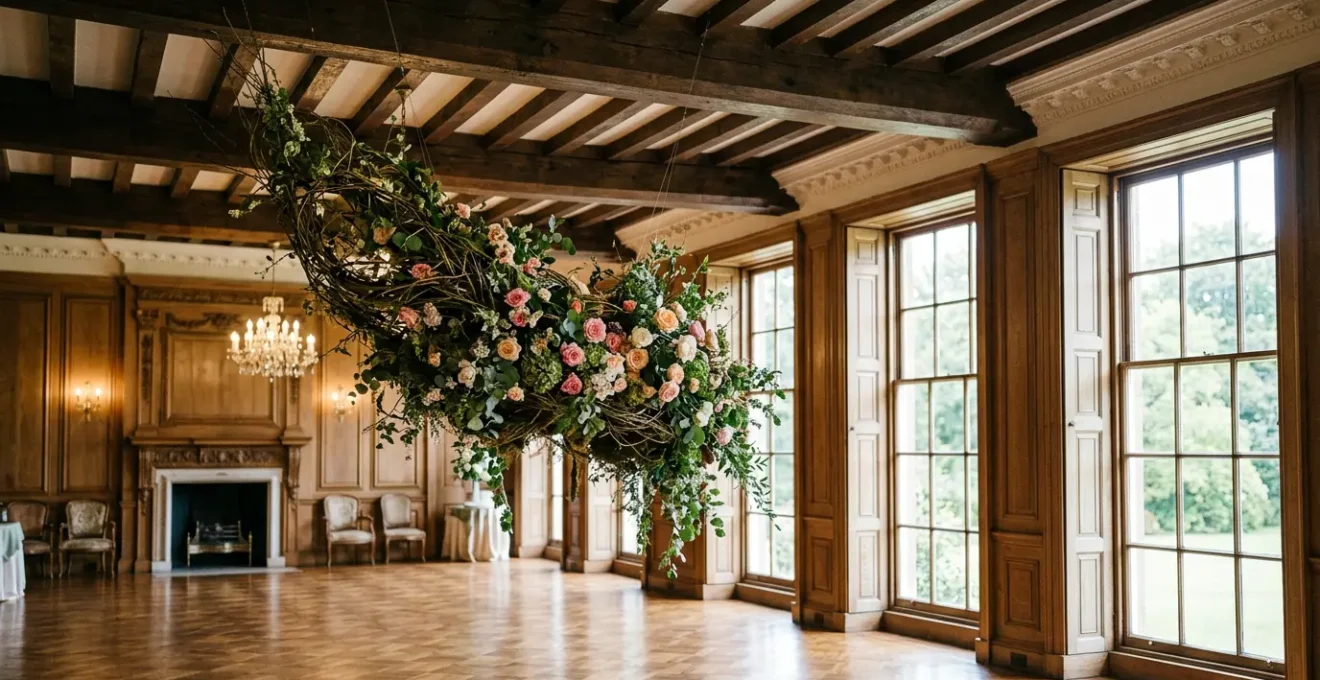
To create high-impact living sculptures, you must shift your mindset from florist to bio-engineer, where structural integrity and safety compliance are as crucial as aesthetics.
- Success depends on mastering the unseen mechanics: wet weight calculations, load-bearing capacities, and UK-specific LOLER regulations for overhead work.
- Pricing for these custom installations must account for design complexity, engineering, risk, and installation labour, not just the cost of flowers.
Recommendation: Begin every large-scale project by requesting technical specifications from the venue and presenting a documented weight-load assessment to establish yourself as an expert partner, not just a supplier.
The vision is always breathtaking: a cloud of flowers floating effortlessly above wedding guests, or a living, breathing wall of foliage that becomes the centrepiece of a corporate gala. As an event planner or floral artist, creating these high-impact installations is the pinnacle of the craft. The internet is filled with inspiration and basic advice, often boiling down to “get some chicken wire” and “think about the venue’s style.” But when you move from Pinterest boards to the reality of a historic UK venue or a vast marquee, these platitudes fall dangerously short.
The truth is, large-scale floral art is not just decoration; it’s temporary bio-engineering. The real challenge lies not in the visible beauty but in the invisible physics, logistics, and legal responsibilities that ensure it stays beautiful—and safely in place. But what if the key to unlocking this next level of artistry wasn’t about finding more creative ideas, but about mastering the structural principles behind them? This is where the true expert emerges: the one who can speak fluently about wet weight, load-bearing points, and professional compliance as easily as they can about colour palettes.
This guide will not just show you what is possible; it will equip you with the foundational knowledge to engineer it. We will move beyond aesthetics to dissect the critical components of creating safe, stable, and stunning living sculptures. We’ll explore how to select the right British-grown structural materials, master the science of keeping flowers alive for 48 hours without soil, understand the forces of gravity and balance, and ultimately, how to cost and charge for this complex, high-value work professionally within the UK market.
This article provides a comprehensive roadmap for transforming your creative ambitions into engineered realities. The following sections break down the essential knowledge, from material science to business strategy, providing the framework you need to design and execute living sculptures with confidence and professionalism.
Summary: Engineering Spectacular Floral Installations for UK Events
- Willow or Dogwood: Which British Branches Create the Best Frameworks?
- Moss and Test Tubes: How to Keep Flowers Alive in a Sculpture for 48 Hours?
- Gravity and Balance: How to Ensure Your Hanging Installation Doesn’t Fall?
- Asymmetry in Design: Why Off-Center Placement Creates Visual Tension?
- Costing Creativity: How to Charge for Labour on a Custom Living Sculpture?
- Weight Loading: How Heavy Is a Wet Floral Cloud?
- Softer Density: How to Secure Heavy Stems in Basalt Wool?
- How to Engineer Gravity-Defying Floral Clouds for Marquee Weddings?
Willow or Dogwood: Which British Branches Create the Best Frameworks?
The best framework material depends on your sculpture’s required form and longevity. For fluid, woven structures and organic shapes, coppiced willow (Salix) is unmatched. Its long, pliable rods, especially when freshly cut or soaked, can be bent into intricate curves and domes. For more rigid, architectural frameworks that require straight lines and strong angles, dogwood (Cornus) offers greater stiffness. Varieties like Cornus sanguinea ‘Midwinter Fire’ also provide stunning winter colour, making the structure itself a design element. Sourcing from British growers who practice coppicing—a traditional woodland management technique—ensures sustainable, high-quality material. In fact, coppicing practices have been documented in the UK for over 6,000+ years, providing a heritage of strong, renewable resources perfect for modern artistry.

The choice is strategic. Willow lends itself to ethereal, cloud-like installations, while dogwood is better suited for geometric backdrops or freestanding sculptures. Consider the venue’s architecture; a historic building with soft lines might be complemented by a woven willow crescent, whereas a modern, minimalist space could be enhanced by a stark dogwood grid. Timing is also critical, as the flexibility and colour of the stems are directly related to the season they are harvested.
Case Study: Cheshire Willow for RHS Chelsea Lunar Installation
At the RHS Chelsea Flower Show, a floral artist created ‘Moon In Bloom,’ a large crescent moon woven from Cheshire-grown willow. The installation featured seasonal British flowers and highlighted sustainable floristry by using only compostable or reusable materials. This project demonstrated how regional British willow varieties can be used to create ambitious shapes that complement their environment while maintaining ecological harmony, proving the material’s versatility for high-profile events.
Understanding the properties of these native materials is the first step in building a sculpture with true structural integrity. A well-chosen framework not only supports the weight of your florals but also becomes an integral part of the artistic narrative. To ensure you’re working with the best materials, it’s vital to understand their lifecycle.
Moss and Test Tubes: How to Keep Flowers Alive in a Sculpture for 48 Hours?
Keeping flowers fresh in a soil-free sculpture for a multi-day event is a science of micro-hydration. The solution lies in creating a network of hidden water sources. For individual or small clusters of flowers, glass or plastic test tubes with rubber caps are the industry standard. They provide a discreet reservoir for each stem. For larger, denser sections, a base of saturated sphagnum moss wrapped around a chicken wire form can retain a surprising amount of moisture. However, it’s crucial to use sustainably sourced moss and ensure it’s thoroughly soaked before installation. The key is to design the sculpture with these mechanics in mind from the start, hiding tubes within the framework and ensuring mossy areas are accessible for re-misting if necessary.
A layered approach often works best. A core of saturated, eco-friendly foam alternative or moss provides a base level of humidity, while individual test tubes target the thirstiest blooms like hydrangeas or delphiniums. Conditioning your flowers properly before they even enter the sculpture is half the battle. This means allowing them a long, deep drink in a cool, dark place for at least 12 hours. For a 48-hour event, you cannot simply “set and forget.” You must have a hydration strategy that accounts for the entire event duration, including planned moments for discreetly topping up water levels.
- Hour 0 (Installation Day Morning): Ensure all water sources are filled to capacity; use flower preservative in test tubes and hidden reservoirs.
- Hour 12 (Evening Check): Discreetly inspect reservoir levels during evening event transition; top up any accessible water sources without disturbing guests.
- Hour 24 (Day 2 Morning): Conduct full water replenishment; replace any wilting stems in accessible areas; mist delicate blooms lightly.
- Hour 36 (Day 2 Evening): Final discrete water check; assess flower condition and document for post-event review.
- Hour 48 (Breakdown): Remove installation; evaluate hydration method success for future installations.
Ultimately, longevity is about proactive planning, not reactive fixes. By building a robust internal hydration system into your design, you can ensure your living sculpture remains vibrant from the first guest’s arrival to the last’s departure, demonstrating a truly professional command of your craft.
Gravity and Balance: How to Ensure Your Hanging Installation Doesn’t Fall?
Ensuring a hanging installation is secure is not a matter of guesswork; it is a legal and ethical responsibility governed by strict UK regulations. Any overhead work involving lifting equipment, which includes the rigging for a floral sculpture, falls under the Lifting Operations and Lifting Equipment Regulations (LOLER). This framework, enforced by the Health and Safety Executive (HSE), which was established in 1974, mandates that all lifting operations must be properly planned by a competent person, supervised, and carried out safely. For a floral artist, this means you are part of a chain of responsibility. You must provide an accurate calculation of the installation’s total weight—including the “wet weight” once hydrated—to the venue and the certified rigger who will install the anchor points.
The principle of balance is equally critical. A sculpture must be designed to hang evenly, without putting undue stress on any single rigging point. This is achieved by finding the sculpture’s centre of gravity during construction. A simple way to do this is to build the framework and temporarily hang it from different points in your studio. Observe how it hangs and adjust the structure or rigging points until it achieves the desired orientation without tilting. Using multiple, distributed anchor points is always safer than relying on a single point, as it spreads the load and provides redundancy. Professional compliance is not an obstacle to creativity; it is the very foundation that allows for ambitious and breathtaking art to be realised safely.
Your LOLER Compliance Checklist for Overhead Floral Installations
- Pre-use Examination: Ensure all lifting equipment (cables, hoists) has a thorough examination report from a competent person, especially if it’s not brand new with an EC Declaration of Conformity.
- Risk Assessment: Position the installation to minimise lifting over people. Plan the installation process to prevent anyone from being struck by the load.
- Load Calculation: Accurately assess all forces involved, including the total wet weight of the sculpture. Apply an appropriate ‘factor of safety’ to guard against failure.
- Regular Inspection: If the installation is in place for an extended period, it may require re-examination. For permanent or semi-permanent setups, examinations are required every 6-12 months.
- Record Keeping: Maintain written reports of all examinations and weight calculations. This documentation is essential for insurance and venue compliance in the UK.
Ignoring these principles is a risk to your business, your reputation, and most importantly, the safety of every person in the room. Embracing them elevates you to a trusted, professional partner capable of executing large-scale projects.
Asymmetry in Design: Why Off-Center Placement Creates Visual Tension?
In floral design, symmetry can feel calm, formal, and predictable. Asymmetry, however, creates energy and movement. Placing a sculpture off-centre introduces a dynamic imbalance that forces the viewer’s eye to engage more actively with the piece and the space around it. This visual tension is not a flaw; it is a powerful artistic tool. An asymmetrical arrangement feels more natural and organic, mimicking the beautiful imperfections found in nature. It creates a sense of curiosity and asks the viewer to explore the composition rather than taking it all in at a single glance. In a large event space, this can be particularly effective for directing flow or creating distinct zones within a larger room.
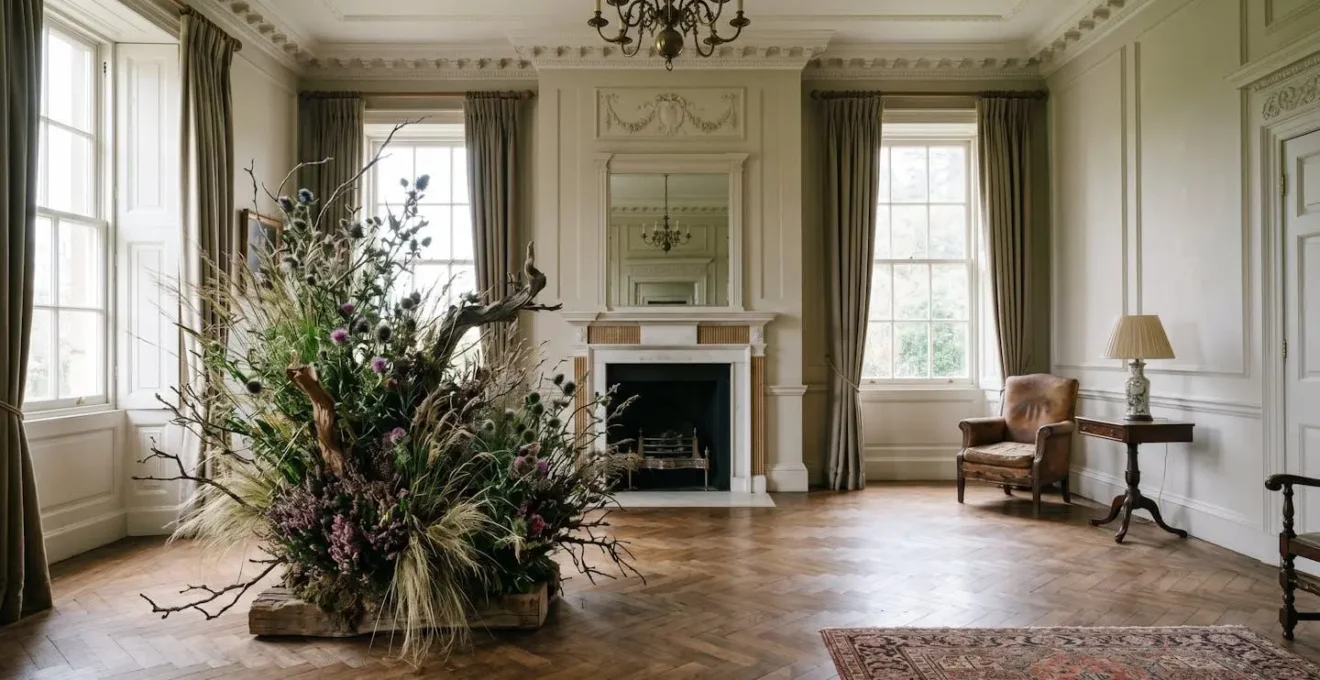
The key to successful asymmetry is not chaos, but intentional imbalance. The design must still achieve a sense of visual balance through other means, such as colour, texture, and scale. A large, heavy mass on one side might be balanced by a smaller, but more vibrant or texturally complex, element on the other. This “weighted asymmetry” feels sophisticated and deliberate. By positioning a wild, organic sculpture against a very formal, symmetrical architectural element—like a Georgian window or a grand fireplace—you create a powerful dialogue between the built environment and the natural world.
Case Study: Asymmetrical Installation at Garden Museum’s British Flowers Week
For British Flowers Week, the creative studio Palais London designed ‘Leaf.Block.’ at the Garden Museum. The piece was a deliberately asymmetrical installation combining concrete blocks with bright pelargoniums and wild stinging nettles. By playing with oppositions—wild versus controlled, private versus public—the installation challenged the conventional expectations of symmetry in British public spaces. This off-centre, abstract form created an engaging visual tension that invited conversation and demonstrated how asymmetry can be a powerful conceptual tool in floral art.
Using asymmetry is a confident design choice. It suggests that the artist is in full control, able to break the rules intentionally to create a more compelling and memorable experience for the viewer. It’s a move away from simple decoration towards a more profound artistic statement.
Costing Creativity: How to Charge for Labour on a Custom Living Sculpture?
Charging for a custom living sculpture is fundamentally different from pricing standard floral arrangements. You are not just selling flowers; you are selling design, engineering, risk management, and artistry. A common mistake is to simply apply a standard markup to material costs. For complex installations, this method drastically undervalues your work. In the UK wedding market, a general guideline is that labour costs typically represent 20-25% of the total price for standard floristry, but for bespoke sculptures, this percentage must be significantly higher to reflect the extensive non-floral work involved.
Your pricing model must account for several distinct labour categories:
- Design & Consultation: The time spent creating concepts, sketching, and meeting with the client.
- Sourcing & Prep: The hours spent sourcing unique materials, from coppiced branches to specialist mechanics, and conditioning the florals.
- Construction (Studio Time): The core build time in your studio. This is often the most significant labour component.
- Installation & Rigging: The on-site labour, which often requires a team and must be performed under tight time constraints. This should be charged at a premium rate.
- Breakdown & Disposal: The labour required to safely dismantle and remove the installation post-event.
The table below, based on an analysis of UK event pricing, shows how bespoke sculptures fit into the highest tier of service, where the price reflects a complete transformation of a space rather than just the provision of flowers.
| Budget Tier | What’s Included (UK Events) | Typical Price Range | Best For |
|---|---|---|---|
| Essentials | Bridal bouquets, bridesmaids, buttonholes, corsages, simple ceremony florals | £1,000 – £1,500 | Intimate weddings, corporate receptions with minimal floral focus |
| Standard | Above + cohesive table décor (low centrepieces), top table design, modest ceremony feature | £2,500 – £4,000 | Average UK weddings (100 guests), mid-scale corporate events |
| Elevated | Above + large statement designs, ceremony installation, tall centrepieces, venue décor (fireplace/staircase) | £5,000 – £7,000 | Heritage venue events, brand activations, luxury weddings |
| Bespoke | Full venue transformation, suspended installations, bespoke sculptures, extensive styling | £8,000+ | Marquee weddings, high-profile corporate launches, premium hospitality spaces |
Ultimately, you must charge for your expertise. Presenting a detailed, itemised quote that breaks down these labour categories helps the client understand the immense value and skill involved. It repositions you from a simple vendor to a creative and technical partner essential to the event’s success.
Weight Loading: How Heavy Is a Wet Floral Cloud?
A floral cloud may look ethereal, but its weight is a serious engineering consideration. The most critical error an artist can make is calculating the load based on the dry weight of the materials. The true weight, or “wet weight,” of a fully hydrated installation can be two to three times its dry weight. This additional mass comes from the thousands of flower stems, water-filled test tubes, and, most significantly, the saturated mechanics like moss or foam alternatives. A single litre of water adds exactly one kilogram to your load, and a large-scale sculpture can hold many litres. Providing a precise wet weight calculation to the venue and rigging team is a non-negotiable part of professional practice in the UK.
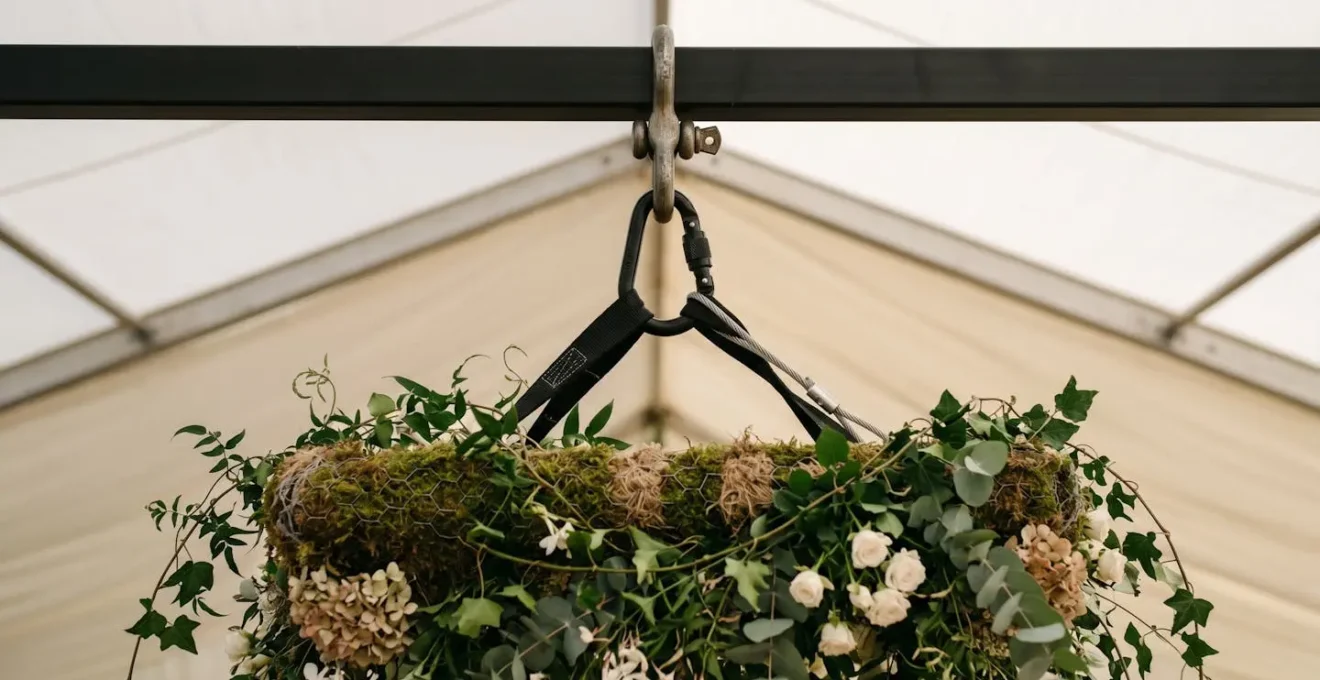
Calculating this weight is a methodical process, not an estimate. You must weigh each component of your dry build: the framework, the chicken wire, the empty containers. Next, calculate the volume of your water-holding mechanics and refer to manufacturer specifications for their saturated weight. Finally, you must estimate the weight of the fresh flower stems and the total volume of water in your reservoirs and test tubes. This detailed breakdown is not just for your own planning; it’s a critical document for venue managers and riggers, who use it to confirm that the structure can be hung safely from the available rigging points without exceeding their load capacity.
Wet Weight Calculation Protocol for UK Venue Managers
- Step 1: Calculate Dry Weight: Weigh all structural materials (willow framework, chicken wire, containers) by weighing a sample section and extrapolating for the full structure.
- Step 2: Mechanic Volume Weight: Determine the volume of your floral foam or alternative mechanic in cubic metres; multiply this by the manufacturer’s specified saturated weight.
- Step 3: Estimate Stem Weight: Estimate the total weight of fresh flower stems. Use an average (e.g., 30-50g for large stems, 10-20g for small stems) and multiply by the total number of stems.
- Step 4: Calculate Water Capacity: Calculate the total water capacity of all hidden reservoirs, test tubes, and saturated mechanics, remembering that 1 litre of water equals 1 kg of weight.
- Step 5: Add a Safety Margin: Add a 20% safety margin to the final total weight. Present this final, documented calculation to the venue manager and rigger for UK insurance and compliance purposes.
Presenting this calculation, complete with a 20% safety margin, demonstrates the highest level of professionalism. It builds trust and shows that you understand the profound responsibility that comes with hanging a heavy object above people’s heads. It is the signature of a true structural artist.
Softer Density: How to Secure Heavy Stems in Basalt Wool?
Basalt wool is an excellent sustainable alternative to traditional floral foam, but its softer, lower density can present a challenge when trying to secure heavy or thick-woody stems. Unlike foam, which grips stems tightly, basalt wool has more give. The solution is not to force the stem, but to build an internal armature or secondary mechanic within the wool itself. This creates the solid anchor points needed for structural integrity while still benefiting from the wool’s superior water-holding capabilities. You are essentially creating a hidden skeleton inside the softer body of the wool.
For large-scale pieces, this armature can be a custom-welded grid or a pre-formed chicken wire shape embedded within the basalt wool block. This internal grid provides multiple points to which you can wire heavy branches, ensuring they are locked into place. For individual heavy stems, a “hybrid Kenzan technique” is highly effective. By embedding traditional Japanese pin frogs (Kenzan) at strategic points within the wool, you create solid metal anchor points that can hold a heavy stem at a precise angle. Furthermore, proper stem preparation is crucial. Splitting the base of a woody stem or cutting cross-notches dramatically increases its surface area, allowing it to grip the fibrous basalt wool more securely.
- Create a Skeleton Framework: Use chicken wire formed into the desired shape. For very large installations, consider commissioning custom-welded grids from a local UK metal fabricator.
- Embed the Armature: Position the wire framework inside the basalt wool block, leaving a 3-5cm margin of wool on all sides for easier stem insertion.
- Hybrid Kenzan Technique: Insert traditional Japanese pin frogs (Kenzan) at key structural points within the wool to create ultra-secure anchor points for the heaviest stems.
- Prepare Your Stems: Split woody stems vertically for 3-5cm from the base, or cut cross-notches. This technique dramatically increases their grip and water uptake in lower-density mechanics.
- Layer Your Density: Use a core of high-density basalt wool for the main structural support, surrounded by an outer layer of lower-density wool for placing more delicate flowers.
By thinking of the mechanics in layers—a strong internal skeleton for support and a soft outer layer for artistry—you can overcome the challenges of lower-density materials. This approach allows you to create large, dynamic sculptures with heavy, architectural stems, all while adhering to sustainable, foam-free principles.
Key takeaways
- Structural engineering is paramount: A living sculpture’s success relies on understanding frameworks, wet weight, and balance, not just aesthetics.
- Professional compliance is non-negotiable: In the UK, adherence to safety regulations like LOLER for overhead installations is a mark of a true professional and a legal requirement.
- Value your expertise: Pricing must reflect the complex labour of design, engineering, risk management, and installation, moving beyond a simple markup on materials.
How to Engineer Gravity-Defying Floral Clouds for Marquee Weddings?
Engineering a gravity-defying floral cloud in a marquee is a specialised discipline that requires close collaboration with the marquee provider. Unlike a permanent venue with known structural ratings, a marquee is a temporary structure. Your first step must be to request the technical specifications for the marquee’s roof purlins, specifically their load capacity in kilograms per linear metre. You must receive written confirmation that the structure is rated for suspended installations and identify the approved rigging points. Attempting to hang a heavy installation without this information is professionally negligent.
Access and timing are also unique challenges in marquees. Your installation window is often limited to the morning of the event, requiring a highly efficient team and a design that can be assembled quickly on-site. You must clarify access times, ceiling height, and what equipment, like scissor lifts, is permitted. If your design incorporates lighting, all electrical components must be PAT tested, and often, the marquee’s own electrician must handle the connections for UK compliance. Working with a company that specialises in high-end installations, such as B Corp certified luxury florist Bloominghaus in London, shows a commitment to these professional standards. Their work on large-scale projects, like a Roksanda Ilincic fashion show at The Barbican, demonstrates the importance of working collaboratively with venue riggers and meticulously documenting weight loads for insurance and safety.
- Structural Capacity: Request the roof purlin load capacity specifications in kg per linear metre from the marquee provider. Verify if the structure is rated for suspended loads.
- Rigging Approval: Confirm the approved rigging methods and attachment points. Ask if the marquee company requires their own certified riggers or if they provide the service.
- Wind Rating: Determine the marquee’s wind-load rating. Understand how opening side panels can affect structural integrity and plan accordingly.
- Access and Timing: Clarify the exact access times for installation (often just the event morning). Confirm ceiling height and whether equipment like ladders or scissor lifts is permitted.
- Electrical Integration: If incorporating lighting, verify PAT testing requirements and confirm whether the marquee’s designated electrician must handle all connections for UK compliance.
Successful marquee installations are born from a partnership between the artist and the technical provider. By asking these questions and respecting the structural limitations of the space, you position yourself as a responsible and expert creative partner capable of delivering breathtaking results without compromising safety.
Armed with this engineering mindset and a rigorous approach to safety and costing, your next step is to initiate these professional conversations with venue managers and marquee providers. By presenting yourself as an expert partner who understands the technical challenges as well as the aesthetics, you can confidently take on more ambitious projects and transform event spaces with truly spectacular living sculptures.