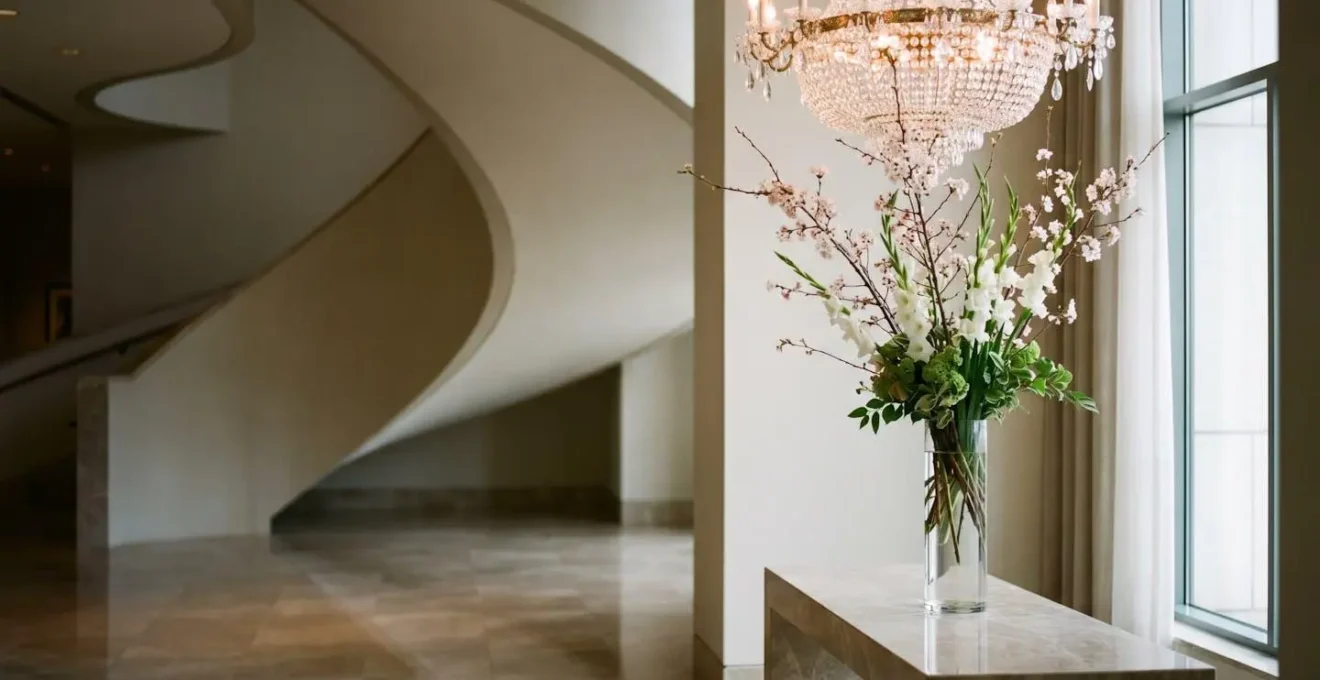
A grand foyer arrangement is an operational asset, not just a decoration; its true value lies in flawless execution and planned logistics.
- Stability is engineered with internal mechanics and weight, not just a heavy vase.
- Modular design with a hardy base and replaceable “pods” of fresh flowers drastically cuts weekly costs and labor.
Recommendation: Shift your focus from weekly flower buying to designing a long-term, modular floral program with clear maintenance protocols.
The first seven seconds a guest spends in your lobby are critical. They form an indelible impression of your brand, and nothing communicates luxury, care, and attention to detail more powerfully than a breathtaking floral centerpiece. It’s the silent handshake, the welcoming embrace that sets the tone for their entire stay. Many hotel managers believe the key is simply a large vase and the tallest flowers available, a strategy that often leads to unstable, costly, and high-maintenance displays that wilt before the week is out.
But what if the secret to a truly stunning and sustainable display wasn’t the flowers themselves, but the invisible engineering and logistical choreography behind them? This is the perspective of a lobby designer. We don’t just see a floral arrangement; we see an engineered installation. Its success or failure is determined by physics, operational planning, and strategic foresight long before the first bloom is placed. This guide will walk you through that professional mindset.
We will deconstruct the art and science of the grand entrance statement, moving from the foundational principles of vase stability and all-angle aesthetics to the high-level strategy of seasonal rotations and contract management. This is your blueprint for creating an unforgettable welcome that is as smart and efficient as it is beautiful.
Summary: Tall Foyer Arrangements: A Designer’s Blueprint for Impact and Efficiency
- Base Stability: How to Stop a 6-Foot Vase from Tipping Over?
- All-Round Viewing: How to Make an Arrangement Look Good from Every Angle?
- Forced Branches: Using Cherry Blossom for Height and Drama in Spring
- Ladder Maintenance: How to Change Water in a Giant Vase Safely?
- The Weekly Change: How to Plan a Rotation Schedule for Hotel Contracts?
- Base Stability: How to Stop a 6-Foot Vase from Tipping Over?
- The Vertical Line: How to Make a Room Feel Taller with Gladioli?
- Formal Linear Architecture: Creating High-End Impact with Minimal Stems
Base Stability: How to Stop a 6-Foot Vase from Tipping Over?
The most common mistake in creating a grand foyer arrangement is underestimating physics. A six-foot vase filled with water and top-heavy branches is a significant liability. True stability isn’t just about a heavy vase; it’s about engineered stability from the inside out. Professionals don’t just “arrange” flowers; they build an internal armature that controls every stem and lowers the center of gravity. This internal structure is the unseen hero of any lasting, safe, and impressive display.
The primary tool for this is not floral foam, but a carefully constructed matrix of chicken wire. Layering wire inside the vessel creates a grid that grips stems at multiple points, preventing them from shifting and creating a domino effect. This technique, coupled with strategic weight distribution at the base using clean, decorative elements like river stones or even clear glass pebbles, creates a solid foundation. The goal is to build a structure that is inherently balanced, so the arrangement resists tipping even with the added weight of fully hydrated, towering branches. It’s a fundamental shift from decorating to structural design.
Your Action Plan for Unshakeable Stability
- Internal Mechanics: Layer chicken wire inside the vase at multiple levels (approx. 1-inch separation) to create a grid that controls stem placement and builds passive stability.
- Secure Edges: Cover any loose wires along the vase rim with clear waterproof tape, stretching it taut and making 2-4 continuous passes around the container for safety and a clean look.
- Weighted Base: Before adding mechanics, fill the bottom quarter of the vase with clean, heavy materials like large pebbles, sand, or even whole lemons/limes to lower the center of gravity.
- Proper Hydration: Fill the vase three-quarters full with a fresh flower food solution specifically formulated for clear glass to prevent cloudiness and support the blooms.
- Vessel Selection: When sourcing new vases, prioritize a favorable base diameter-to-height ratio. A wider footprint is always a safer choice for tall, dramatic designs.
By implementing these mechanical steps, you transform a potentially hazardous decoration into a secure and stable installation, a core principle detailed in professional florist training guides. This foundation of safety and control is the prerequisite for any truly grand statement.
All-Round Viewing: How to Make an Arrangement Look Good from Every Angle?
A foyer arrangement is not a painting to be viewed from one spot; it is a sculpture standing in the round. It will be seen from the front entrance, from the check-in desk, from the elevators, and even from the staircase above. Designing for 360-degree viewing is paramount. This means there is no “back” to the arrangement. Every angle must be a deliberate composition, offering a new and interesting perspective as the guest moves through the space.
The key to achieving this is to think in terms of pathways and internal landscapes. A great all-round arrangement is not a dense, impenetrable mass of flowers. Instead, it has a sense of airiness and depth. A skilled designer creates “windows” or negative spaces within the arrangement, allowing the eye to travel through it. This creates a dynamic interplay of form and void, making the piece feel lighter and more architectural. You can achieve this by grouping stems of varying heights and textures to create valleys and peaks, ensuring no single element blocks the view of another from a different angle.
As this image illustrates, the composition is built with an internal structure that guides the eye. The tallest branches establish the overall shape, while mid-level foliage and flowers fill the body, and shorter elements anchor the design to the vase. By constantly rotating the arrangement during its creation and viewing it from high, low, and all sides, a designer ensures that every guest, no matter their vantage point, is greeted with a complete and captivating visual story.
Forced Branches: Using Cherry Blossom for Height and Drama in Spring
To achieve the dramatic height required for a grand foyer, designers often turn to flowering branches. In spring, nothing is more iconic than cherry blossom. However, you don’t have to wait for mother nature. The technique of “forcing” branches allows you to bring these spectacular blooms indoors weeks ahead of schedule, creating an unforgettable statement of seasonal luxury. This process essentially tricks the dormant branches into thinking spring has arrived by providing them with water and warmth.
The process is a delicate but straightforward piece of horticultural science. It begins with careful selection, choosing branches laden with plump, rounded flower buds. A crucial step is maximizing water uptake by making angled cuts and vertical slits at the base. A full submersion in lukewarm water for a day can rapidly break dormancy. From there, it’s a patient process of providing fresh, clean water and a stable, cool environment away from direct heat or sun. Within a few weeks, your lobby can be filled with the ethereal beauty of cherry blossoms, a powerful symbol of renewal and high-end care.
- Select & Cut: In late winter, use sharp pruners to cut branches with plump flower buds at a 45-degree angle.
- Maximize Absorption: Make several small vertical slits in the branch ends with a knife to open them up to more water.
- Initial Soak: Submerge the entire branches in a tub of lukewarm water overnight to rapidly hydrate and break dormancy.
- Vase & Placement: Place branches in a vase with warm water in a cool location (60-65°F), away from direct sun or heat vents.
- Maintain Water: Change the water every few days, adding a tiny amount of bleach (1/4 tsp per gallon) to inhibit bacteria.
- Encourage Blooming: Once buds show color (usually 2-4 weeks), move the arrangement to a brighter spot with indirect sunlight to encourage the flowers to open.
Case Study: The Year-Round Forcing Branch Calendar
Top-tier hospitality doesn’t limit this dramatic effect to a single season. Professional florists create a year-round calendar by diversifying their branch selection. The strategy begins in late winter with fast-blooming forsythia, quince, and pussy willow (1-2 weeks). This transitions into the more patient spring subjects like cherry, dogwood, and redbud (approx. 4 weeks). This rotation allows a hotel to maintain its signature tall, architectural arrangements continuously, celebrating authentic seasonal shifts and providing immense value beyond the single-season cliché of cherry blossoms.
Ladder Maintenance: How to Change Water in a Giant Vase Safely?
The glamour of a six-foot floral masterpiece quickly fades when faced with the logistical challenge of its upkeep. Changing the water in a giant, heavy vase is not just difficult; it’s a significant health and safety risk if not handled with a professional protocol. The idea of an employee teetering on a ladder while trying to lift or tip a vessel containing gallons of water is a manager’s nightmare. The solution lies in a “work smart, not hard” approach, using the right tools and strategies for logistical choreography.
Instead of attempting a full water change that requires moving the vase, the professional approach focuses on extraction and replenishment. A simple, inexpensive siphon pump or a small, battery-operated water pump is the tool of choice. These devices allow staff to remove the old, stale water from the bottom of the vase safely from ground level or a stable platform. There is absolutely no need to tip or move the heavy, established arrangement. This single technique mitigates the vast majority of risks associated with large-scale floral maintenance.
Furthermore, a “top-off and treat” schedule can extend the time between full cleanings. This involves daily hydration and the use of professional-grade clarifying tablets or preservatives. These products not only feed the flowers but also inhibit bacterial growth, keeping the water clearer for longer and reducing the frequency of more intensive maintenance.
- Daily Hydration: Instead of the vase base, pour fresh water directly into the elevated foam holder (lomey dish) where the stems are, as this is where water is lost fastest.
- Water Extraction Tool: Use a simple siphon pump or small battery-operated pump to remove old water from the bottom of the vase without any lifting or tipping.
- Top-Off & Treat Strategy: Implement a schedule to add fresh water mixed with professional clarifying preservatives to safely extend the life of the arrangement between full water changes.
- Safe Transport: When moving completed large arrangements, secure the lomey dish to the vase with floral clay and use rolling racks with brakes and ties to prevent tipping during transport.
The Weekly Change: How to Plan a Rotation Schedule for Hotel Contracts?
For a hotel manager, the floral budget is a significant line item. The traditional model of replacing an entire grand arrangement every week is not only expensive but also wasteful. The most successful and long-term hotel-florist relationships are built on a smarter, more strategic approach: the modular refresh. This method maximizes visual impact while controlling labor and material costs, turning a simple expense into a manageable operational asset.
The core concept involves designing a long-lasting, architectural base composed of hardy elements like forced branches, sculptural twigs, and robust foliage. This “base” can often last for several weeks, providing the arrangement’s height and structure. The “refresh” comes from smaller, easily replaceable “pods” of fresh, delicate flowers like roses, tulips, or orchids. These pods are designed to be quickly swapped out once a week. This modular approach means the florist isn’t rebuilding the entire structure each time; they are performing a quick, targeted update. This dramatically cuts down on weekly labor and material costs, a benefit that is passed on to the client.
Case Study: The Modular Refresh Strategy for Luxury Hotel Contracts
An analysis of successful florist contracts for luxury hotels reveals that they are rarely simple weekly swaps. Instead, they are tiered service models based on 1-3 year relationships. As detailed in a review of the intricacies of mastering hotel contracts, the most effective florists propose a long-lasting base of hardy branches and foliage. The weekly or biweekly service then involves replacing only the “pods” of delicate flowers. This modular system allows the hotel to maintain a consistently grand and fresh look at a fraction of the cost of a full weekly replacement. Contracts are structured to reflect this, with different charges for base installation versus modular refresh, providing transparency and significant long-term savings for the property.
This strategy is the industry standard for high-end properties, most of which maintain a weekly to biweekly replacement schedule for the “fresh” elements of their displays. By working with a florist who understands this modular philosophy, a hotel manager can ensure a stunning first impression that is both financially sustainable and operationally efficient.
Base Stability: How to Stop a 6-Foot Vase from Tipping Over?
While internal mechanics provide the core strength of a tall arrangement, the job of ensuring base stability is only half done. The second, equally critical component is assessing the external environment where the vase will be placed. An impeccably constructed arrangement can still be a hazard if its location is fundamentally unstable. Before a single flower is delivered, a professional designer or a responsible manager must conduct a site assessment.
The first consideration is the floor itself. Is the surface perfectly level? Marble or tile floors can be deceptively uneven. Use a simple level to check the intended spot. A slight, invisible slope can exert constant pressure on one side of the vase’s base, creating a long-term risk. Secondly, consider proximity to traffic. Placing a towering vase at the apex of a tight corner or directly beside an automatic door is inviting disaster. The arrangement needs a “safety bubble” of personal space around it to prevent accidental bumps from luggage carts, bellhops, or distracted guests.
Finally, look up. Is the arrangement directly under a strong HVAC vent? The constant airflow, while subtle, can cause tall, flexible branches to sway, creating micro-vibrations that can compromise stability over time. The ideal location is a high-visibility, low-traffic spot on a certifiably level surface. If the perfect visual spot is not perfectly stable, the solution is not to risk it; it’s to choose a better, safer location or to invest in a heavy, wide, and non-tippable pedestal to serve as the true foundation for the vase.
The Vertical Line: How to Make a Room Feel Taller with Gladioli?
Large arrangements do more than just fill a space; they have the power to actively change our perception of it. In a foyer with a standard or even low ceiling, a strategically designed tall arrangement can create a powerful illusion of height. The key is to emphasize the strong vertical line. Flowers like gladioli, delphiniums, or liatris are perfect for this, as their natural growth habit is a tall, elegant spike of color that draws the eye upward.
The trick is to use these lines to their full advantage. By placing the tallest, most dramatic vertical stems at the core of the arrangement and allowing them to stand well above the mass of other flowers, you create a visual trajectory that pulls the gaze from the tabletop straight to the ceiling. This upward movement makes the entire room feel taller, more open, and grander. The surrounding foliage and flowers should support this vertical thrust, not compete with it. They form the base and body, while the tall stems are the spires that stretch for the sky.
However, this quest for height must be balanced with the laws of physics. As floral designer Ami Wilber notes, there are clear limits. In a feature for The Washington Post on flower arranging principles, she offers a critical rule of thumb:
My rule of thumb is that the arrangement should be no more than 1½ times the height of the container, and that’s to create stability for the arrangement. Anything taller than that and you run the risk of having it not be balanced.
– Ami Wilber, Floral event decor designer at the Hillwood Museum
This 1.5x rule is the perfect marriage of aesthetic ambition and structural reality. It allows you to create that powerful vertical line with gladioli or other tall stems while ensuring the entire piece remains stable and secure.
Key Takeaways
- Treat large arrangements as engineered installations, focusing on internal mechanics and both internal and external stability factors.
- Adopt a modular design with a long-lasting hardy base and replaceable “pods” of fresh flowers for a cost-effective and sustainable weekly refresh program.
- Embrace minimalist, architectural designs inspired by principles like Ikebana to create a sophisticated, high-end impact with intentional restraint.
Formal Linear Architecture: Creating High-End Impact with Minimal Stems
In the world of luxury, the loudest statement is often a whisper. While a dense mass of flowers can be beautiful, true sophistication is frequently found in intentional restraint. The principles of formal-linear design, heavily influenced by the Japanese art of Ikebana, offer a powerful alternative to the “more is more” Western style. This approach creates maximum impact with minimal materials, focusing on the beauty of individual stems, the elegance of the line, and the power of negative space.
This minimalist philosophy is not about emptiness; it’s about making the space between the stems an active and essential part of the composition. This concept, known as ‘Ma’ in Japanese design, values the air, shadow, and movement around the elements as much as the elements themselves. A single, perfectly sculptural branch and three immaculate calla lilies can have more presence and command more attention in a high-end lobby than a hundred roses packed together. It communicates confidence, precision, and an appreciation for form.
This approach is particularly effective in modern, minimalist, or art-focused hotel interiors, where a dense, traditional arrangement might feel cluttered. The focus shifts from the color and quantity of blooms to the architectural quality of the entire composition. As practitioners explain, it’s a more thoughtful and deliberate way of designing. In a feature on the modern embrace of Ikebana, this core difference is highlighted:
Unlike maximalist Western floral designs, Ikebana focuses on a composition that erases rigidity or formulas, often utilizing minimal materials. It values shape, size, and dimension while driving intentionality, embracing asymmetry, praising imperfections, and encouraging multi-dimensionality.
– Ikebana practitioners interviewed, NYLON Magazine
Case Study: The ‘Ma’ Principle in High-End Hospitality
Leading luxury hotel designers are increasingly applying the Ikebana principle of ‘Ma’ to foyer arrangements. Instead of dense floral masses, they commission sculptural compositions where the form of each branch and the space around it become the focal point. An arrangement might consist of only three primary elements representing heaven (the tallest stem), earth (the lowest), and humanity (the element connecting them). This intentional restraint creates a serene, gallery-like atmosphere. The quiet sophistication speaks volumes, suggesting a level of taste and refinement that resonates deeply with a high-end clientele.
Begin today by auditing your current floral program not just for its beauty, but for its structural integrity, maintenance efficiency, and long-term cost-effectiveness. The grandest statements are built on the strongest foundations.