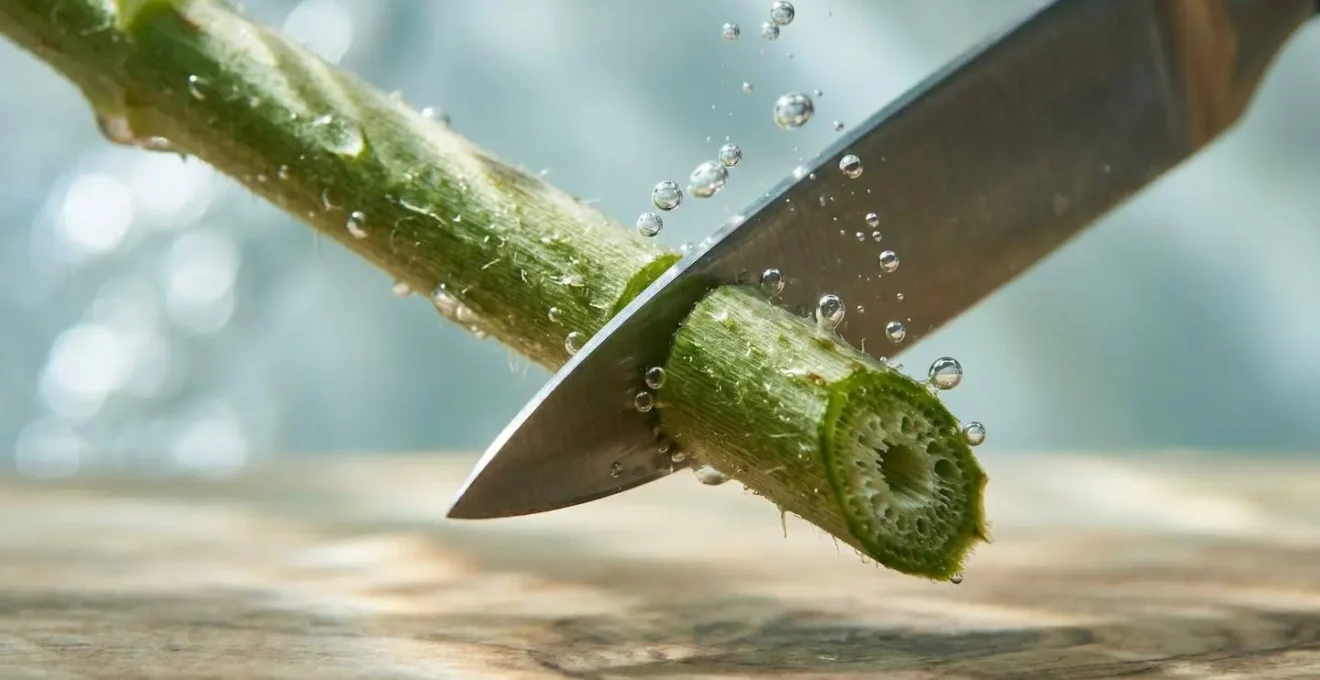
The primary cause of wilting in cut flowers is not a simple “airlock,” but a progressive hydraulic failure caused by physical and biological occlusions within the stem’s vascular system.
- The dominant force for water uptake is transpirational pull, a negative pressure gradient far stronger than gravity or capillary action alone.
- Stem blockages are primarily caused by the plant’s own wound response (tyloses, gums) and bacterial biofilm, not by air bubbles drawn in during cutting.
- Water temperature directly impacts fluid viscosity; warmer water flows more easily, but also accelerates bacterial growth, requiring a strategic approach.
Recommendation: Focus on maintaining the structural integrity of the xylem and inhibiting microbial growth, rather than on the myth of underwater cutting to prevent embolism.
Observing a freshly cut rose, placed dutifully in water, begin to droop is a frustrating paradox for any florist or flower enthusiast. The stem is submerged, yet the petals wilt as if in a drought. The common diagnosis is an “airlock” or embolism—a bubble of air supposedly sucked into the stem’s vascular system, blocking the flow of water. Consequently, a host of rituals have emerged: re-cutting stems underwater, piercing them with pins, or adding various concoctions to the vase. These practices are often followed without a deep understanding of the underlying mechanics.
But what if the concept of an “airlock” is a misleading simplification of a much more complex fluid dynamics problem? The stem of a cut flower is not a simple straw; it is a sophisticated hydraulic system governed by principles of pressure, viscosity, and surface tension. The failure of this system is rarely as simple as a single bubble. It’s a cascade of events involving cellular damage, physiological defense mechanisms, and microbiological warfare. Understanding this system from a physicist’s perspective changes everything.
This analysis will deconstruct the common beliefs surrounding flower hydration. We will dissect the stem’s vascular network—the xylem and phloem—and examine how it responds to the trauma of being cut. We will quantify the impact of variables like water temperature and cutting tool sharpness on hydraulic conductivity. Ultimately, we will move beyond the myth of the airlock to diagnose and treat the true culprits of vascular occlusion. By applying principles of fluid dynamics, we can develop a more effective, evidence-based protocol for ensuring maximal vase life.
To navigate this analysis, we will explore the forces at play, the real mechanisms of stem blockage, and the specific conditioning required for delicate vascular systems. The following sections break down each component of this hydraulic challenge.
Summary: A Physicist’s Analysis of Hydraulic Failure in Cut Flowers
- Deep Water Cutting: Does Gravity Help Push Water Up the Stem?
- Pin Pricking Tulips: Does It Release Air or Just Damage the Stem?
- Daily Snip: Why Does the Stem End Seal Up After 24 Hours?
- Warm vs Cold: Does Warm Water Move Faster Up the Stem?
- Soft Head, Hard Stem: Is It an Airlock or Bacterial Blockage?
- Xylem and Phloem: Why Blunt Scissors Kill Flowers by Crushing Tubes?
- The Air Embolism Myth: Do You Really Need to Re-cut Stems Underwater?
- How to Protect Delicate Vascular Systems of Spring Flowers?
Deep Water Cutting: Does Gravity Help Push Water Up the Stem?
A common practice involves placing freshly cut flowers in a deep bucket of water, with the theory that the increased water pressure, or hydrostatic pressure, helps “push” water up the stem. From a fluid dynamics standpoint, this premise is fundamentally flawed. The primary driver of water transport in a cut flower is not positive pressure from below but a powerful negative pressure gradient from above, a phenomenon known as transpirational pull. Water evaporates from the surfaces of leaves and petals, creating a tension that pulls the continuous column of water up through the xylem vessels. This force is extraordinarily strong, capable of overcoming both gravity and the internal resistance of the vascular network.
The pressure exerted by a column of water is minor in comparison. For every 10 meters of water depth, pressure increases by approximately 1 atmosphere. A 30 cm deep bucket, therefore, generates only about 0.03 atmospheres of positive pressure at the stem base. This is negligible compared to the negative pressure of many atmospheres generated by transpiration. As Dr. Garry Legnani, a Senior Postharvest Scientist, clarifies, the system’s efficiency is about how easily water enters and moves, not how hard it’s pushed.
Cut flower hydration is a dynamic process driven by transpiration (evaporation of water from the leaves) through the stomata and how easily water can enter and move up the stem.
– Dr. Garry Legnani, FloraLife Research Update on Water Temperature and Cut Flower Hydration
While deep water doesn’t significantly “push” water, it does ensure the cut surface remains submerged even as water levels decrease, preventing the stem end from drying out and allowing the transpirational pull to function without interruption. However, it’s crucial to understand that factors like ambient temperature and humidity, which control the rate of transpiration, have a far greater impact on water uptake than the depth of the vase. For example, research from FloraLife demonstrates that moving flowers from a warm environment to a cold one can cause a 64% reduction in water uptake, a change driven by decreased transpiration, not water pressure.
Pin Pricking Tulips: Does It Release Air or Just Damage the Stem?
The folk remedy of pricking a tulip stem just below the flower head is based on the same “airlock” misconception. The theory suggests that a trapped air bubble is preventing water from reaching the head, causing it to droop, and that a pinprick allows this air to escape. This is mechanically and biologically unsound. Firstly, the xylem vessels that transport water are microscopic capillaries, not large, open pipes. An embolism, if it occurs, would be a microscopic cavitation event within these tubes, not a large, mobile bubble that can be “released” with a pin.
Secondly, and more critically, the act of stabbing the stem inflicts significant and unnecessary trauma. Instead of solving a problem, it creates several new ones. This action ruptures cell walls, destroying the integrity of both the water-conducting xylem and the sugar-transporting phloem. This physical damage creates a wound site that immediately triggers the plant’s defense mechanisms. The plant may respond by producing gums or forming tyloses to seal off the “breach,” further impeding water flow in the surrounding tissue.
Furthermore, the hole created by the pin serves as a perfect port of entry for bacteria and other pathogens. By breaking the stem’s protective cuticle and epidermis, you are essentially opening the door for microbial contaminants to enter the vascular system directly, accelerating the formation of the very blockages you are trying to prevent. The slight, temporary straightening sometimes observed after pricking is more likely due to a stress response or minor redistribution of turgor pressure, not the release of a mythical air bubble. The long-term consequence is almost always a reduction in vase life due to increased risk of infection and structural damage to the hydraulic architecture.
Daily Snip: Why Does the Stem End Seal Up After 24 Hours?
The advice to trim flower stems daily is common, but the underlying reason is often misunderstood. It’s not just that the stem gets “old.” Within hours of being cut, a complex series of events begins at the wound site, leading to a rapid decline in hydraulic conductivity. Post-harvest research confirms the severity of this issue, showing over a 50% reduction in water uptake within 24 hours if the stem is not re-cut. This blockage is not a single event but a combination of physiological and microbial processes.
The primary mechanisms of this blockage, or vascular occlusion, are threefold:
- Physiological Response (Wound Sealing): When the stem is cut, the plant initiates a wound response to prevent water loss and pathogen entry. Parenchyma cells adjacent to the xylem can produce balloon-like outgrowths called tyloses that inflate and plug the vessels. The plant can also secrete gums and gels that effectively seal the cut surface.
- Bacterial Biofilm Formation: The vase water is a fertile breeding ground for bacteria. These microorganisms multiply rapidly at the cut surface, feeding on sugars leaching from the stem. They form a slimy matrix, or biofilm, that physically blocks the openings of the xylem vessels.
- Debris and Cavitation: Small particles of debris from the cutting process or impurities in the water can be drawn into the xylem, causing physical blockages. While less significant than often believed, cavitation (the formation of vapor-filled voids) can occur under high water stress, but this is typically a consequence of other blockages, not the primary cause.
This microscopic view reveals the true nature of stem blockage. It is a progressive sealing process from both the plant itself and external contaminants.
As the illustration above helps visualize, the open channels of the xylem become progressively clogged. A comprehensive study on xylem occlusion in cut Clematis stems confirms that these blockages are the primary limiters of vase life. A daily snip removes this occluded section, exposing fresh, fully conductive tissue and effectively resetting the hydraulic system. This simple act is one of the most effective ways to combat the inevitable process of vascular decay.
Warm vs Cold: Does Warm Water Move Faster Up the Stem?
The temperature of the hydration solution is a critical variable that directly influences the rate of water uptake, a fact rooted in basic fluid physics. The answer to whether warm water moves faster is an unequivocal yes. This is primarily due to two properties of water: viscosity and molecular energy. As water temperature increases, its viscosity decreases. It becomes “thinner” and flows more readily through the narrow xylem capillaries with less resistance. Concurrently, the water molecules themselves possess higher kinetic energy, allowing them to move more actively and diffuse more rapidly across cell membranes at the cut surface.
This principle is why professional florists often initiate the hydration process with lukewarm water. The goal is to achieve the fastest possible rehydration for flowers that may be stressed or dehydrated post-transit. The recommended temperature range is quite specific; for instance, many professional florists recommend using lukewarm water at 100°F to 110°F (37-43°C) for this initial “charge.” This burst of warm water can help to quickly restore turgor pressure throughout the plant.
However, the benefits of warm water are short-lived and come with a significant trade-off: accelerated bacterial growth. The same warmth that promotes water flow also creates an ideal incubator for the microorganisms that cause vascular occlusion. Using warm water continuously can lead to a rapid fouling of the vase solution and a swift decline in vase life. The optimal strategy, therefore, is a two-phase approach: a short, initial burst of warm water for rapid uptake, followed by a switch to cool water for maintenance. Cool water slows the flower’s metabolism, reduces microbial proliferation, and ultimately extends the functional life of the hydraulic system.
Action Plan: Optimal Water Temperature Protocol
- Initial Hydration (First Hour): Use lukewarm water between 100-110°F (37-43°C) to maximize rapid water uptake through increased molecule movement and reduced viscosity.
- Maintenance Phase (After 1-4 Hours): Replace the initial solution with cool water and a proper flower food solution to slow the flower’s metabolism and reduce bacterial growth.
- Storage Temperature: If storing, keep fully hydrated flowers in a cooler at 34-38°F (1-3°C) and high humidity (75-85%) to dramatically slow transpiration and decay.
- Bacterial Control: Always remember that the benefit of warm water is strictly for initial hydration. It is not a long-term solution as it accelerates bacterial proliferation.
- Consistent Monitoring: Check water levels and clarity daily. Cloudy water is a clear indicator of high bacterial load and must be changed immediately.
Soft Head, Hard Stem: Is It an Airlock or Bacterial Blockage?
The classic symptom of a wilting rose with a firm stem is often misdiagnosed as an “airlock.” However, from a diagnostic perspective, it’s crucial to differentiate between a simple hydraulic interruption and a more severe pathological condition. A soft or “bent” neck on a flower indicates a localized failure of turgor pressure. Water is simply not reaching the uppermost tissues in sufficient quantity to keep the cells rigid. The question is, what is the nature of the blockage preventing this flow?
In most cases, the culprit is not a mythical air bubble but a very real bacterial occlusion. The blockage is located somewhere below the wilted head, often at the base of the stem. As bacteria multiply in the vase water, they are drawn into the xylem vessels with the water stream. They continue to proliferate inside, forming a biofilm that clogs the microscopic tubes. This is a progressive process. The stem can remain hard and seem healthy while the flow rate is steadily decreasing, until it drops below the critical threshold required to support the flower head against gravity and transpiration.
A key diagnostic clue is the condition of the vase water. If the water is cloudy, murky, or has a foul odor, a high bacterial load is almost certain. Scientific studies provide a quantitative basis for this diagnosis; for instance, research on cut lilies found that water uptake is significantly impeded when bacteria populations exceed 10⁶ colony-forming units per milliliter (cfu/mL). A true air embolism, or cavitation, is more likely to occur in flowers that have been left out of water for a prolonged period and are already under severe water stress. For a flower that has been consistently in water, a bacterial blockage is the far more probable cause of failure.
The treatment follows the diagnosis. If a bacterial blockage is suspected, the solution is not to prick the stem or search for an air bubble. The correct protocol is to remove the flower, thoroughly clean the vase with a biocide (like bleach), refill with fresh, cool water containing a proper flower food (which includes a bactericide), and re-cut a significant portion (2-5 cm) off the stem base to remove the most heavily colonized section of xylem.
Xylem and Phloem: Why Blunt Scissors Kill Flowers by Crushing Tubes?
To fully appreciate the importance of a clean cut, one must first understand the intricate anatomy of the stem’s vascular system. This system is composed of two primary types of transport tissue: the xylem and the phloem. The xylem consists of microscopic, rigid-walled tubes responsible for the upward transport of water and minerals from the stem base to the rest of the plant. The phloem transports sugars, produced during photosynthesis in the leaves, to other parts of the plant for energy. When we discuss hydration, our primary concern is the integrity of the xylem. These vessels are the hydraulic pipelines of the flower.
Using a blunt cutting tool, especially household scissors, is catastrophic for this delicate system. The blades of standard scissors are not designed for the fibrous, three-dimensional structure of a stem. Instead of making a clean slice, they act as a vise, pinching and crushing the stem before the cut is complete. This crushing action collapses the xylem vessels, permanently deforming their circular structure and rendering them incapable of transporting water efficiently. It’s the equivalent of stomping on a bundle of drinking straws; even if the ends are open, the crushed middle section prevents any fluid from passing through.
The visual evidence is stark. A stem cut with a sharp floral knife or bypass shears will have a clean, open surface with its vascular bundles intact. A stem crushed by dull scissors will appear frayed and compressed, its water-conducting pathways destroyed at the point of entry. The Brooklyn Botanic Garden offers a stern warning on this matter, emphasizing the mechanical incompatibility of household scissors with plant tissue.
Never use ordinary household scissors. The gauge on scissors is set for paper or fabric, not for flower stems, which are bulkier. Using scissors will crush their vascular systems and prevent proper water uptake.
– Brooklyn Botanic Garden, Cut-Flower Care: How to Make Fresh Flowers from Your Garden Last Indoors
The choice of tool is therefore not a matter of preference but a critical factor in determining the initial hydraulic potential of the cut flower. A clean cut maximizes the surface area of open, undamaged xylem vessels, ensuring the highest possible flow rate from the very start.
- Best: Sharp Florist Knife – Creates the cleanest slice with minimal cellular damage.
- Excellent: Bypass Pruning Shears/Secateurs – Blades pass each other for a clean, slicing cut.
- Poor: Serrated Knives – Tearing action damages vascular tissue.
- Worst: Anvil Pruners & Dull Scissors – Crushing action completely collapses xylem tubes.
Key Takeaways
- Hydraulic failure (wilting) in cut flowers is primarily caused by physical and biological blockages (occlusions) in the xylem, not mythical “airlocks.”
- The choice of cutting tool is critical; sharp blades preserve the stem’s vascular structure, while blunt scissors crush it, severely limiting water uptake from the start.
- A strategic, two-phase approach to water temperature—a short, warm-water bath for initial hydration followed by cool water for maintenance—optimizes both uptake speed and bacterial control.
The Air Embolism Myth: Do You Really Need to Re-cut Stems Underwater?
The practice of re-cutting flower stems underwater is perhaps the most widespread ritual in flower care, preached as an absolute necessity to prevent a fatal air embolism. The theory is that as soon as the stem is cut in the air, the xylem’s negative pressure immediately sucks in a bubble, blocking the water column. While the physics of transpirational pull is correct, the conclusion that this necessitates underwater cutting for all flowers is a significant overstatement. Experts at Teleflora repeat the common wisdom, stating that ” cutting underwater reduces the risk of air pockets and allows the flowers to absorb water right away.”
However, the actual risk and timeline of embolism formation are far more nuanced. The critical window for air to be aspirated into the xylem is extremely short, on the order of seconds. For a healthy, turgid stem, the surface tension of the water within the xylem vessels offers considerable resistance to air entry. If a freshly cut stem is placed into water within this brief window, the likelihood of a significant, flow-stopping embolism forming is minimal. The water column simply re-establishes itself before air can penetrate deeply.
Professional Florist Practices: When Underwater Cutting Is Actually Used
Field observations reveal that many professional florists do not cut every stem underwater despite industry recommendations. The practice is reserved for critical situations: reviving wilted or dehydrated flowers (especially hydrangeas), processing woody-stemmed varieties prone to issues (roses), and flowers that have been out of water for extended periods (3-4+ hours). For fresh flowers moving directly from a harvest bucket to a design vase, the focus is on speed. The “critical window” for air aspiration is only a few seconds, making a rapid stem-to-water transfer equally effective as the more cumbersome underwater cutting method for healthy stems. The professional secret is efficiency and context, not dogmatic adherence to a single rule.
This is not to say the practice is useless. Underwater cutting is an excellent corrective procedure for flowers that are already visibly wilted or have been out of water for an extended time. In these cases, the water stress is high, the negative pressure in the xylem is extreme, and the risk of cavitation is real. Cutting underwater in this scenario ensures that water, not air, is the first substance to enter the newly exposed xylem. But for routine processing of fresh, healthy flowers, a swift, clean cut in the air followed by immediate placement in water is a perfectly sound and efficient method. The focus should be on speed and a sharp blade, not on the logistical challenge of a submerged cutting board.
How to Protect Delicate Vascular Systems of Spring Flowers?
The general principles of hydraulic maintenance apply to all flowers, but certain species, particularly early spring bloomers, possess unique anatomical or physiological traits that require specific conditioning protocols. Their vascular systems can be unusually delicate, hollow, or prone to secreting substances that cause self-inflicted occlusion. Mastering these species-specific treatments is the mark of an advanced understanding of floral hydrodynamics.
For example, daffodils (Narcissus) exude a slimy, toxic sap from their cut stems. This mucilage is not only harmful to other flowers in a mixed arrangement but can also clog the xylem of the daffodil itself. The proper protocol is to hydrate them separately for at least 12-24 hours, allowing the majority of the sap to leach out before they are introduced to other flowers. Tulips, with their soft, geotropic stems that continue to grow in the vase, require cold water to slow their metabolism and a tight wrapping of paper during initial hydration to ensure they set straight.
Other flowers, like poppies, have hollow stems that contain a milky latex. This sap coagulates upon contact with air, effectively sealing the stem end and preventing any water uptake. For these, a more aggressive treatment is necessary. As the Royal Horticultural Society explains, the cut end must be immediately seared, either by dipping it in boiling water for 20-30 seconds or passing it through a flame. This cauterization process coagulates the sap, preventing it from leaking out and blocking the xylem. This table summarizes the critical protocols for common spring flowers.
| Flower Type | Stem Characteristic | Special Conditioning Need | Water Preference | Critical Warning |
|---|---|---|---|---|
| Tulips | Soft, continues growing | Wrap tightly in paper for first 2-3 hours to set straight | Cold water (slows growth) | Stems keep growing and bending in vase |
| Daffodils | Hollow, toxic sap | Hydrate separately for 12-24 hours before mixing | Cold water | Sap is toxic to other flowers; never mix immediately |
| Ranunculus | Delicate, thin | Cut at sharp angle; change water daily | Cool water | Highly susceptible to bacterial rot |
| Anemones | Soft, fragile neck | Short stem length; minimal handling | Cold water | Prone to bent neck syndrome |
| Hyacinths | Thick, bulb-based | Minimal water (2-3 inches); very clean vase | Cold water | Slimy stems accelerate bacterial growth |
| Poppies | Milky sap, hollow | Sear cut end in flame or boiling water for 10-15 seconds | Lukewarm after searing | Sap will clog xylem if not sealed immediately |
These specialized techniques are not arbitrary rituals; they are targeted interventions designed to overcome specific hydraulic challenges posed by the plant’s own biology. By understanding the unique properties of each stem, one can apply the right physical or thermal treatment to ensure the vascular system remains open and functional.
Applying these fluid dynamic principles transforms flower care from a guessing game into a science. By focusing on maintaining the integrity of the stem’s hydraulic architecture and managing the microbial environment, you can systematically address the root causes of wilting and dramatically extend the beauty and life of your cut flowers.