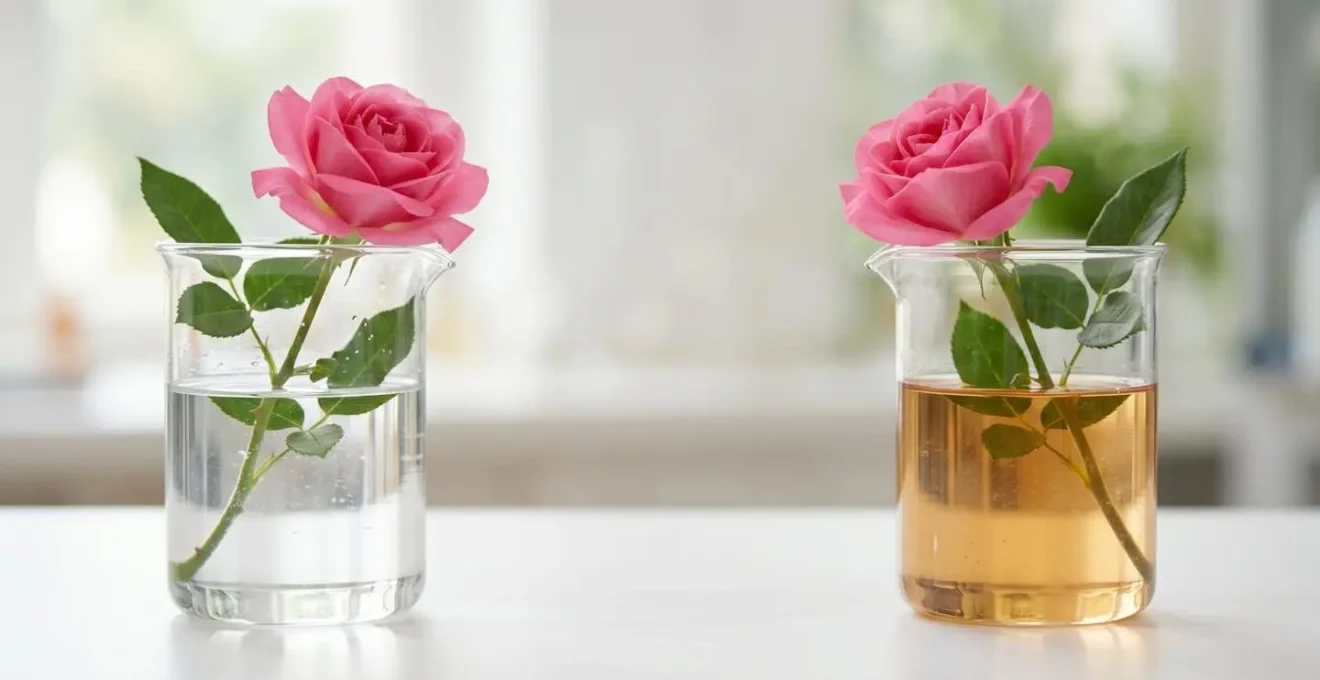
Homemade flower food isn’t magic, it’s chemistry—and most DIY recipes fail because of incorrect dosage, not bad ingredients.
- Sugar feeds flowers but also fuels bacteria that clog stems; it requires a biocide (like bleach) and an acidifier (like citric acid) in precise balance.
- Water pH is critical: a slightly acidic environment (pH 3.5-4.5) dramatically improves water uptake, a detail most homemade recipes ignore.
Recommendation: Stop guessing. Either use a commercial preservative or build your own formula by treating each component—sugar, acid, biocide—as a separate variable to be measured, not estimated.
If you’re a thrifty flower lover, you’ve been there. You bring home a beautiful bouquet and immediately turn to the kitchen, concocting a “magic” potion of lemon juice, sugar, and a splash of bleach, hoping to prolong its life. Sometimes it seems to work; other times, the flowers wilt even faster. The internet is filled with these DIY recipes, positioning them as a natural, cheap alternative to those little commercial flower food packets. They promise professional results with pantry staples, but the outcomes are frustratingly inconsistent.
The common advice—recut stems, change the water—is sound but incomplete. The real problem isn’t that homemade solutions are inherently bad; it’s that we treat them like a cooking recipe instead of a chemical formula. The belief that “a little bit of this and a dash of that” will work is where we go wrong. What if the key wasn’t in the ingredients themselves, but in their precise concentration and interaction? What if your kitchen could become a small-scale lab for flower longevity?
This guide abandons the “magic recipe” approach. We will act as comparative product testers, breaking down both homemade and commercial solutions into their core components. We’ll analyze each variable—sugar, acid, biocide—to understand its specific role and, most importantly, its correct dosage. By the end, you will understand not just *what* to put in your vase, but *why* and *how much*, empowering you to achieve consistent, 7-day vase life based on science, not guesswork.
This article dives deep into the chemistry of flower preservation. We will dissect the most common DIY ingredients, compare their function to commercial standards, and provide a clear, science-backed protocol for extending the beauty of your bouquets. The following table of contents outlines our methodical investigation.
Summary: A Scientific Comparison of Flower Preservation Methods
- The 1% Rule: Why Overdosing Flower Food Can Burn Leaves?
- Chlorine: How Many Drops of Bleach Keep Water Clear Without Damage?
- Glucose Boost: Which Flowers Benefit from Extra Sugar and Which Rot?
- Citric Acid: Why Flowers Drink Better in Slightly Acidic Water?
- Sugar and Acid: Why Do You Need Both in Flower Food?
- Woody Plant Food: Do Roses Need Different Food Than Tulips?
- Top Up or Full Change: Which Routine Keeps Bacteria Low?
- How to Guarantee 7-Day Vase Life for Your Floral Customers?
The 1% Rule: Why Overdosing Flower Food Can Burn Leaves?
One of the most common mistakes in flower care is the “more is better” fallacy. Believing we’re giving our flowers an extra treat, we add a little more sugar or an extra scoop of flower food. The result is often the opposite of what we intend: brown, crispy leaf edges and a faster decline. This isn’t a sign of starvation; it’s a symptom of chemical burn caused by osmotic stress. Think of a flower’s vascular system as a network of microscopic straws. These straws pull water up through a process called osmosis, which depends on a delicate balance of solutes (sugars, salts) inside and outside the plant cells.
When the concentration of solutes in the vase water is much higher than inside the flower’s cells, the process reverses. Instead of absorbing water, the flower’s cells are forced to release water into the overly concentrated solution in the vase. This cellular dehydration is what causes the visible “burn” on the leaf margins, a condition known as leaf margin necrosis. The standard concentration for most commercial flower foods is around 1-2%, a level carefully calibrated to provide energy without causing this damaging osmotic shock.
This paragraph introduces the concept of osmotic stress. To better understand this cellular damage, the illustration below shows a macro view of the effect of excessive fertilizer concentration on a leaf.
As you can see, the damage is localized at the edges, where water regulation is most critical. A homemade solution with an unmeasured amount of sugar can easily exceed the safe concentration, effectively poisoning the flowers with kindness. This is our first critical finding as product testers: dosage is not a suggestion, it’s a rule. Getting the concentration right is the first step toward successful preservation and away from accidental damage.
Chlorine: How Many Drops of Bleach Keep Water Clear Without Damage?
The “splash of bleach” is a cornerstone of many DIY flower food recipes. The logic is sound: bleach (sodium hypochlorite) is a powerful biocide that kills the bacteria, fungi, and yeasts that cloud the water and clog the flower’s vascular system. However, as with flower food, dosage is everything. Too little, and it’s ineffective against the microbial onslaught. Too much, and you’re not just killing bacteria; you’re actively damaging the flower stems themselves, causing cellular damage that prevents water uptake.
So, how many drops are just right? The “drop” is a terribly imprecise unit. A more scientific approach is to think in terms of Parts Per Million (PPM). Horticultural science provides clear guidelines for water sanitation in greenhouses, which we can adapt for our vase. The goal is to create an environment that is hostile to microbes but safe for plant tissue. It’s a fine line to walk.
The key is achieving a low but consistent residual chlorine level. According to research on greenhouse irrigation, a residual chlorine concentration of 2 PPM is effective, and concentrations of 0.5 – 1.0 ppm at extended contact times are also effective at controlling many plant pathogens. To translate this for home use, this is roughly equivalent to ¼ teaspoon of standard household bleach (around 5-6% sodium hypochlorite) per gallon of water. This is far less than the arbitrary “splash” many people use. It provides just enough power to keep the water clear without causing chemical damage to the stems. This precise measurement transforms bleach from a potential plant-killer into a reliable bio-inhibitor.
Glucose Boost: Which Flowers Benefit from Extra Sugar and Which Rot?
Sugar is the “food” part of flower food. Cut flowers are separated from their energy-producing leaves and root system, so they rely on carbohydrates in the vase water to fuel their metabolic processes, which helps keep petals vibrant and turgid. In theory, all flowers should benefit from this energy boost. In practice, adding sugar to vase water is a double-edged sword. While you are feeding the flower, you are also providing an all-you-can-eat buffet for bacteria.
These microorganisms thrive in sugary water, multiplying at an explosive rate. As they grow, they produce waste and form a slimy biofilm that blocks the cut ends of the stems, preventing water uptake far more effectively than if there were no sugar at all. In essence, the flower dies of thirst in a vase full of water. This is why a simple sugar-and-water solution often leads to cloudy, smelly water and rapid wilting. In fact, research using 16S rRNA gene sequencing shows that bacterial numbers in vase water increased 1.4 to 3.9-fold over a seven-day period, even in controlled solutions.
So, which flowers benefit? Those with high energy demands and sturdy stems, like roses or carnations, can utilize the sugar effectively, *provided* it’s paired with a strong biocide (like bleach) and an acidifier. Flowers with soft, fleshy stems, such as tulips or gerberas, are much more susceptible to bacterial rot at the stem base and may do worse in a high-sugar environment if not perfectly balanced. The conclusion of our test is clear: sugar should never be used alone. It is only beneficial as part of a complete system that includes an agent to control the bacterial growth it inevitably encourages.
Citric Acid: Why Flowers Drink Better in Slightly Acidic Water?
While bleach and sugar are common in DIY recipes, the third component of a professional formula—an acidifier—is often overlooked. This is a critical omission. The pH of the water has a direct and dramatic impact on a flower’s ability to “drink.” Most tap water is neutral or slightly alkaline (pH 7.0-8.5) to prevent pipe corrosion. However, flowers absorb water most efficiently in a slightly acidic environment.
Lowering the water’s pH helps in two key ways. First, it inhibits the growth of most bacteria, complementing the work of a biocide like bleach. Second, and more importantly, it improves water flow within the flower’s vascular system (the xylem). The scientific principle at play is the cohesion-tension theory. Water molecules stick together (cohesion) and are pulled up the stem as water evaporates from the leaves (tension). This process works best when the water column is unbroken. An acidic pH helps maintain the electrostatic charges that keep water molecules moving smoothly and prevents the formation of air bubbles (embolisms) that can block the xylem. It’s like making the drinking straw “slipperier” on the inside.
The ideal target is a pH between 3.5 and 4.5. This is where most commercial flower foods operate. Indeed, studies on vascular hydration demonstrate that a pH of 3.5 to 4.5 is optimal for stem absorption and water transport efficiency. For a homemade solution, this is where ingredients like lemon juice or citric acid (found in powder form for canning) come in. A small amount can significantly lower the pH, unlocking the flower’s ability to properly hydrate. This makes the acidifier a non-negotiable part of any effective flower food, whether homemade or commercial.
Case Study: The Impact of Xylem pH on Water Uptake
Research on tomato plants, whose vascular systems function similarly to cut flowers, showed that as soil dried, the pH of the plant’s internal xylem sap rose from 5.0 to 8.0. When leaves were detached and placed in an artificial sap solution, those in the higher pH solution showed significantly reduced transpiration (the process of water movement and evaporation). This demonstrates a direct physiological link: higher pH impedes water flow. By artificially lowering the vase water pH to the 3.5-5.0 range, we are essentially overriding this “blockage” response, ensuring the flower’s vascular system remains open and efficient, thus maximizing vase life.
Sugar and Acid: Why Do You Need Both in Flower Food?
We’ve tested our variables in isolation: sugar is energy but feeds bacteria; acid improves water uptake and suppresses some bacteria. The question now is, why is the combination so much more effective than either part alone? The answer lies in a powerful synergy. Sugar and acid work together as a team, where each component enhances the function of the other, creating a system that is far more effective than the sum of its parts.
Think of it this way: the acid opens the door, and the sugar provides the meal. The acidifier (like citric acid or the acid in a commercial formula) lowers the water’s pH. As we’ve seen, this makes the flower’s vascular system (xylem) significantly more efficient at drawing up water. But it’s not just drawing up water; it’s drawing up everything dissolved *in* the water. By “opening the door” to better hydration, the acid ensures that the sugar (the energy source) is efficiently delivered to the cells in the petals and leaves, where it’s needed to maintain color and structure.
Without the acid, the flower struggles to drink, and the sugar in the vase water primarily feeds bacteria. Without the sugar, the flower can drink efficiently but eventually starves, its metabolic processes grinding to a halt. This synergistic relationship is the core principle behind every commercial flower preservative. In fact, studies demonstrate that flowers treated with commercial preservatives last up to 60% longer than those in plain water, precisely because they provide this balanced system of hydration-facilitator and energy source, along with a biocide to keep the system clean. A DIY recipe that includes only sugar or only lemon juice is a job half-done.
Woody Plant Food: Do Roses Need Different Food Than Tulips?
Our comparative testing has established a baseline formula: sugar for energy, acid for hydration, and a biocide for hygiene. This leads to the next question: is this formula universal? The simple answer is no. Just as different people have different dietary needs, different types of flowers have unique physiological structures and challenges that require specialized care. The most significant distinction is between flowers with woody stems (like roses or hydrangeas) and those with soft, herbaceous stems (like tulips or gerberas).
Woody-stemmed flowers have a tough, lignified vascular system. Their primary challenge is xylem blockage, or “clogged arteries.” They are highly susceptible to air bubbles (embolisms) and bacterial sludge. Therefore, their ideal preservative formula will be high in acidifiers and may even include wetting agents to maximize water penetration into the tough tissue. Some professional protocols for roses even involve a two-step process: an initial rehydration solution that is very acidic and contains no sugar, followed by a standard display solution with sugar.
Conversely, soft-stemmed flowers from bulbs, like tulips, face a different problem: excessive elongation and weak stems. After being cut, they can continue to grow, leading to droopy heads. Their preservative formula often contains calcium nitrate to strengthen cell walls and may include growth regulators to prevent this stretching. For these flowers, a high-sugar formula can sometimes exacerbate stem rot. This is why a one-size-fits-all homemade recipe often fails: a formula perfect for a rose can be detrimental to a tulip. As vase life science evolves, formulas are becoming increasingly variety-specific, recognizing that a rose’s needs differ greatly from a lily’s.
The following table, based on data from floriculture research, breaks down these distinct requirements and illustrates why a customized approach yields better results than a generic one.
| Flower Type | Stem Structure | Primary Challenge | Specialized Ingredient | Solution Strategy |
|---|---|---|---|---|
| Roses (Woody) | Lignified vascular tissue | Xylem blockage & embolism | Strong acidifiers + wetting agents | Two-step: rehydration solution (high acid, no sugar) then display solution (with sugar) |
| Tulips (Bulb) | Soft herbaceous stems | Excessive elongation & weak stems | Calcium nitrate for cell wall strength | Single solution with growth regulators to prevent stretching |
| Carnations (Herbaceous) | Solid stems with nodes | Bacterial blockage at nodes | Standard biocides | Continuous preservative with balanced sugar/acid/biocide |
Top Up or Full Change: Which Routine Keeps Bacteria Low?
Even the most perfectly formulated flower food will fail if the vase environment isn’t maintained. As flowers sit in water, they shed organic material, and any surviving bacteria begin to multiply. This leads to a common dilemma: when the water level drops, should you simply top it up, or go through the effort of a full water change? From a product tester’s perspective, the data on this is unequivocal. Topping up is a recipe for failure.
When you top up, you are adding fresh water to a solution that is already becoming a rich bacterial soup. You’re diluting the preservative, reducing its effectiveness, and leaving the existing biofilm on the vase walls and stems to continue thriving. It’s like adding clean water to a dirty bath. The number of microorganisms can be staggering; microbiological analysis of cut flower vase water reveals a mean bacterial count of 4.5 × 10^8 organisms per 500 ml, with dozens of different species identified. A full change is the only way to reset the environment.
A complete water change every 2-3 days involves more than just swapping out the liquid. It requires physically removing the source of the problem. This means re-cutting the stems to remove any clogged or bacteria-infested ends and, crucially, thoroughly washing the vase. The slimy film you feel on the inside of a vase is a bacterial biofilm, a stubborn colony that must be scrubbed away. Following a strict protocol is the key to keeping bacterial counts low and ensuring your preservative can do its job.
Your Action Plan: Professional 4-Step Water Change Protocol
- Remove flowers carefully from the vase to prevent stem damage during handling.
- Re-cut 1-2 cm (approximately half an inch) from all stems at a 45-degree angle, preferably under running water to prevent air embolism.
- Thoroughly wash the vase with soap and a scrub brush to physically remove the bacterial biofilm from the vase walls and base.
- Refill with completely fresh, correctly measured preservative solution. Never reuse old solution or simply top up.
Key Takeaways
- Successful flower preservation is based on chemistry, not magic, requiring a balance of sugar (food), acid (hydration aid), and a biocide (hygiene).
- Dosage is critical: too much sugar causes osmotic burn, and too much bleach damages stems. Precision beats guesswork.
- Flower-specific needs matter: a formula for a woody-stemmed rose is different from one for a soft-stemmed tulip.
How to Guarantee 7-Day Vase Life for Your Floral Customers?
After all the tests, the data is clear. Guaranteeing a 7-day vase life isn’t about finding a single secret ingredient, but about consistently applying a complete, scientific system. It’s the culmination of everything we’ve discussed: correct formulation, precise dosage, flower-specific knowledge, and rigorous hygiene. Whether you choose a commercial product or a carefully constructed homemade solution, success hinges on embracing this methodical approach.
Commercial preservatives are effective because they have done the lab work for you. They provide a balanced, buffered, and stable solution that reliably delivers the essential trio of ingredients. Research consistently shows that proper preservative use extends flower vase life by 50% to 200% depending on the flower type. They are, in essence, a guarantee of correct dosage and formulation.
However, our tests also show that a DIY approach can be successful if, and only if, you stop “cooking” and start practicing “kitchen chemistry.” It means measuring your bleach, using a pH indicator (like simple test strips) to adjust your acidity, and understanding that your sugar-to-water ratio is a scientific concentration, not a spoonful. As proven by one compelling study, a well-made homemade solution can indeed rival its commercial counterparts.
Case Study: North Carolina State University’s Homemade vs. Commercial Test
Researchers at NCSU conducted controlled experiments on several specialty cut flowers, including roses and zinnias, comparing various homemade preservative recipes to commercial standards. The results were clear: homemade preservatives using precise sugar-acid-biocide ratios achieved a vase life comparable to commercial products. The study’s key takeaway was that success was entirely dependent on accurate measurement, understanding the specific needs of each flower, and maintaining strict protocols for water changes and stem sanitation throughout the vase period. This validates our findings: with discipline, a DIY solution can be a scientific solution.
Ultimately, the choice between homemade and commercial isn’t a moral or financial one, but a practical one. If you value convenience and guaranteed results, a commercial preservative is the clear winner. If you enjoy the process and are willing to be precise and methodical, you can achieve the same outcome from your own kitchen. The goal is the same: to move beyond folklore and embrace the science that makes flowers last.